4.4 million access attempts from 'North Korean IPs' detected targeting the financial sector, packet analysis suggests possible third-party abuse
Large-scale access detected in the early hours of the 21st from an IP range allocated to North Korea, Financial Security Institute urges financial firms to conduct emergency security checks
Authorities say it is difficult to conclusively attribute the activity to North Korean hackers, the Blue House National Security Office also convenes a response meeting on the string of hacks
Published
Updated
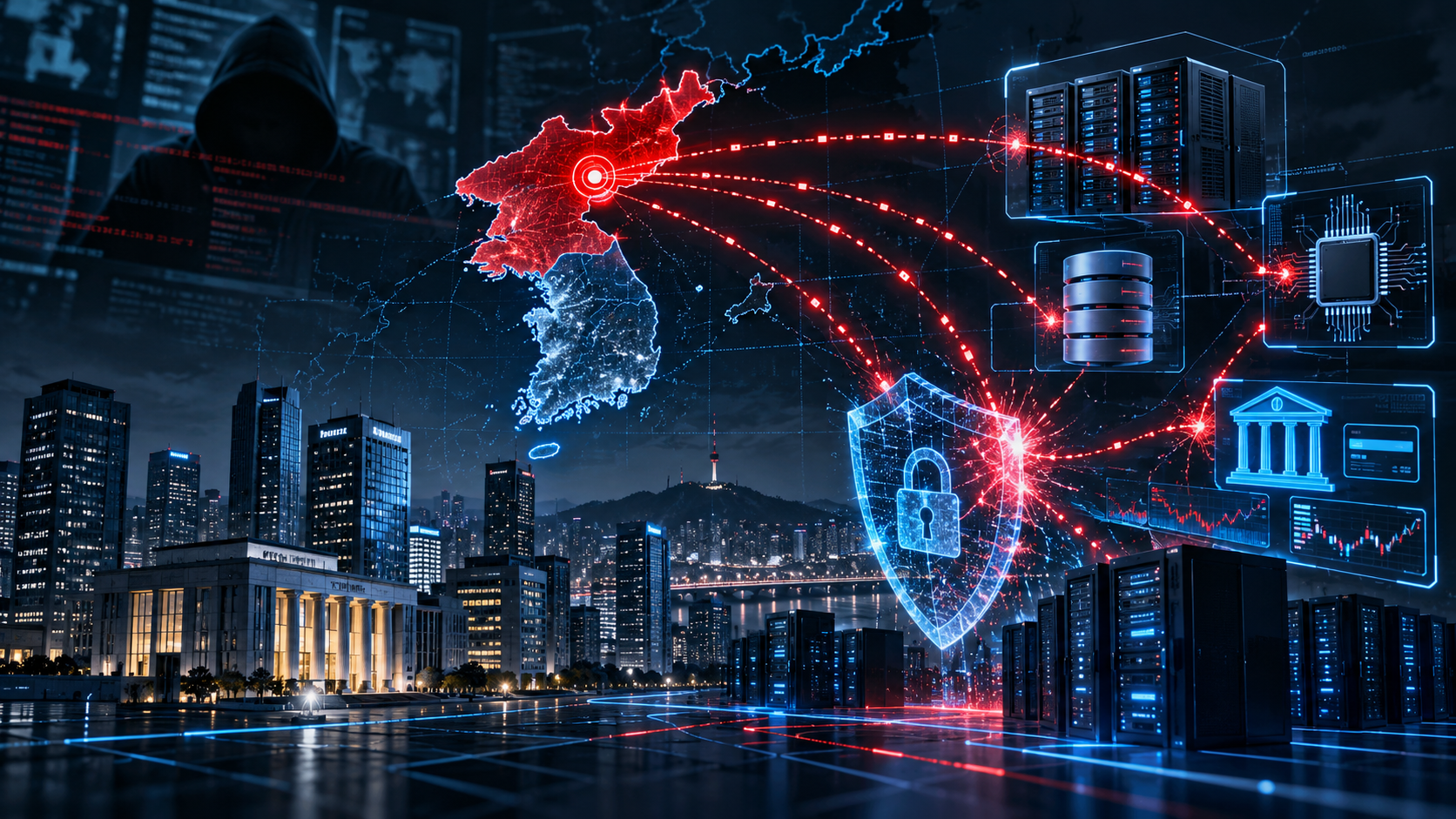
More than 4.4 million abnormal access attempts using internet protocol addresses assigned to North Korea were detected against South Korea's financial sector, prompting financial authorities to launch emergency security checks. With hacking incidents and personal data leaks recently hitting banks, securities firms, asset managers and virtual asset exchanges, the discovery of large-scale access via North Korean IPs has raised questions about who was responsible and whether the damage could spread. Financial authorities said their analysis of the traffic suggests a high likelihood that a third party abused the North Korean IPs, and they have not secured grounds to conclude it was a direct attack by a North Korean hacking group.
According to the financial industry and financial authorities on the 28th, the Financial Security Institute on the 21st sent financial companies and virtual asset exchanges a notice through its integrated financial security monitoring system, FIRST, on precautions related to scanning activity targeting the financial sector from North Korean IPs. Starting at 03:00 that day, a large volume of access attempts targeting domestic financial firms was recorded from an IP range assigned to North Korea, and by the time the official notice was sent, the total number of detected access attempts had reached 4,404,101.
The IP range in question was 175.45.176.0/22, a block that includes internet addresses assigned to North Korea. Scanning activity refers to attempts from outside to connect to servers or network equipment to probe open communication ports, services and vulnerabilities. Through this process, an attacker can identify systems that may be penetrated and possible attack paths, and automated programs can generate a large number of access records even in a short period of time.
Financial authorities asked each financial company to check connection logs for the IP range and review its information security and internal control systems, as well as real-time monitoring for signs of anomalies. They instructed firms to immediately report any unusual findings in the access logs to the authorities. The Financial Security Institute said the move followed standard response procedures for sharing threat information with the financial sector when abnormal access is detected.
So far, no cases have been confirmed in which access from the IP range led to an actual system breach or personal data leak. The figure of about 4.4 million also refers to the total volume of access logs detected on financial company servers, and does not mean that that many financial accounts were compromised or that individual attacks succeeded.
Packet analysis suggests possible third-party abuse, with signs North Korea also suffered a cyberattack the same day
As controversy spread over who was behind the attack, financial authorities launched a technical analysis to determine whether the access using North Korean IPs actually originated in North Korea.
According to an Edaily report on the 29th, financial authorities and security experts found indications from their analysis of packets that flowed into financial companies at the time that the North Korean IPs were likely abused by a third party. They said response packets to connection requests, rather than the packets for ordinary connection requests, were repeatedly observed in the signals that reached the financial companies.
TCP communications used on the internet generally involve sending a connection request, receiving a response from the other side and then confirming the connection. One possibility raised in connection with the analysis is that a third-party attacker spoofed a domestic financial company's IP address as the source, sent a connection request to a North Korean server and induced the North Korean server to respond to that financial company. In that case, the source address in packets logged by the financial company would show a North Korean IP, but the attacker who actually triggered the communication could be elsewhere.
A financial authorities official told Edaily that even if a packet's source IP appeared as North Korea, there was a high likelihood that the IP had been abused, meaning it is difficult to identify the actual attacker from address information alone.
It also emerged that some major North Korean websites experienced access disruptions the same day. On the 21st, the website of Rodong Sinmun, the Workers' Party newspaper, suffered disruptions to normal access and article uploads, and at the time various possibilities were raised, including an external cyberattack, an internal access block and a server failure. While these signs suggest North Korea's internet infrastructure may have been targeted by an external attack, no direct link has been confirmed with the traffic detected in the financial sector.
The Financial Security Institute also is not identifying North Korea as the actual attacker based solely on the fact that access via North Korean IPs was detected. Earlier, on the 6th, the Financial Supervisory Service said in relation to financial-sector breach incidents that even if an IP address is assigned to a specific country, it may be used through rerouting, so caution is needed when determining who was behind an attack.
To identify who was behind a cyberattack, investigators must comprehensively analyze access logs, malware, the attack tools used, intrusion routes and traces left by the attacker on systems. Even state-backed hacking groups sometimes operate through servers in third countries or systems they have already compromised in order to hide the origin of an attack, meaning there are limits to tracing an attacker by IP address alone.
20 financial companies hit by breaches in a month, National Security Office holds emergency response meeting

This incident involving access from North Korean IPs came as breach cases have continued across South Korea's financial sector. Over the past month, about 20 financial companies, including banks, insurers, securities firms and asset managers, have confirmed hacking incidents or personal data leaks.
Daishin Securities said on the 28th that illegal external access occurred on a linked server used for remote brokerage account opening, resulting in the leak of personal and credit information of 38,490 customers. The leaked information included customers' names, email addresses, bank names, account numbers and mobile phone numbers, and the company said some of the data was encrypted.
Mirae Asset Global Investments also detected abnormal access from an external IP address on some web systems and blocked the related access routes. The company said information leaks have so far been confirmed from some internal business systems, but no leaks of personal credit information or sensitive information have been identified. At virtual asset exchange Bithumb, signs were found that employee-related personal information was leaked through unauthorized external access to the company's mobile groupware system.
Earlier, Shinhan Bank suffered an incident in which the personal information of 25,729 customers was leaked through a system related to loan solicitation. As systems used by financial companies in connection with outside vendors, as well as internal web services, are repeatedly exposed to attacks, the need is also growing to review the financial sector's management of external access points and its access control systems.
The Blue House National Security Office on the 28th held an emergency review meeting on responding to the string of hacks in the financial sector, chaired by third deputy director Song Gi-ho. Officials from the Financial Services Commission, the Ministry of Science and ICT, the Personal Information Protection Commission, the Financial Security Institute and the Korea Internet & Security Agency attended the meeting and reviewed the status of investigations into breach incidents at Bithumb, Daishin Securities and Mirae Asset Global Investments, as well as measures to prevent further damage.
The relevant agencies discussed ways to block secondary harm, including smishing and voice phishing using leaked personal information, and agreed to check whether similar intrusion routes exist in externally linked servers and internal business systems. They also agreed to strengthen interagency cooperation to quickly share attack information and investigation results.
Song Gi-ho stressed that hacking in the financial sector directly affects the public's assets and confidence in the financial market, and called for a swift response and measures to block secondary harm. In particular, he urged stronger oversight and support so that security blind spots do not emerge at small and mid-sized financial companies, where security staffing and budgets are relatively limited.
The continuing cyber breach incidents in the financial sector go beyond the issue of protecting customer information and financial transaction systems held by financial companies, and are also tied to the system for responding to cyber threats against key infrastructure underpinning the national economy. As state-linked hacking groups such as North Korea's Lazarus have a record of attacking international financial institutions and virtual asset operators, financial authorities are analyzing various intrusion routes, including the possibility of state-backed attacks.
No direct link has been confirmed between the North Korean IP range detected this time and the recent actual breaches at financial companies. Financial authorities plan to identify the attacker and trace the intrusion route based on the findings of investigative and related agencies, while continuing to check financial companies for security vulnerabilities and share threat intelligence.