Debate flares over Defense Minister Kang Shin-cheol's remark: 'Can U.S. forces be trusted in a war with North Korea?'
Kang clashes with lawmaker Sung Il-jong over OPCON transfer, opposition camp says he damaged trust in the South Korea-U.S. alliance and even calls for his dismissal
Defense Ministry says he was rebutting a lawmaker's argument and meant to stress trust between Seoul and Washington, as dispute grows over how to interpret the remark
Published
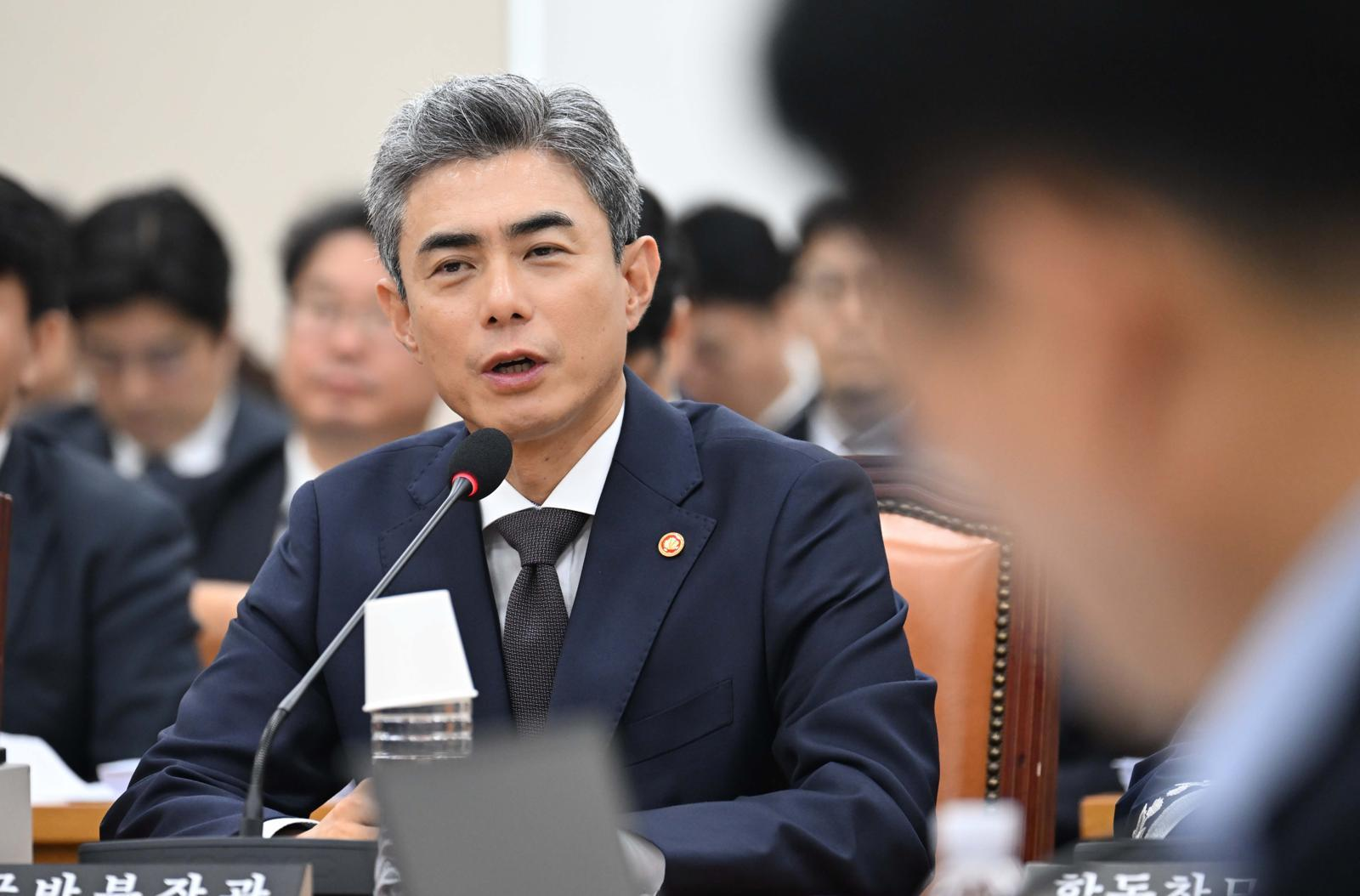
Political controversy is spreading over Defense Minister Kang Shin-cheol's remark during a National Assembly audit questioning whether U.S. forces can be trusted if war breaks out with North Korea. The opposition camp, including the People Power Party, criticized the minister, saying he made comments that undermined trust in the South Korea-U.S. alliance. The Defense Ministry said he was posing a counterquestion to a lawmaker's argument over the transfer of wartime operational control, or OPCON, and was emphasizing the importance of trust between South Korea and the United States.
The remark at the center of the controversy came on the 26th during the Defense Ministry's comprehensive National Assembly audit by the Defense Committee. People Power Party lawmaker Sung Il-jong argued that the transfer of wartime operational control should be approached cautiously, citing the war between the United States and Iran as an example. He said that even the United States, the world's strongest country, has been unable to end its war with Iran early, and urged that the matter be reported to the president with caution because the OPCON transfer concerns the survival of the state and the lives of its people.
Kang responded that claims the country's survival would be threatened by the OPCON transfer were excessive, asking, "Then if a war breaks out with North Korea, can those U.S. forces be trusted?" He added, "Precisely because that is not the case, we are seeking to transfer wartime operational control with trust assured and create a system in which a South Korean general commands and U.S. forces provide support." Kang also pushed back against Sung's claim that discord between South Korea and the United States was limiting intelligence sharing on North Korea, saying information sharing was proceeding smoothly.
After Kang's remarks became known, criticism from the opposition camp followed in quick succession. Kim Dae-sik, the opposition ranking member of the National Assembly Foreign Affairs and Unification Committee and a People Power Party lawmaker, said at a National Assembly audit countermeasures meeting on the 27th, "Are you South Korea's defense minister, or North Korea's Ministry of National Defense?" Lim Jong-deuk, the opposition ranking member of the Defense Committee, also called the remark inappropriate for a defense minister who should be strengthening the South Korea-US alliance, and urged him to stop actions that undermine trust in the alliance. Independent lawmaker Han Dong-hoon also took issue with Kang's remarks on social media, saying they were inappropriate words and actions at a difficult time for South Korea-US relations.
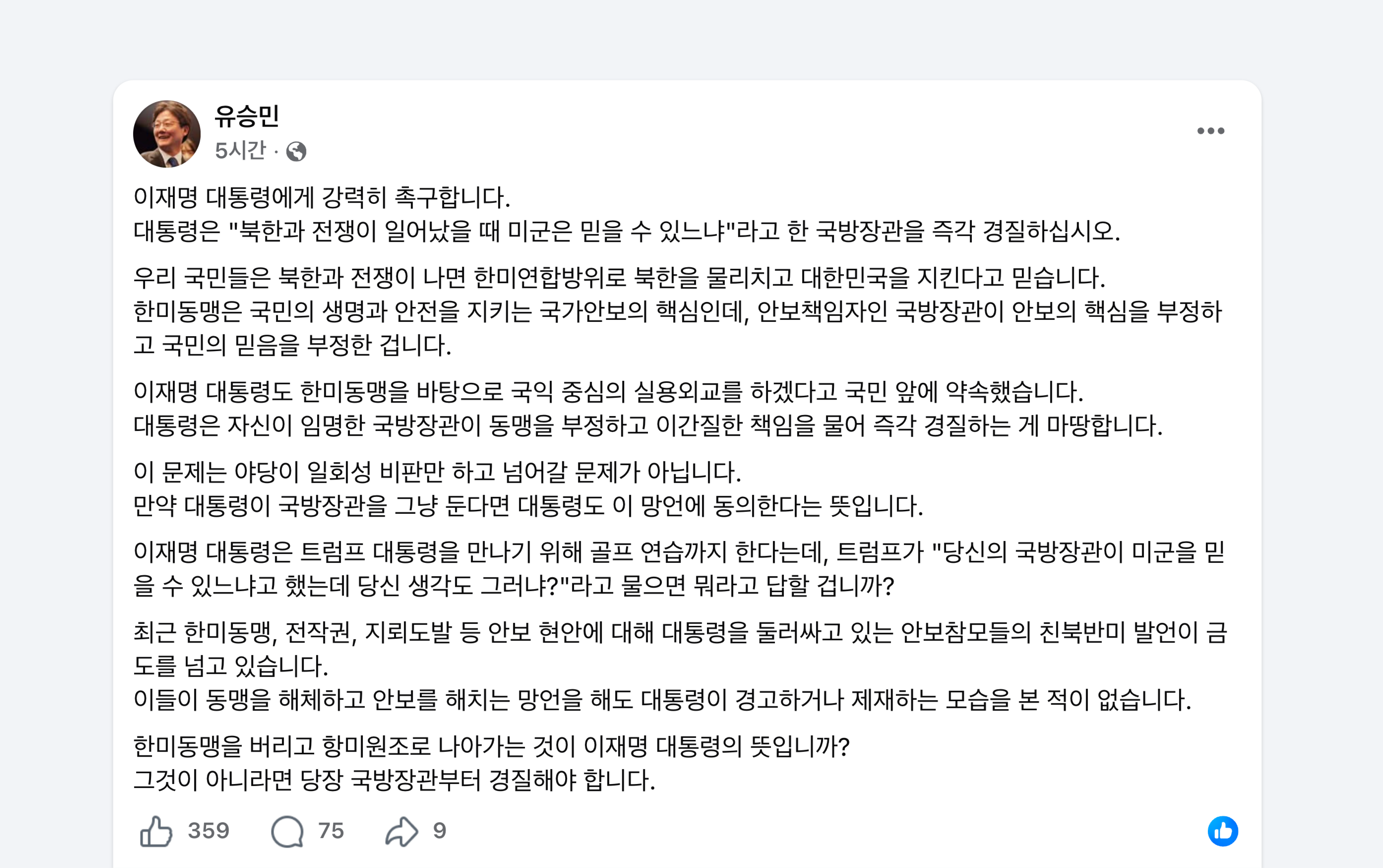
Former People Power Party lawmaker Yoo Seong-min called for Kang's dismissal. In a Facebook post that day, Yoo criticized the defense minister's remarks, made to the effect that U.S. forces cannot be trusted in wartime, as dangerous and crude. He voiced concern that, at a time when South Korean and U.S. service members are jointly responding to North Korea's military threat, the defense minister's remarks could negatively affect trust in the alliance and troop morale, and urged President Lee Jae-myung to remove Kang immediately.
As the controversy grew, the Defense Ministry explained the full context of the remark at a regular briefing on the 27th. Defense Ministry spokesperson Jeong Bit-na said Kang had posed a counterquestion in response to Sung's argument that the OPCON transfer should be handled cautiously based on the United States' conduct of the war with Iran. Jeong said that following Sung's logic would lead to the conclusion that U.S. forces could not be trusted even if a war broke out with North Korea, but that Kang's response meant he did not agree with that conclusion. She added that Kang stressed trust between South Korea and the United States in his very next remark and has consistently emphasized the importance of the alliance since his time as a minister nominee.
Behind the controversy are differences of opinion in political circles over the timing and method of the OPCON transfer. The South Korea-U.S. Combined Forces Command is currently structured with a U.S. four-star general serving as commander and a South Korean four-star general as deputy commander. After the transfer of wartime operational control, it is to be reorganized into a system in which a South Korean four-star general commands the Future Combined Forces Command. South Korea and the United States are pursuing the transfer based on three conditions: the South Korean military's ability to lead combined defense, the alliance's ability to respond to North Korea's nuclear and missile threats, and the security environment on the Korean Peninsula and in the region.
The government is seeking at this year's Security Consultative Meeting, or SCM, to complete verification of the Future Combined Forces Command's full operational capability, or FOC, and decide a target year for the transfer of wartime operational control. Kang said at the National Assembly audit on the 26th that Seoul and Washington were forming a broad consensus on setting the target year and were in close consultations. At the same time, recent remarks by U.S. Forces Korea Commander Xavier Brunson suggesting that the criteria for evaluating the conditions for the OPCON transfer could change have drawn attention to consultations between South Korea and the United States over the transfer schedule and conditions. Kang said Brunson's remarks were military-level views on some of the conditions and reaffirmed that the existing agreement between Seoul and Washington remains valid.
Within the ruling party, voices also emerged calling for a clearer timetable for the OPCON transfer. Democratic Party lawmaker Kim Byung-joo argued at the National Assembly audit on the 26th that this year's SCM should finalize a target year for the transfer, and even mentioned the option of South Korea declaring the independent exercise of wartime operational control if no agreement is reached with the U.S. side. In response, Kang reaffirmed the existing principle that the OPCON transfer should take place through close consultations, with trust between South Korea and the United States assured.
As discussion over the OPCON transfer expands into questions of the South Korean military's independent command capability and the operation of the combined South Korea-U.S. defense system, the controversy over Kang's remark has once again brought military trust and cooperation between Seoul and Washington to the forefront of politics. The Defense Ministry has moved to contain the fallout by explaining the intent of Kang's remark, but criticism continues from the opposition camp that he damaged trust in the alliance. With South Korean and U.S. defense authorities pushing to set a target year for the OPCON transfer within the year, attention is also focused on the outcome of future consultations between the two countries.