Russia summons German ambassador... Sharp anti-Western sentiment and support for North Korea's deployment
Following the expulsion of over 20 individuals, the Goethe Institute has a deadline of the 13th... Once the retaliatory closures related to the drone incident are completed, only the German embassy in Moscow will remain in Russia
Published
Updated
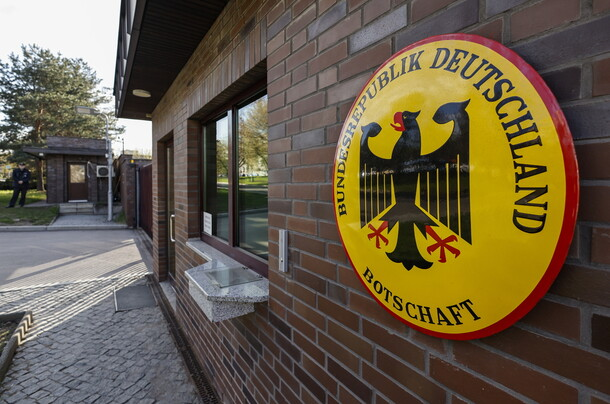
Russia has ordered the closure of the German consulate in St. Petersburg and the departure of its staff. The Goethe Institute in Russia will also cease all activities by the 13th.
After Germany and Russia expelled dozens of diplomats from each other in 2023, the already frozen relations between the two countries have now entered a phase of dismantling cultural and consular exchange networks.
Retaliatory chain reaction starting from the drone incident
The immediate trigger was the discovery of an explosive-laden drone at Leipzig-Halle Airport on August 4.
Based on police investigations and intelligence agency analyses, the German government officially identified Russian state agencies as responsible for the incident on the 1st, to which Russia strongly denied, calling it an 'absurd fabrication.'
As a result of this incident, Germany has decided to close its last consulate in Bonn, which Russia operated, by the 18th, and to terminate the agreement that served as the basis for the operation of the Russian cultural institution 'Russian House' in Berlin.
Russia's response was almost symmetrical. It notified the closure of the German consulate in St. Petersburg on September 18, and the Goethe Institutes in Moscow, St. Petersburg, and Novosibirsk were ordered to completely cease operations starting from the 13th. Consequently, staff dispatched from Germany were also required to leave by that date.
In this situation, the Russian Foreign Ministry stated that 'the German authorities triggered new tensions,' shifting the blame for the deterioration of relations onto Berlin.
2023 expulsion of over 20 individuals, now the last consulate as well
However, this is not the first time the two countries have engaged in a diplomatic expulsion battle.
In April 2023, after Germany reduced its diplomatic personnel in Russia, Russia expelled over 20 German diplomats in a reciprocal move. At that time, the Russian Foreign Ministry did not disclose the exact number, but German media reported, citing internal sources, that the actual number of those expelled reached 34. In 2022, after Germany expelled 40 Russian diplomats due to the civilian massacre in Bucha, Ukraine, Russia responded with a similar scale of expulsion.
Since then, both countries have gradually reduced their respective consulates. Currently, the only formal diplomatic missions Germany maintains in Russia are the embassy in Moscow and the consulate in St. Petersburg. Once the closure is completed on the 18th, the operations of the St. Petersburg consulate are expected to be transferred to the German embassy in Moscow.
Closing doors with Germany, 'comrades' with North Korea
As Russia narrows its diplomatic and cultural ties with Europe, its relationship with North Korea, which has become a kind of 'bloody alliance' through troop deployments, is rapidly tightening.
North Korea has dispatched approximately 14,000 troops to the Kursk region of Russia starting from the end of 2024, and both countries have since officially acknowledged the deployment, with North Korean leader Kim Jong-un publicly praising the North Korean military participating in 'overseas military operations' as recently as the 9th.
Russia is also actively praising the participation of North Korean troops. Foreign Minister Sergey Lavrov stated in a congratulatory message sent to North Korean Foreign Minister Choe Son-hui last month that the two countries are working together to create a 'new and just world order.' In the same message, he evaluated the participation of North Korean troops in the Kursk operation as clear evidence of 'the tradition of combat camaraderie.' It is observed that Russia treats the North Korean military as comrades and 'brothers' in the Kursk battle.
Although the closure of the German consulate is not directly linked to the North Korea-Russia closeness, the direction of Russian diplomacy since the Ukraine war is clear. While reducing diplomats and closing consulates and cultural centers with Europe, Russia is deepening military and diplomatic ties with North Korea, which has sent actual troops to support its war.
The retaliatory battle between Germany and Russia, reignited by the Leipzig drone incident, is now erasing the diplomatic spaces of each other one by one. This movement is noteworthy as it not only solidifies ties with North Korea but also strengthens the anti-Western bloc centered around Russia, which is already deepening strategic cooperation with China and Iran.