South Korea enters the proving ground with a self-propelled howitzer the U.S. failed to build for 25 years
Hanwha's K9MH has been solely selected for a wheeled self-propelled howitzer program that the United States has failed to deliver for 25 years. It is not a confirmed export sale, but a system now being put to the test in the world's largest defense market.
강병지
Published
Updated
■ What the contract says
On Aug. 18 local time, the U.S. Army selected Hanwha Defense USA, the U.S. subsidiary of Hanwha Aerospace, as the sole prototype developer for the Mobile Tactical Cannon, or MTC, program and signed a contract with the company. Hanwha officially announced the deal the following day.
The numbers matter. The firm contract is worth $100.3 million, or about 141.7 billion won. If all options are exercised, the cumulative face value rises to $262.9 million, or about 371.5 billion won. Hanwha will first deliver six prototype guns on an expedited basis, with an option for 12 more based on test results, bringing the total to as many as 18. The performance period runs up to 48 months, during which firing and mobility tests and soldier operational evaluations will be conducted.
This is not a production contract, much less a formal service adoption. In the U.S. Army press release, the systems are described as prototypes for "operational experiments," and any replacement is framed under the conditional phrase "if fielding is approved." More precisely, the K9 family has entered the U.S. Army procurement system for full-scale evaluation. Still, the fact that these are prototypes for operational testing is, as explained below, an unprecedented first.
■ The graveyard of U.S. self-propelled howitzer development
Why, then, is the United States, home to the world's strongest military, trying to buy another country's self-propelled howitzer?
For the past 25 years, the U.S. Army has repeatedly tried and failed to develop a new self-propelled howitzer on its own. Crusader, launched in 1994, was canceled in 2002. The Non-Line-of-Sight Cannon, or NLOS-C, which was part of the Future Combat Systems, or FCS, program, disappeared with it when the program itself was scrapped in 2009. Most recently, the Extended Range Cannon Artillery, or ERCA, program began ambitiously in 2018, aiming for a 70 km range by mounting a 58-caliber long barrel on a Paladin chassis, but it was terminated in April 2024 after failing to overcome technical hurdles.
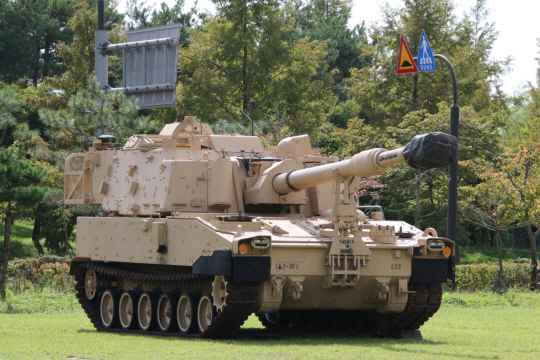
The U.S. Army's latest self-propelled howitzer, the M109 A7 Paladin. Defense Times
After three failures, the U.S. Army changed course. It is no longer trying to build a new system from scratch. Instead, it is choosing from systems that are already mature. Domestic or foreign, it is looking for something that can be produced and fielded right away. The MTC program represents that shift.
The shift was not only in method but also in speed. The competition began with a request for information, or RFI, in January this year, followed by a request for proposals in March, a bid deadline in April and selection in August. It took eight months from launch to contractor selection. By U.S. procurement standards, where such programs often take years, that was an unusually fast schedule. It is cited as the first use of this rapid procurement method in the ground equipment sector.
■ Why wheels?
It is important to identify exactly what MTC is meant to replace. It is not the tracked M109 Paladin self-propelled howitzer. It is the M777 towed howitzer introduced in the 2000s. The tracked replacement remains a separate task under the higher-level self-propelled howitzer modernization, or SPH-M, program, while MTC is the subordinate wheeled replacement effort for towed artillery. The initial fielding target is Stryker Brigade Combat Teams, or SBCTs, followed by mobile brigade combat teams and then infantry units. Here, "mobile brigade" refers to a new formation in which the U.S. Army is reorganizing existing infantry brigades to reflect lessons from the war in Ukraine, with an emphasis on dispersed, fast-moving operations.
Why wheels rather than tracks? A towed howitzer takes time to haul into position, emplace, then pack up and move out after firing. The problem is that today's battlefield does not allow that time. In Ukraine, as drones and other surveillance assets have come to watch the battlefield in real time, a target that stays in one place too long quickly becomes a dead target. The ability to stop, fire and immediately move out, or "shoot and scoot," and to maintain rapid mobility have become conditions for survival. Wheels are the answer to that requirement. For this program, the U.S. Army required a 155 mm gun with a barrel length of 49 to 56 calibers, along with compatibility with ammunition already in U.S. military service.
■ What the K9MH is
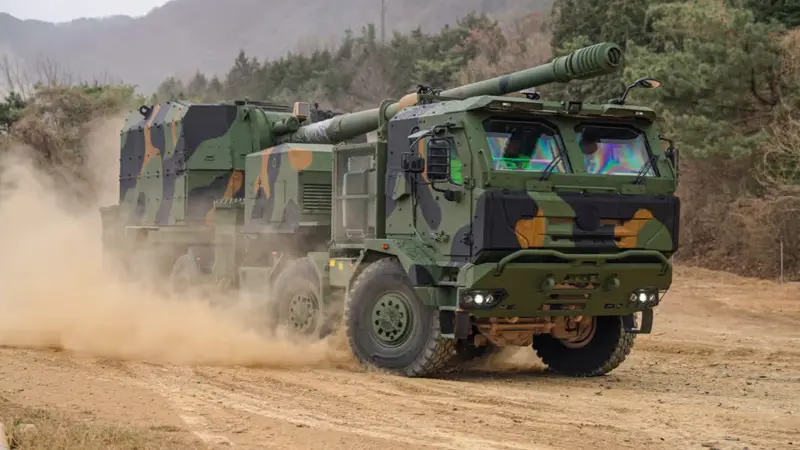
It would be wrong to think of Hanwha's K9MH as simply a tracked K9 with wheels attached. Hanwha took only the gun, ammunition-handling, fire-control and automation technologies from the K9A2, the latest upgraded K9 variant, and mounted them on an entirely newly designed wheeled chassis. In other words, it is not a modified version with tracks replaced by wheels, but a separate wheeled offshoot of the K9 family.
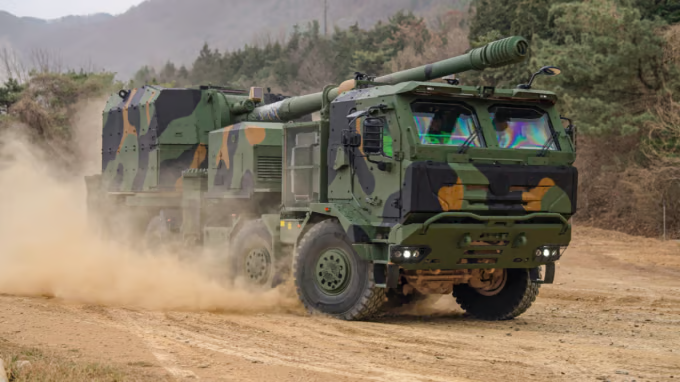
Hanwha Aerospace's K9 wheeled self-propelled howitzer (K9MH) undergoing driving tests at an Agency for Defense Development test site
Its configuration is as follows. The chassis is Tatra's third-generation Force 8x8 from the Czech Republic, fitted with an armored crew cab. The gun is Hyundai Wia's CN98 155 mm/52-caliber system, equipped with an autoloader and capable of firing eight to nine rounds per minute. It carries 40 shells and 192 propelling charges, and its crew of two to three remains inside the protected cab even during firing. It can fire its first round within 20 seconds of stopping and leave the firing position within 50 seconds.
What stands out is the speed of development. Formal development began in December 2024, yet by the spring of 2026 a completed prototype had already been unveiled, and by that summer it had broken into a U.S. Army program. That is less than two years from formal launch. The fact that traditional Western defense primes could not match that pace was, in itself, Hanwha's sharpest weapon.
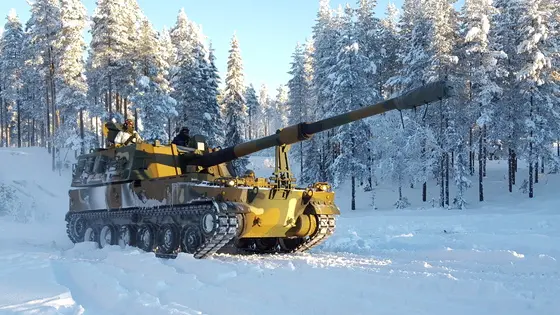
It is also worth noting that the K9MH did not emerge overnight. Its parent platform, the K9, entered operational service with the South Korean military in 1999 and has since established itself as the world's most widely exported tracked self-propelled howitzer. According to one tally, the total number contracted at home and abroad is approaching 3,000 units. Of those, overseas export contracts alone account for about 1,500 units, worth a cumulative roughly 15 trillion won. Starting with Türkiye, its first export customer in 2001, Poland, India, Finland, Norway, Estonia, Australia, Egypt, Romania and Vietnam have adopted the K9 or its derivatives or are producing them locally. Poland, which has agreed to acquire up to 672 units, is the largest overseas customer. The fact that it has been proven in very different environments, from Egypt's desert to Norway's Arctic region and India's Himalayan highlands, worked in the K9's favor when the U.S. Army went looking for an "already mature system."
■ What it beat
The list of rivals shows the weight of this selection. The candidates Hanwha beat were not obscure names.
They included Germany's Rheinmetall with the RCH155; Caesar, offered by France-based KNDS in partnership with Leonardo and General Dynamics; Britain's BAE with Archer; Sigma from Israel's Elbit, teamed with Oshkosh and Anduril; and the MArG 52 from India's Kalyani paired with U.S.-based AM General.
Top-tier artillery systems from Europe, Israel and India competed for a single slot, and a Korean-designed system claimed it as the sole selection. (The list of participants in the competition has been reported somewhat differently depending on the timing of the announcement and the media outlet.)
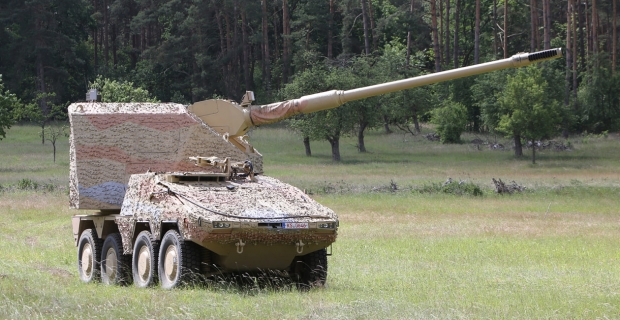
RCH155 with an AGM mounted on a wheeled armored vehicle, kmwmeg.com
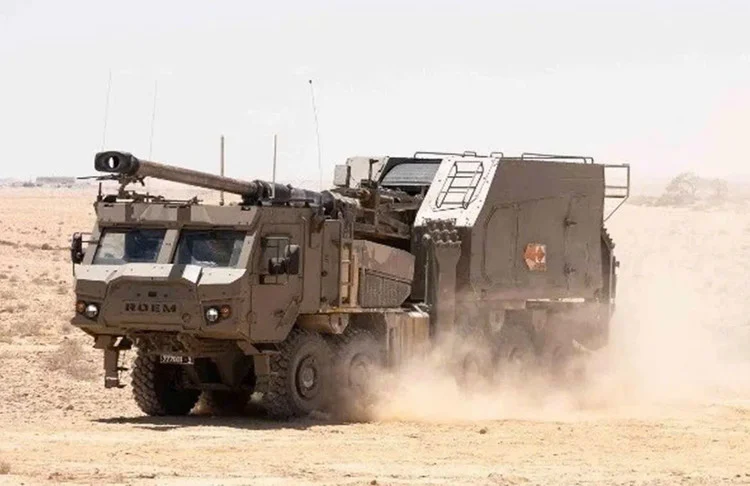
SIGMA 155 ROEM self-propelled howitzer, IDF (Israel Defense Forces)
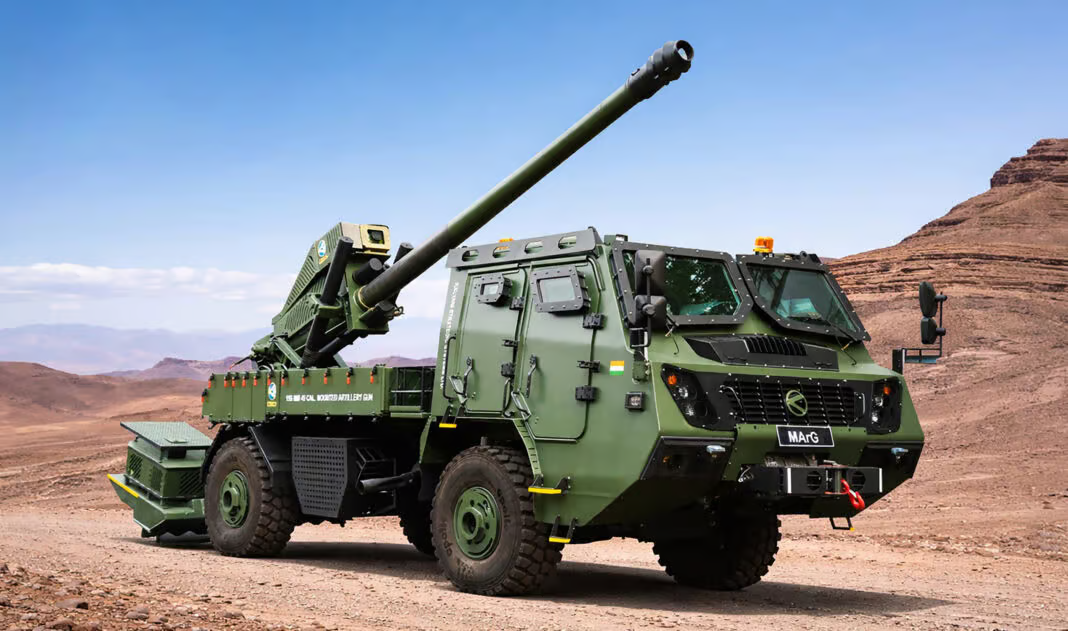
MArG 52 self-propelled howitzer, KSSL
■ Challenges Ahead
But it would not be honest to end the victory narrative here. This is not the end, but the beginning.
Over the next roughly four years, the K9MH will undergo gruelling live-fire and mobility tests, along with soldier user evaluations. If technical flaws emerge during that process or the U.S. Army changes its requirements, the next stage will become uncertain. A decision on whether to field the system will be made based on the test data, and if that proceeds smoothly, it will move into full-scale production. Industry estimates eventual production at around 500 guns and project costs in the 10 trillion won range, with full-scale production seen beginning around 2028. It should be made clear, however, that these figures are estimates, not fixed quantities.
The U.S. Army has also attached another demanding condition. It explicitly made "onshoring," meaning shifting the production base into the United States, a formal requirement. The demand is for manufacturing capacity in the United States that can ramp up output in a wartime mobilization. In response, Hanwha is leasing a production facility in Opelika, Alabama, for three years to establish an integration and testing hub. By some assessments, having prepared a U.S. production base while it was still competing, rather than only after being selected, worked in its favor.
And there is one more fact that should not be forgotten. The United States has a history of scrapping self-propelled howitzer programs of its own several times. Depending on changes in budgets, priorities and battlefield conditions, the program can change direction at any time. A prototype contract does not in itself guarantee mass production.
■ What the Starting Line Means
So calling it a confirmed export to the United States is an exaggeration. The more accurate description is that it has made it onto the testing stage. But that is precisely what makes this case unprecedented.
A fully developed weapon system designed in Korea has entered that slot as the sole candidate for evaluation, a slot the United States itself could not fill for 25 years and ultimately did not hand to Europe's long-established defense primes. This is not the finish line. Ahead lie four years of testing, a decision on fielding, and the hurdle of production in the United States. But one thing is clear: this is a starting line that Korea's defense industry has never stood on before.