South Korea's homegrown air-to-air missile is not meant to match Meteor: What a missile that needs no foreign approval would give the KF-21
The real reason for the 1.9 trillion won homegrown ramjet missile is control, not price. But another lock remains: the engine.
강병지
Published
Updated
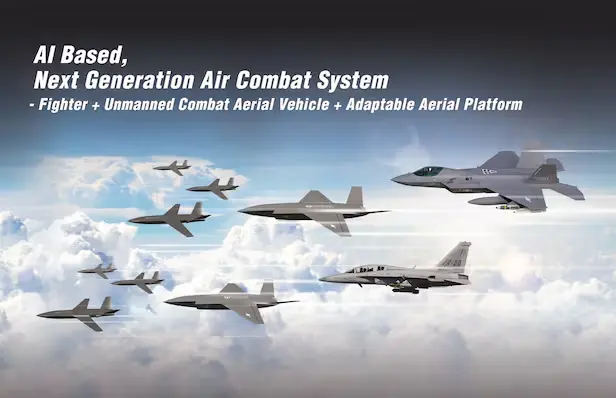
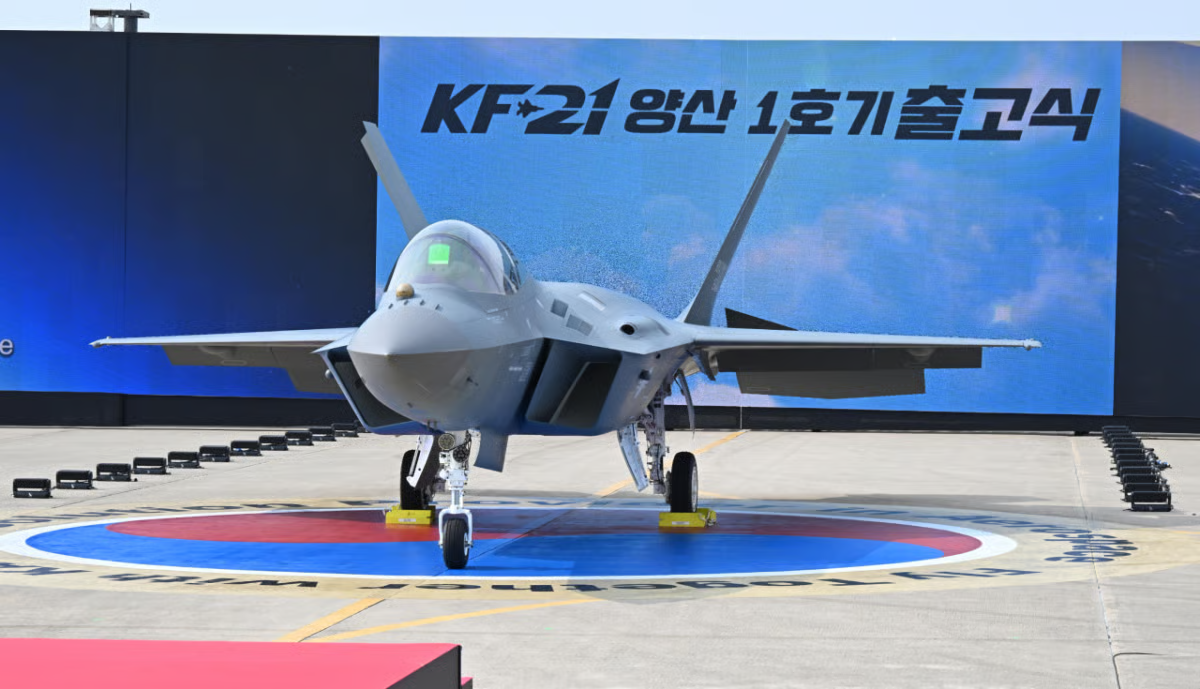
On the 22nd of last month, the first KF-21 Boramae, aircraft No. 001, was delivered to the Air Force. It came about 10 years and nine months after development began. Under the fuselage is a semi-recessed mount for carrying missiles.
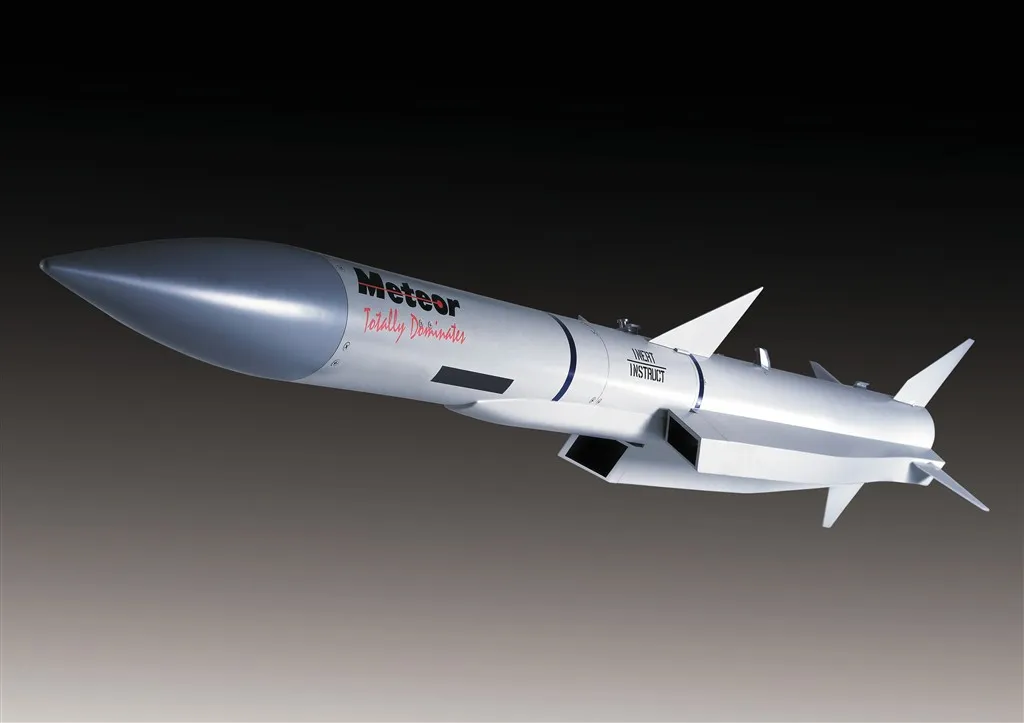
The long-range air-to-air missile fitted there is MBDA's Meteor of Europe. The airframe is Korean, but the weapon that would first target enemy aircraft is still foreign-made.
Ten days later, on the 2nd of this month, the outline of a domestic missile to fill that spot emerged. The Agency for Defense Development (ADD) notified companies of the results of its evaluation for the long-range air-to-air guided missile system development project. LIG Defense & Aerospace (LIG D&A) ranked first in five areas, including system integration and the seeker, while Hanwha Aerospace ranked first for the missile's core components, the ducted ramjet propulsion system and airframe structure. A main contract is scheduled around December after formal designation of preferred bidders and negotiations on technology and price. The project totals about 1.9 trillion won, with 753.5 billion won for development and 1.1471 trillion won for mass production from 2035.
That raises a question. With Meteor already having completed live-fire testing, why spend nearly 2 trillion won to build a new one?
■ U.S. missiles were blocked, and European ones are expensive?
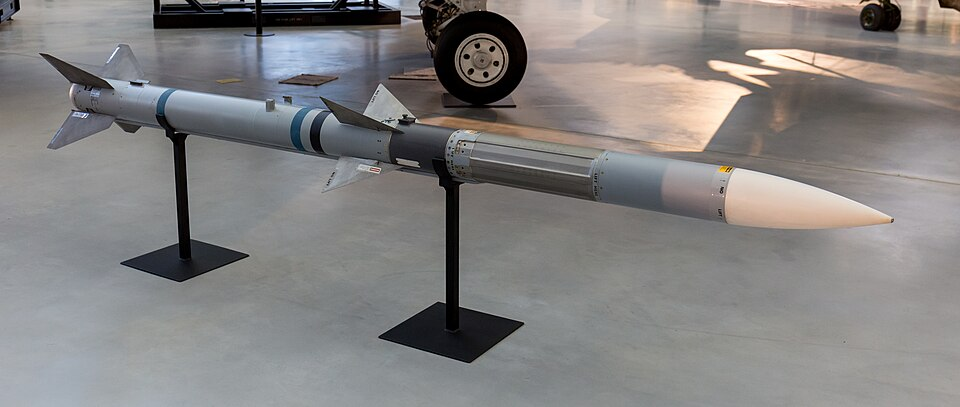
In the early stages of KF-21 development, localizing long-range armament was a lower priority. The original plan reportedly considered equipping the jet with U.S.-made AIM-120 and AIM-9 variants, but it fell through because the U.S. government did not approve the exports.
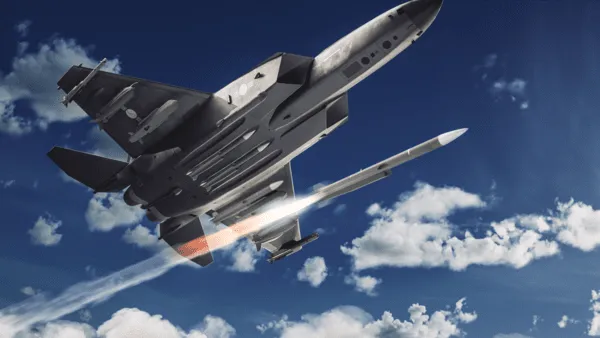
That left Meteor as the remaining option. The prototype's first flight in July 2022 already carried four Meteor mock rounds, and in May 2024 it succeeded in a live firing, joining the ranks of fighters able to launch Meteor after the Eurofighter, Rafale and Gripen. In October that year, the Defense Acquisition Program Administration (DAPA) signed a contract to buy an initial batch of 100 missiles.
Discussion of localization proceeded in the meantime. In April 2024, the Defense Acquisition Program Promotion Committee approved a basic strategy to secure the missile through domestic research and development, and on Sept. 30 last year, the basic plan for system development was finalized. Interest grew after the president, in a work briefing last December, asked why an air-to-air missile had not been developed alongside the fighter. The sequence of events, however, needs to be clear. The project plan had already been finalized more than two months earlier.
What about the price? In South Korea, a single Meteor is widely said to cost several billion won, and one column estimated the figure at about 4.4 billion won. DAPA did not disclose the contract amount, and estimates differ. Publicly available overseas data paint a somewhat different picture. In 2024, the German parliament approved about 521 million euros for a third Meteor purchase including ancillary equipment, and the quantity is estimated at about 270 missiles. That comes to less than 2 million euros apiece. The Polish sale of AIM-120D3 missiles approved by the United States last year was worth up to $1.33 billion for 400 missiles. That figure includes support costs, but it still works out to about $3.3 million per missile, leading some analysts to argue that Meteor is actually cheaper. It is certainly an expensive weapon, but not unusually expensive among comparable Western systems.
Price was not the rationale DAPA put forward either. DAPA said developing the fighter's basic armament at home would contribute to self-reliant defense and create export benefits when bundled with the KF-21. The key is control. Foreign-made armament depends on the exporting country's approvals, production schedules, prices and upgrade plans. Whether replenishing stocks quickly in wartime or modifying missiles in peacetime to counter an enemy's electronic warfare, South Korea would have to follow someone else's timetable.
■ The engine that keeps going to the end: the ducted ramjet
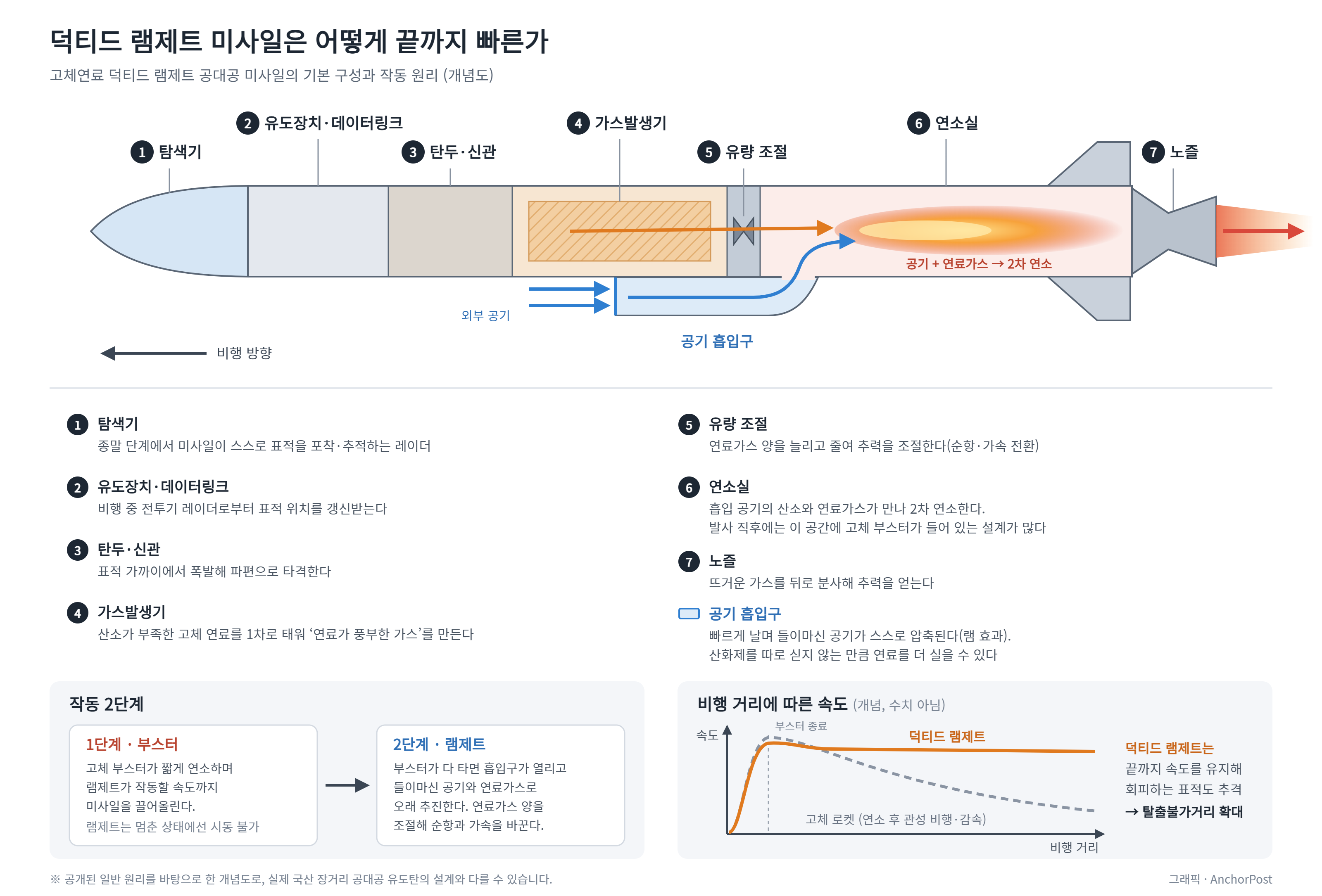
The core of the domestic missile is the same solid-fuel ducted ramjet propulsion method used by Meteor. Immediately after launch, a solid booster burns briefly to bring the missile up to high speed. That is because a ramjet cannot start from a standstill. Once the booster burns out, the intake opens, and the air drawn in as the missile flies at high speed compresses itself. A gas generator then injects fuel-rich gas made by burning oxygen-poor solid fuel, and that gas burns again in the combustion chamber to produce thrust.
Conventional rocket missiles must carry an oxidizer as well, so their burn time is short. Once the fuel is exhausted, they cover the remaining distance on inertia and lose speed. A ducted ramjet uses oxygen from the air, so it can carry more fuel for the same size, and by controlling the amount of fuel gas it can switch between cruising and acceleration. The companies involved say it is as easy to maintain as a solid propulsion system while offering the range of a liquid propulsion system. Its biggest advantage is that it retains enough energy to keep chasing a target to the end even if the target makes evasive maneuvers. The no-escape zone, or NEZ, is extended.
Target performance has not been officially disclosed. Some reports say the range will be at least 110 kilometers, while others say it is aiming for a maximum range of about 200 kilometers and more than Mach 4, in other words Meteor-class or better. According to released concept material, the missile is envisioned as receiving target information via datalink from the KF-21's active electronically scanned array (AESA) radar during midcourse flight, then using its own AESA seeker to find the target in the final phase. Development is expected to be completed in 2033, with the missile entering mass production and being carried on the KF-21 after 2036.
Work is divided by component. LIG D&A, which would handle system integration and the seeker, has played the same role on the long-range air-to-ground guided missile Cheonryong and the Short-Range Air-to-Air Guided Missile-II. If the long-range air-to-air program is confirmed as well, it will integrate all three types of domestically developed aircraft armament for the KF-21. Hanwha Aerospace said it has been researching propellants and gas generators for ducted ramjets since 2005 and has carried out five of six related government projects since 2021.
■ Where will 'Meteor-class' stand in the skies of 2036?
Competitiveness should be judged against the late 2030s, when this missile is expected to enter service. The skies then will be different from today's.
Meteor is an operational missile jointly developed by six European countries under British leadership. MBDA says its no-escape zone exceeds 60 kilometers thanks to its ramjet, which continues producing thrust to the end. China's PL-15 is reported to have a domestic version with a range of 200 to 300 kilometers, while the export PL-15E, whose official range is at least 145 kilometers, was used in combat during the India-Pakistan clash in May last year. The International Institute for Strategic Studies (IISS) in Britain assessed that the PL-15E may have contributed to Indian Air Force fighter losses.
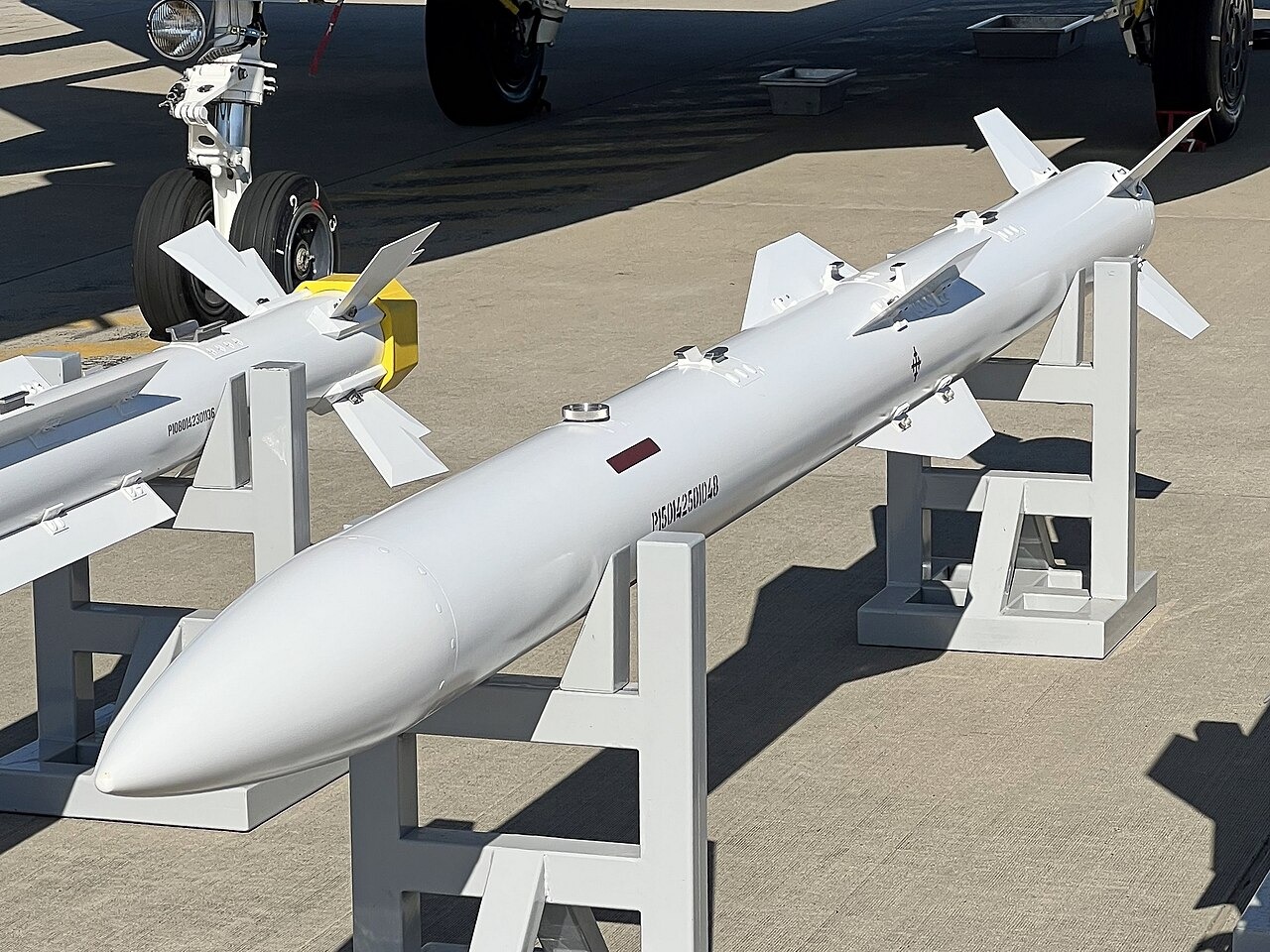
On the 17th of last month, the United States reached a basic agreement to expand mass production of the next-generation AIM-260. The AIM-260's minimum required range is reported to be about 190 kilometers. India is developing the Astra Mk3, which uses a solid-fuel ducted ramjet. It has set a target range of 340 kilometers and, according to some reports, plans airborne integration tests in 2027-28.
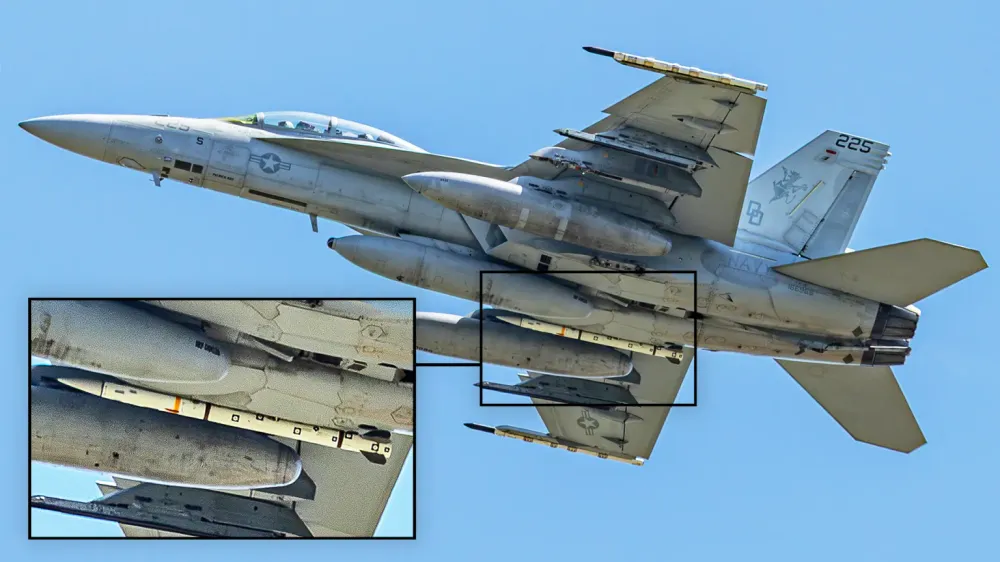
In this landscape, the domestic missile's strength lies less in its performance figures than in its design conditions. It is designed from the outset to mesh with the KF-21's domestic radar and mission computer, and South Korea decides when and how it is upgraded. The weaknesses are also clear. It has no combat record, and by the time it appears, 'Meteor-class' may no longer rank among the top tier. Getting the ramjet propulsion system and seeker to work together is difficult even by guided-weapon standards. Industry officials say it typically takes at least six years just to fully integrate a single air-to-air missile with a fighter. With mass-production quantities undisclosed, it is still unknown whether the per-missile price will be lower than Meteor's.
■ The final piece of the export package, but not the only lock
For KF-21 exports, the significance of this missile is that it completes the package. The president of Korea Aerospace Industries (KAI) said in May that specifically cited export demand exceeds 200 aircraft, and Indonesia, Malaysia, the Philippines and the United Arab Emirates (UAE) are named as potential customers. Industry sources believe Middle Eastern countries prefer package offers that integrate the aircraft and its armament. At a summit last November, South Korea and the UAE agreed to expand defense cooperation beyond simple purchases to joint development, local production and joint exports to third countries. If the armament is domestic as well, South Korea can directly determine the scope of technology transfer and local production in such deals. Industry sources also argue that because missiles are consumables that must be purchased continuously, they can generate greater follow-on revenue than aircraft sales.
But that should not be overstated. First, any near-term exports will use the Meteor. Negotiations are continuing with Indonesia, the co-development partner and the leading export candidate, over a 16-aircraft deal, but no contract has yet been signed. KAI is aiming to conclude it by year-end. In the meantime, Indonesia disclosed plans last year to acquire China's J-10, and local reports said the first aircraft could arrive as early as next April. The type and quantity have not been officially confirmed, and Indonesia's Defense Ministry denied reports in May of a 42-aircraft, $9 billion contract. Pakistan imported the J-10CE, the export version of the J-10, together with the PL-15E and used them in combat. The Korean missile is not expected to be included in export packages until the late 2030s or later. Second, MBDA is not what stands in the way of exports. It agreed with KAI in 2023 on joint export cooperation, and in October last year signed a memorandum of understanding to integrate its SPEAR air-to-ground missile onto the KF-21 and jointly promote the KF-21 weapons package overseas. Third, even if the missile is developed domestically, the KF-21 still uses GE's F414 engine from the United States. Under the U.S. International Traffic in Arms Regulations (ITAR), if even one key U.S. component is included, exports to third countries require approval from the U.S. government. The extent to which the Korean missile depends on foreign components has not yet been disclosed.
■ Remaining variables
The project itself also carries risks. Both companies face the risk of restrictions on their eligibility to bid. LIG D&A was indicted this past August on charges that its employees and others gave money and valuables to Defense Acquisition Program Administration (DAPA) officials. The company expressed regret and said it hopes the facts will be clarified in court. At Hanwha Aerospace, five people were killed in an explosion at its Daejeon plant on June 1, and some of the violations identified in a special inspection by the Ministry of Employment and Labor were referred for judicial proceedings. If a related official is indicted, the company could become subject to restrictions. DAPA is reported to be considering a bidding restriction of around two years for LIG D&A, but neither company has yet been sanctioned. The two companies previously split roles on the Cheongung-II surface-to-air missile, but they also clashed during the Iraq export process over unit prices for supplied components. This time, they are intertwined from the development stage, but the ratio for allocating project costs has not yet been disclosed.
There are four indicators to watch going forward: the main contract in December and how project costs are divided between the two companies, the schedule for ground-firing and flight tests of the propulsion system, the weapons configuration included in the first KF-21 export contract, and discussions on localizing the engine.
Return to the underside of aircraft No. 001. It is still unclear whether the missile hanging there 10 years from now will fly farther than the Meteor. What is clear is that South Korea will decide when to modify that missile, whom to sell it to, and how many to produce. The 1.9 trillion won is less a price tag on range than on that decision-making power. But as long as the engine remains another lock, the KF-21's "export autonomy" is still only half the story.