The 15-minute window: What was the Russian drone targeting?
A Russian drone hit a locomotive 2 km from the Polish border. It came just after a diplomatic train had passed. Under current NATO rules, it was a place where the alliance could do nothing.
강병지
Published
Updated
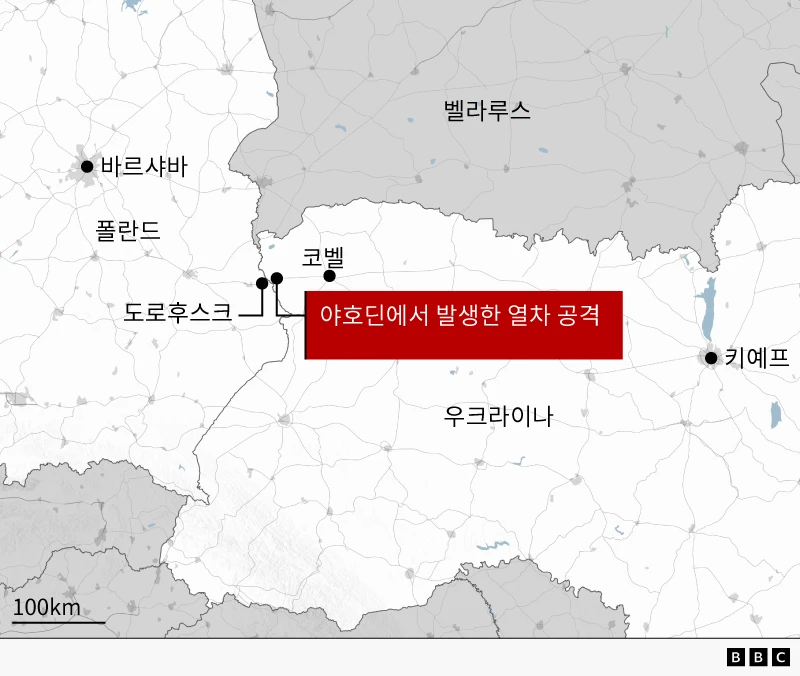
Early on Sept. 13, an evacuation order was issued for a passenger train bound for Warsaw from Kyiv at Yahodin Station in western Ukraine's Volyn region, about 2 km from the Polish border. A controller in the Ukrainian railway authorities' central monitoring unit had spotted an approaching Russian drone. About 15 minutes after 206 passengers cleared the train, the drone slammed into a locomotive standing at the station. The locomotive was wrecked, but no one was hurt.
Another train had passed along the same tracks earlier. It was a diplomatic train returning from the Yalta European Strategy (YES) international security forum in Kyiv. On board were former British Prime Minister Boris Johnson, former Swedish Prime Minister Carl Bildt, British National Security Adviser Jonathan Powell and security officials from across Europe. Because of the air raid threat, the train left earlier than scheduled and had already crossed the border into Poland by the time the drone struck. Former CIA Director David Petraeus was on another train standing at Yahodin Station during the attack. In an interview, he said he heard the drone overhead and then an explosion moments later, calling it "terrible."
It was a single airstrike that ended without casualties. But the question raised by the incident is bigger than those tense few minutes. Under current rules, NATO could do nothing about an attack that took place 2 km from the border.
■ Who was the target?
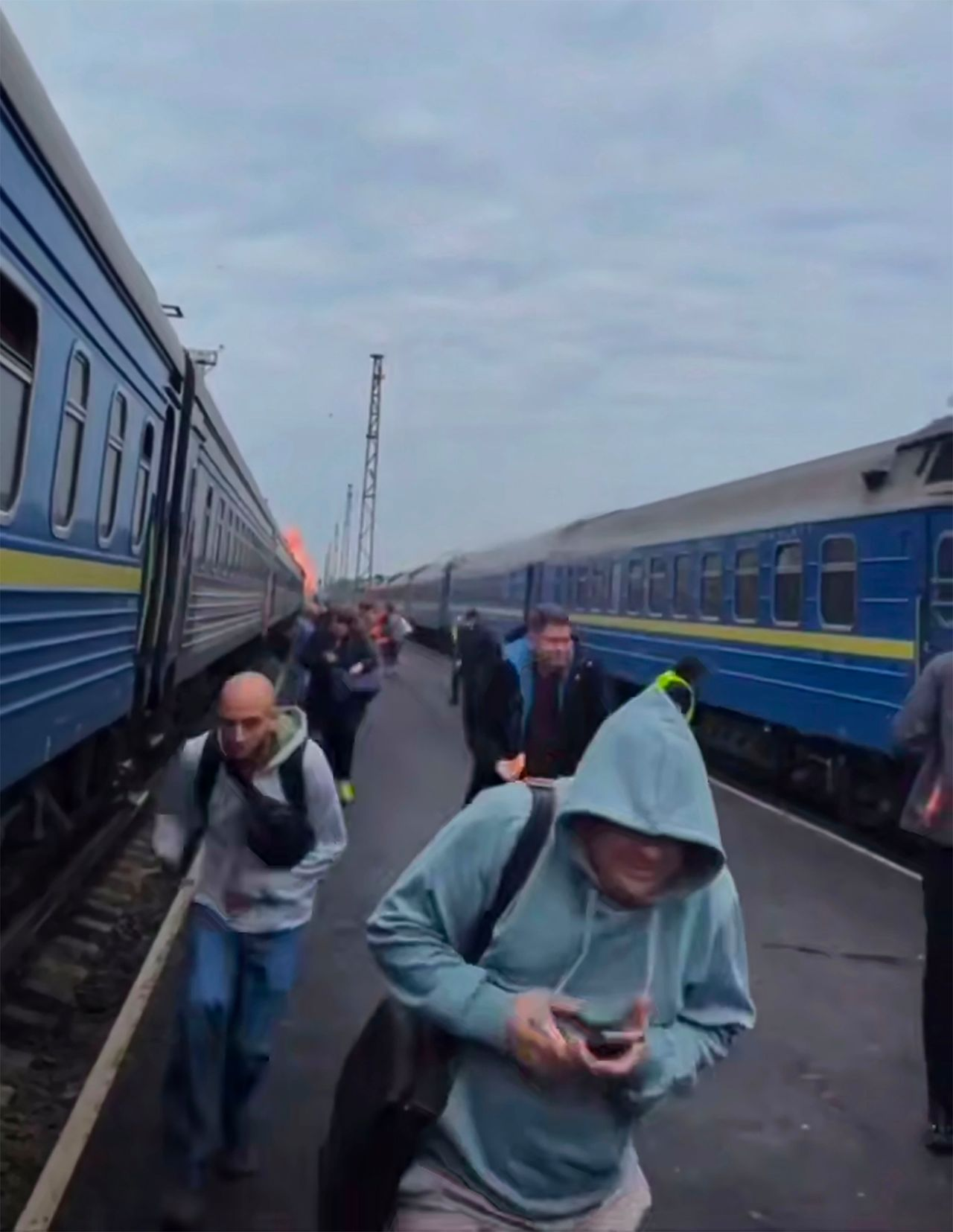
Ukraine's state railway company said there was a fairly high possibility that the diplomatic train, which departed ahead of schedule, had been the original target. It added, however, that there was no proof that Russia had targeted the foreign delegation. Ukrainian President Volodymyr Zelenskyy accused Russia of "deliberately" attacking the locomotive.
Russia's account is different. The Russian Defense Ministry said only that it had struck rail facilities in western Ukraine used to transport military cargo sent by European countries, and made no mention of foreign visitors. The ministry later released footage of strikes around Yahodin that it said had been filmed by a Geran-series drone, but it is not clear whether the target in the video was a locomotive.
Neither account has been verified. But whether the target was people or the tracks, the place under attack was the same: Yahodin itself. Since Ukraine's airspace was closed after the full-scale invasion, this rail line has become the main route for heads of state and senior officials traveling to and from Kyiv. At the same time, it is a key junction for much of the Western weaponry and humanitarian aid entering from Poland. Early that same morning, a gas station near a border checkpoint and several trucks burned in the aftermath of the drone attack, and traffic was halted during the air raid alert.
Kaja Kallas, the European Union's high representative for foreign affairs and security policy, said she saw the attack as an attempt to intimidate Western countries into not supporting and visiting Ukraine. The view that the diplomatic train was the target is Ukraine's inference, but the message that "this route is not safe" was delivered regardless of the target.
■ Faster weapons
The model used in the attack has not been officially confirmed. Petraeus, who was at the scene, said a jet-powered Geran-series drone hit the locomotive. Polish Prime Minister Donald Tusk, after convening an emergency security meeting that day, also said the range and accuracy of jet-powered drones were worrying. Even Ukraine, despite its extensive experience dealing with drones, cannot intercept them with 100% success, he said.
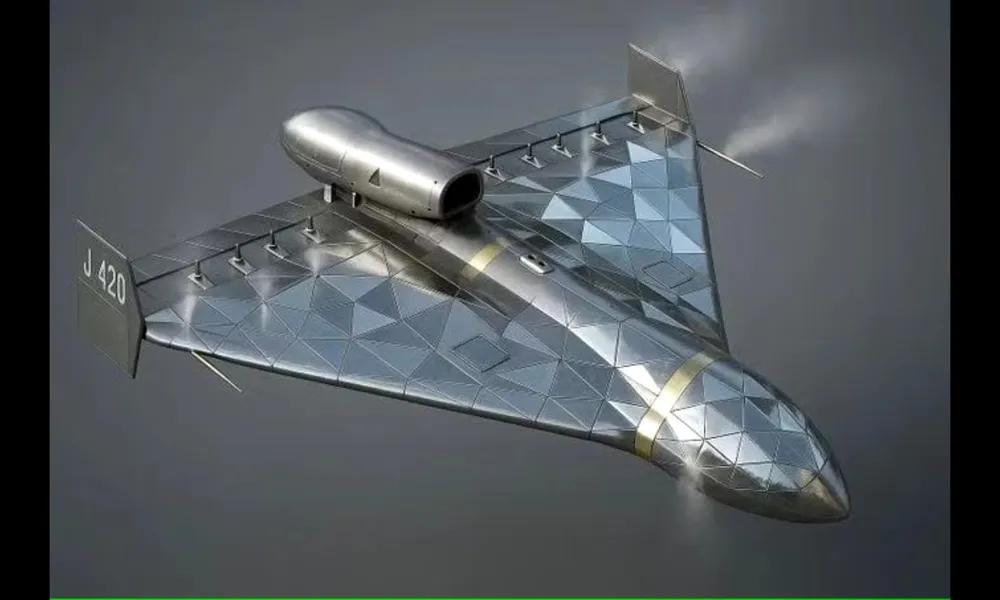
The Geran is Russia's domestically produced version of Iran's Shahed drone. The propeller-driven version, which had been the mainstay until now, was a slow weapon traveling at around 200 kph. By contrast, the jet-powered Geran-5, first used in combat earlier this year, is assessed by Ukrainian intelligence to carry a 90 kg warhead and reach speeds of up to 600 kph, prompting comparisons to a cruise missile. It has not been confirmed which model was used at Yahodin, but the direction is clear. What protected the passengers was a 15-minute warning window. As drones get faster, those 15 minutes get shorter.
■ A 2-km blind spot
The U.S. think tank Institute for the Study of War (ISW), in an assessment released the day of the incident, said it believed the Kremlin had carried out a precision drone strike to wound or kill current and former senior European officials. ISW said reporting to date strongly supports that conclusion. The more fundamental issue it pointed to was interception rules. NATO intercepts Russian aerial targets only after they enter European airspace. Drones heading for targets inside Ukraine are not subject to interception, even if the target is a railway station just 2 km from the Polish border. A drone aimed at Yahodin does not need to cross into Polish airspace. Under current rules, that means Russia can strike infrastructure on NATO's doorstep with virtually no constraint. ISW recommended that NATO review this interception policy and quickly provide Ukraine with more air defense capability.
This debate is not new. One year earlier, on Sept. 10, 2025, about 20 Russian drones violated Polish airspace. Poland requested consultations under Article 4 of the NATO treaty, and NATO launched the Eastern Sentry operation to strengthen defenses on the eastern border. Polish Foreign Minister Radoslaw Sikorski publicly proposed intercepting drones over Ukrainian airspace at the time. Poland's Defense Ministry pushed legislation to amend a 2022 law that required prior consent from NATO, the EU and the country concerned for overseas deployments, so that Poland could independently shoot down drones over Ukraine. It was the so-called principle of "shoot first and ask questions later." It has not been confirmed whether that amendment was actually completed.
A year later, the drone aimed at Yahodin ultimately reached its target. Sikorski again called the attack an "escalation" and urged allies to "double" their support for Ukraine. Tusk said Russian activity would be very intense in the coming weeks and months, and that the possibility of escalation affecting Polish territory could not be ruled out. Three days later, on the 16th, Polish fighter jets scrambled in response to Russian airstrikes on western Ukraine, and Lublin and Rzeszow airports suspended operations for about 40 minutes. The next day, on the 17th, a jet-powered drone fell or was destroyed on Ukrainian territory near Yahodin, about 4 km from the Polish border. Poland's deputy defense minister told parliament that Poland had been ready to shoot it down if it had approached Poland and risked crossing the border. That condition, "if it risked crossing," is the current line.
■ 500 locomotives
The Yahodin attack was not an isolated incident but the most visible scene in a longer trend. According to figures released in late August by Ukraine's minister of restoration, infrastructure and transport, Russian forces have struck rail facilities 1,534 times this year. That has already surpassed the roughly 1,200 strikes recorded in all of last year. Since the full-scale invasion, 52 railway employees have been killed while working and 317 have been injured. The number of damaged locomotives, listed at 492 in the same tally, exceeded 500 according to a Sept. 15 statement by Ukraine's foreign minister, and more than half of them were hit this year.
Among those figures, the number worth watching is locomotives. No matter how many passenger cars there are, without a locomotive to pull them, trains can only stand still. That Russia again hit a locomotive rather than passenger cars after people had evacuated fits the logic of a war of attrition against the railways, whatever the target may have been (this interpretation is the article's analysis). The evacuation procedures that prevented casualties are also a product of that same trend. On Ukraine's railways, where drones have become routine, trains have repeatedly been stopped and emptied when a threat is detected.
■ A dwindling shield
As attacks increase, the means to stop them are shrinking. President Zelenskyy said air defense interceptors sent by allies in the first half of this year amounted to only about one-third of last year's level. He cited the war in the Middle East as the main reason, but did not rule out the possibility that the supply delays were intended to draw concessions from Ukraine in peace talks.
The cost structure also favors the attacker. The unit price of a jet-powered Geran is not known precisely. Analysts say it may cost two to three times more than the propeller-driven version because of the jet engine, but it is still nowhere near a Patriot PAC-3 interceptor missile, estimated at about $4 million apiece. It is a case of having to stop a cheap arrow with a far more expensive one. If interceptors are in short supply, not every target can be protected. If the remaining interceptors go first to cities and power plants, a border railway station is unlikely to rank high on the list.
■ Coincidence or pattern?
In Ukraine and parts of Europe, some are focusing on the fact that similar incidents appear to be recurring near the travel routes of senior officials. On Sept. 8, five days before the Yahodyn attack, a Russian drone entered Moldovan airspace, prompting Moldovan authorities to close the airspace, and President Volodymyr Zelenskyy's plane, which was due to leave Chisinau airport in the capital for Norway, was also delayed. The attack also coincided with a period when the United States was stepping up efforts toward talks to end the war. A week earlier, on Sept. 5, US special envoy Steve Witkoff and Jared Kushner met Russian President Vladimir Putin in Moscow, and the following day they held talks with President Zelenskyy in Kyiv.
But that link remains an interpretation. There is also clear evidence pointing the other way. Russia has steadily attacked areas near the Polish border, including Yahodyn, in recent weeks, and Yahodyn is a sufficient target simply because it is a supply hub. The attack that day was part of a large-scale nighttime air raid targeting sites across Ukraine. In the Moldova incident, the drone crashed in a field about 160 km from the airport, and its intent was not confirmed. The overlap in timing does not in itself prove that it was aimed at them. Moreover, the diplomatic train was already in Poland. If Russia really targeted that train, it failed. If it targeted the railway, it succeeded. What is certain is that, either way, the sense of danger felt by Western officials using this route has grown.
■ The next 15 minutes
None of the 206 passengers at Yahodyn were hurt because they had 15 minutes. The surveillance network detected the drone early, and evacuation procedures were well rehearsed. But drones are getting faster, interceptors are dwindling, and the area 2 km from the border remains outside the rules. There is no guarantee the next attack will also allow 15 minutes.