The half-shut door to intelligence sharing: What the United States cut off, and what it left in place
The Joint Chiefs acknowledged restrictions, while the NIS denied reports that only missile-related intelligence is being shared. With some North Korea intelligence blocked for six months, government accounts are also at odds.
강병지
Published
■ Five days in October
On Oct. 8, at a National Assembly audit, Joint Chiefs of Staff Chairman Jin Young-seung acknowledged in response to a question from People Power Party lawmaker Yoo Yong-won that intelligence sharing with the United States on North Korea has not been fully restored. He added that while some core information related to North Korea's nuclear program is restricted, there is no problem carrying out nuclear- and missile-related missions. Asked whether intelligence sharing had ever been even partially blocked for this long, he replied, "I think it may be shared again before long."
On Oct. 9 local time, a response came from Washington. In a written reply to a media inquiry about the state of South Korea-US intelligence cooperation, a senior U.S. administration official said Washington expects South Korea to uphold the standards of an alliance that has lasted for decades, especially in intelligence and counterintelligence. The official did not say what those standards are or whether the United States believes South Korea violated them.
On Oct. 10, a report said the United States was in effect sharing only missile-related intelligence. The Defense Ministry and the National Intelligence Service then issued statements in quick succession. The Defense Ministry said the report was false, and the NIS said it was "not true at all." The NIS even criticized some media outlets for using fake news to undermine intelligence agencies. Then, at a National Assembly audit held in Washington on Oct. 12 local time, Ambassador to the United States Kang Kyung-wha said the issue had not been resolved to the extent the U.S. side expected.
Over five days, the Joint Chiefs acknowledged restrictions, the NIS denied reports of reduced intelligence sharing, the United States spoke of standards, and the ambassador in Washington said the issue was still unresolved. Those four voices on the same issue show where South Korea-US intelligence cooperation now stands.
■ Two syllables: Guseong
It began at the National Assembly on March 6. Unification Minister Jeong Dong-young mentioned Guseong in North Pyongan Province, in addition to Yeongbyeon in North Pyongan Province and Gangseon in Nampo, as a location of North Korea's uranium enrichment facilities. He was citing a report by International Atomic Energy Agency Director General Rafael Grossi while describing the seriousness of North Korea's nuclear program, but the places actually mentioned in Grossi's report were only Yeongbyeon and Gangseon. It was the first time a sitting senior government official had publicly identified Guseong as the site of an enrichment facility. Jeong said he had also mentioned Guseong during his confirmation hearing last year, when he was a nominee.
The United States took issue with the remark. Beginning in early April, it restricted part of intelligence sharing on North Korea, although some reports said the restrictions began immediately after the March remark, and the matter came to light through media reports in mid-April. The U.S. side is reported to have conveyed its protest to foreign affairs and security ministries and intelligence agencies. The Unification Ministry said there was no protest and that it explained the background of the remark after an inquiry from the U.S. Embassy. Washington's concern was that surveillance assets could be traced back. Working backward from public information can reveal the assets and methods used to collect it, and if North Korea detects that and tightens security, further surveillance becomes more difficult.
The South Korean government's position was different. A government security investigation found no indication that Minister Jeong's remark resulted from a leak of information provided by the United States. Jeong said the information had been confirmed through public materials, including a 2016 report by a U.S. private research institute and domestic media reports. However, regarding a report by the Center for Strategic and International Studies that he also cited as a basis, CSIS Korea Chair Victor Cha countered that he had never issued such a report. President Lee Jae-myung said the existence of the Guseong nuclear facility had already been widely known through academic papers and media reports.
The government's explanation rests on a subtle distinction. On April 23, National Security Office Director Wi Seong-rak acknowledged that the Guseong-related matter had originally been classified and became "joint classified information" when it was shared between South Korea and the United States. He said, however, that Minister Jeong had never received such an intelligence briefing and had spoken based on public materials, so joint classified information and Jeong's remark should be treated separately. In other words, the matter itself was classified, but the minister's source was public material. Whether the alliance accepts that distinction is a separate question. The United States is reported to view the remark as a leak of classified information, and U.S. intelligence authorities are also reported to have judged that Jeong's remark was based on NIS intelligence and to have raised complaints through multiple channels.
■ What was cut off, and what remained
The key to understanding this episode is what, exactly, was cut off. And this is precisely where the explanations diverge.
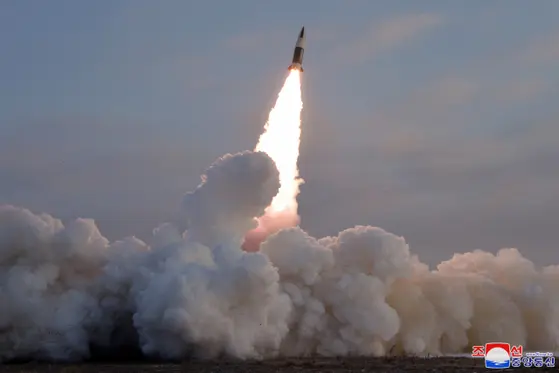
According to the first April report and the military's explanation, the restricted information was technical intelligence on North Korea collected by U.S. satellites. By contrast, surveillance and reconnaissance intelligence such as signs of North Korean missile launches and flight trajectories continued to be shared as before. The military said that even when North Korea fired a short-range ballistic missile from the Sinpo area of South Hamgyong Province on April 19, South Korean and U.S. intelligence authorities had been tracking launch activity.
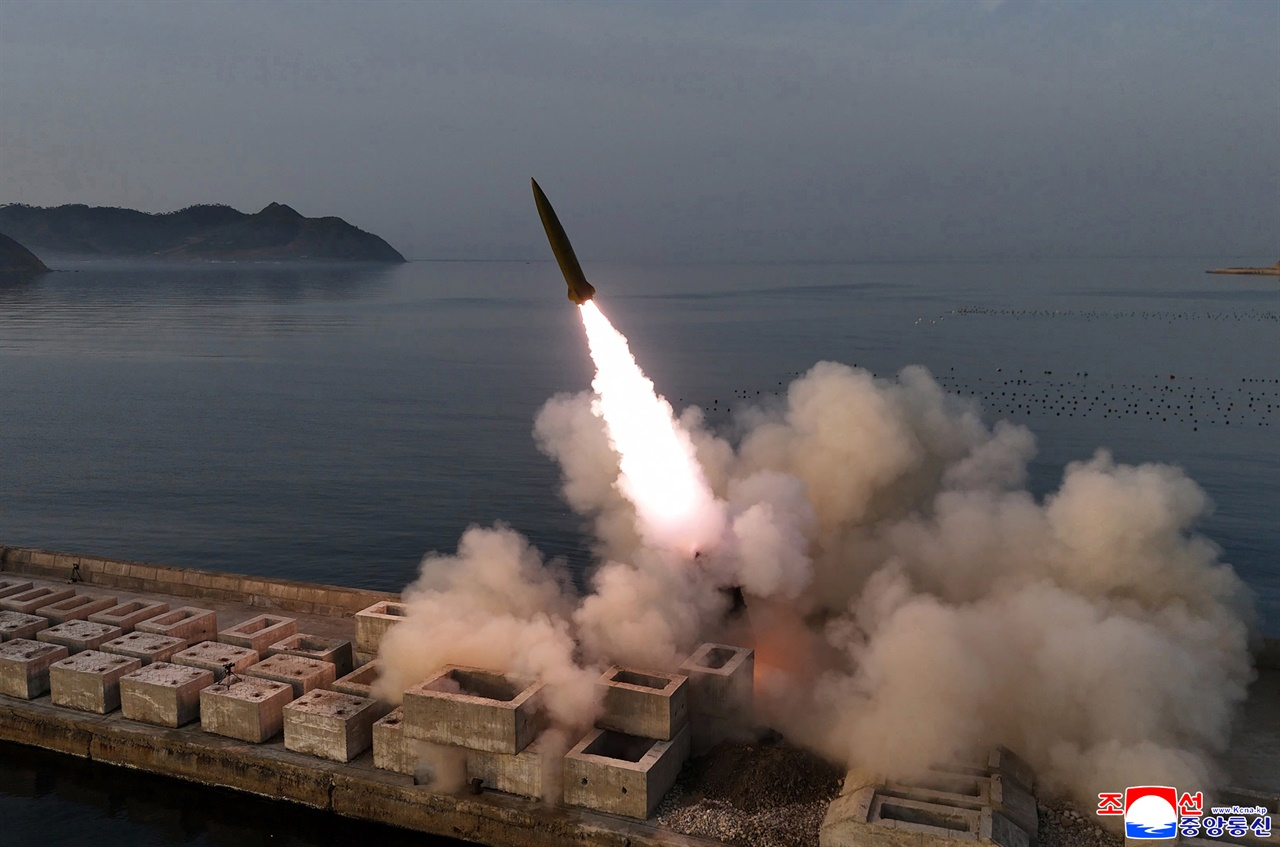
The Oct. 10 report went a step further. It said the North Korea-related intelligence the United States provides had been narrowed to pre-launch indications and post-launch specifications for missiles, while information previously shared on movements among North Korea's senior leadership and on China-Russia relations had been cut off. In the same report, a senior government official acknowledged that the total volume of North Korea-related intelligence provided by the United States had indeed declined. The official said, however, that this was not because of friction between Seoul and Washington, but because U.S. reconnaissance satellites and HUMINT had been concentrated on the wars in Ukraine and Iran. Government agencies strongly denied the report. The Defense Ministry said there are no restrictions on intelligence sharing for military readiness against North Korea, and that some restricted information is being sufficiently offset by the military's greatly improved independent intelligence capabilities. The NIS said that aside from part of the information that led to the restrictions, cooperation remains active across many areas including missiles, conventional forces, North Korean developments, international relations, cyber, and counterintelligence, and that the total volume of information provided by the United States has not decreased either.
Whichever explanation one follows, there is common ground. Missile-related intelligence is being shared, and some information on North Korean nuclear facilities connected to the Guseong issue is blocked. The NIS did not deny that some restrictions remain in place. The issue is their scope and the total volume. Even within the government, accounts differ on whether the overall volume has decreased.
There is no basis to conclude the government's explanation is wrong. But it misses the core of the question. Watching a launch and assessing capabilities are not the same thing.
Signs of missile launches and flight trajectories answer the question, "What is flying right now?" That is operational intelligence for interception and response, and if it were blocked it would immediately create a gap in readiness. The fact that the United States left this intelligence intact can be read as meaning it had no intention of shaking the military foundations of the alliance.
Nuclear facility intelligence answers a different question: where North Korea is making what, and how far its enrichment capability has advanced. It is less relevant to immediate interception, but it is necessary to gauge the threat years down the road and to set response strategy and the direction of force buildup. The Joint Chiefs chairman's remark that there is no problem in carrying out missions, and the NIS explanation that the total volume of intelligence provided has not decreased, were statements about operations and about the quantity of intelligence. No one explained the weight of the intelligence that was blocked.
South Korea is especially vulnerable in this area. Seoul and Washington have shared intelligence on North Korea obtained through satellites, reconnaissance aircraft and intercepts, but South Korea is relatively more dependent on U.S. satellite intelligence. At the end of April, the government was reported to have judged that the restrictions were limited in scope and therefore not a serious problem. But lawmaker Lee Seong-kwon, the People Power Party's secretary on the National Assembly Intelligence Committee, pointed out that if the restrictions drag on, there is bound to be a gap in monitoring developments inside North Korea. And the restrictions in fact lasted more than half a year.
■ The widening cracks
The problem did not stop at intelligence sharing.
It recently emerged that the NIS was left out of the fifth South Korea-US-Japan working group meeting on responding to North Korean cyber threats, held in Washington in June, at the request of the U.S. side. The NIS said there had been some misunderstanding several months ago, but that it was already in the past. However, it said it could not say why the United States had asked for the exclusion or what follow-up steps the NIS had taken. The Foreign Ministry said only that whether relevant ministries attend and at what level is decided for each meeting in consideration of its agenda and schedule. There were also reports that visa issuance for NIS employees had been put on hold, but no direct evidence has been confirmed that this was due to a change in U.S. policy.
Friction was not confined to intelligence. The United States reportedly opposed the arrest and detention of Chairman Kim Beom-seok in connection with the investigation into the leak of Coupang personal data, and pressed Seoul by linking the matter to the implementation of South Korea-US security agreements. On April 27, Ambassador Kang Kyung-wha to the United States took leave and briefly returned to Korea, where she met Foreign Minister Cho Hyun and reportedly discussed the restrictions on North Korea-related intelligence and the Coupang issue.
Domestic politics reads the episode in completely opposite ways. The People Power Party says trust across diplomacy and security has broken down, while the government and the ruling party counter that excessive politicization is itself harmful to managing the alliance. The split remained in October. During a parliamentary audit, Democratic Party lawmaker Park Sun-won argued that the matter was one to be resolved between the US Central Intelligence Agency and the National Intelligence Service and that it was almost fully resolved. By contrast, an opposition lawmaker said the United States was still not providing the information.
■ From a 'remark' to 'standards'
The Oct. 9 remarks by a US official carry weight because of what happened in the meantime.
Six months ago, the US complaint was outwardly aimed at a single remark by a minister. But some analysts say the remark was only a trigger from the start, and that dissatisfaction over other alliance issues lay beneath it. Later reports cited the Coupang investigation, the Hormuz deployment and the transfer of wartime operational control as factors behind US distrust. Either way, the issue moved up to a higher level. On Sept. 18 local time, Foreign Minister Cho Hyun met US Secretary of State Marco Rubio in Washington. Reports on the outcome of the meeting did not mention intelligence cooperation. But Ambassador Kang, who attended the meeting, said during an October parliamentary audit, "There was talk that there were problems with intelligence cooperation." Then in October, the United States used the phrase "alliance standards in the fields of intelligence and counterintelligence." That can be read not as a protest over a specific remark, but as a demand concerning South Korea's overall system for handling intelligence.
Of course, the United States did not define what those standards are. It also did not explicitly say that South Korea had violated them. Linking the remarks to a specific incident is a matter of interpretation. Still, it is possible to read them as shifting the issue from "a misunderstanding that ends once it is explained" to "trust that requires the system itself to be proven." The South Korean government's repeated explanation over the past six months, that there was no leak, answers the former question. Ambassador Kang's statement during the parliamentary audit that the National Intelligence Service is continuing to respond shows the latter question still remains.
■ Blueprints amid it all
There is another episode from the past six months worth noting.
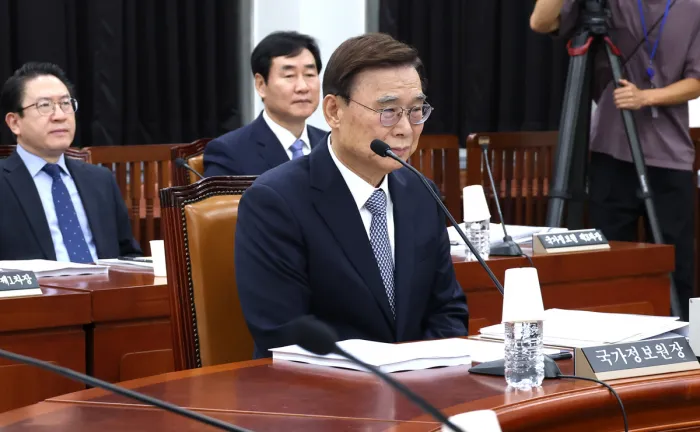
At a closed-door full committee meeting of the National Assembly Intelligence Committee on Sept. 1, the National Intelligence Service reported that it had obtained and was analyzing North Korean internal party documents and missile blueprints. The contents were made public in a briefing by the committee secretary. It was not disclosed which missile the blueprints were for, or how and when they were obtained. At the same meeting, the NIS also said North Korea had expanded and reorganized its Reconnaissance General Bureau into a "Reconnaissance Intelligence General Bureau" and strengthened its counterintelligence functions.
Set beside the restrictions on intelligence sharing, the report suggests two things.
First, they are on different levels. Under the government's explanation, missiles are an area in which intelligence sharing with the United States continues. But if launch signs and trajectories are the result of watching missiles from the outside, blueprints are the result of looking inside them. In effect, the NIS was highlighting information it had obtained without relying on sharing with the United States, and that can be read as a signal of independent collection capability.
At the same time, there is a paradox. The logic behind the US restrictions was the risk of exposure: that public disclosure could reveal the assets and channels used to collect the information. And US intelligence authorities are reported to have regarded the source of the Kusong remark as NIS intelligence. That same NIS then disclosed through a report to the National Assembly that it had obtained North Korean missile blueprints. It was a limited disclosure that concealed the substance, but how the side that restricted intelligence over exposure concerns read that episode is a separate question.
There is no evidence that the two episodes are causally linked. No indication has been confirmed that the NIS disclosed its acquisition of the blueprints with the US restrictions in mind, or that the US remarks about "standards" were aimed at that disclosure. Still, the two episodes, both within the same six-month period, show where South Korea's intelligence agency now stands. It is under simultaneous pressure to prove self-reliance and to prove security discipline.
■ Satellites rely on the US, overseas networks are damaged
The structure of South Korea's North Korea intelligence capabilities makes those pressures even heavier.
South Korea has long relied on the United States for satellite intelligence. Project 425, which involved launching five military reconnaissance satellites, completed its launches last November with the fifth and final satellite. The military said it planned to complete force integration of all five by the end of April this year, and they are reportedly able, once all five are operationally deployed, to monitor specific targets inside North Korea at two-hour intervals. That would give South Korea its first independent satellite surveillance network. This system is also at the center of what the Defense Ministry called a "greatly improved independent military intelligence capability." But five satellites are unlikely to replace the collection range and analytical capacity built up by the United States' vast intelligence assets.
Human intelligence networks have also been hit. In 2024, it emerged that a civilian employee of the Defense Intelligence Command had passed military secrets to a person believed to be a Chinese intelligence operative. The leaked material included a list of so-called black agents operating overseas under concealed identities. He was recruited around 2017 and began leaking secrets for money in 2019. The Supreme Court finalized a 20-year prison sentence last year. Agents working overseas rushed back to Korea immediately after the case broke. Military prosecutors said the leaked list did not include North Korea-related HUMINT lists, but once a HUMINT network is exposed, it takes a long time to rebuild.
With satellite intelligence heavily dependent on the United States and overseas human intelligence networks shaken, some US intelligence was also restricted. For now, it is impossible to know what the report on obtaining the blueprints actually means, or how substantial independent collection really is.
■ If the door is to reopen
An intelligence alliance is, before anything else, a relationship built on mutual promises to protect the information each side receives. The United States shares satellite intelligence because it believes South Korea will protect the source of that information. When that trust is shaken, intelligence sharing shrinks. This episode showed that the principle operates without exception even between allies.
For the past six months, the South Korean government's response has largely been one of explanation. It says there was no leak, the information was public, readiness was unaffected, and the overall volume of intelligence did not decline. Each of those points may be true. But the word the United States raised in October was "standards." What Washington may be waiting for is not an explanation but a system. The Blue House is reported to be considering high-level consultations, including a visit to the United States by National Security Office Director Wi Sung-lac, but nothing has been finalized.
What procedures are followed when a senior official refers in public to a matter that falls under allied classified information? Who decides, and how, where the boundary lies between intelligence shared by an ally and public-source material? When an intelligence agency's achievements are made public, how is source protection reviewed? Whether the door opens again depends not on political sparring but on answers to those questions.