Three North Korean self-propelled guns spotted opposite Gimpo's Aegibong, with signs of training as barrels were pointed directly toward South Korea
122 mm self-propelled guns exposed on the Kaepung County coast, visible to the naked eye from the South, with footage also capturing barrels being moved in response to red-flag signals
With a maximum range of 24 km, they put parts of border areas including Gimpo within range, while military authorities say there are "no unusual movements" amid the possibility of a North Korean show of force
Published
Updated
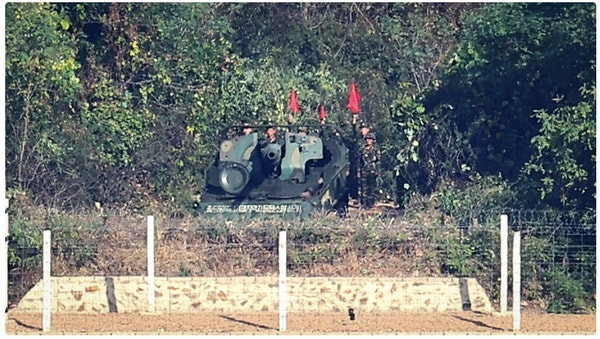
Domestic and foreign media cameras have captured what is presumed to be North Korean troops deploying three 122 mm self-propelled guns on the coast opposite Aegibong Observatory in Gimpo, Gyeonggi Province, and training while moving the barrels toward the South. Because artillery assets are normally concealed to avoid enemy observation and attack, their exposure at a site plainly visible from the South has raised the possibility that this was an intentional show of force.
Photos taken by Yonhap News on the 25th from Aegibong Observatory in Gimpo, Gyeonggi Province, showed self-propelled guns deployed on the coast of North Korea's Kaepung County and North Korean soldiers moving nearby. On the 26th, YTN, Channel A and Reuters also confirmed three self-propelled guns and North Korean activity in the same area.
The area is a border zone where North Korean territory lies just about 1.5 km from Aegibong Observatory. The observatory has previously offered views of North Korean troops installing fencing and building tactical roads there, but analysts say it is unusual for self-propelled guns to be exposed so prominently.
Barrels move on red-flag signals, with North Korean troops also seen observing the South
Video filmed on the 26th showed about 10 North Korean soldiers gathered around the self-propelled guns, operating the artillery and observing the South through binoculars.
Some soldiers sat on the self-propelled guns and talked, while others moved in response to signals made by raising and lowering red flags. In footage shot by Channel A, the barrels moved from side to side after the flag was lowered, and soldiers were later seen moving into nearby grass.
A propaganda slogan was painted in white on the hull of one self-propelled gun: "Destroy the U.S. imperialist aggressors, the sworn enemy of the Korean people!" The activity may have been training to prepare for firing or to practice artillery operating procedures. No live-fire drill was confirmed, and it has not been determined whether South Korean military facilities were set as targets.
Maximum range of 24 km, making it an artillery asset capable of directly striking border areas
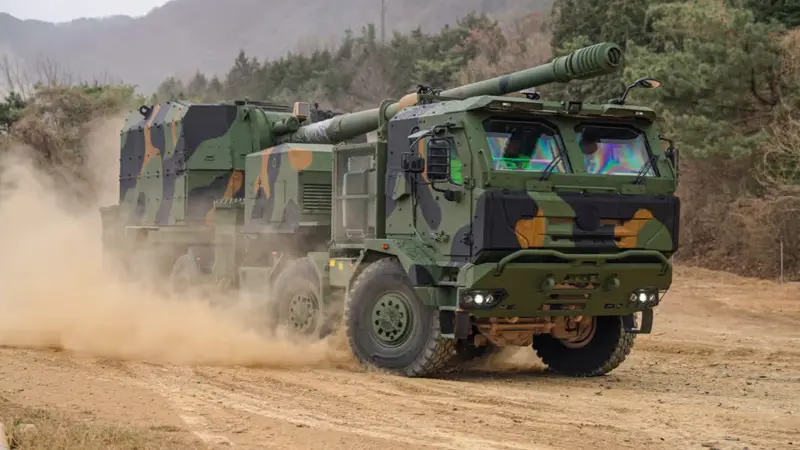
The equipment captured this time is presumed to be a 122 mm self-propelled gun operated by the North Korean military. Reuters reported on the 27th that military experts had identified it as an M-1981 122 mm self-propelled gun.
North Korea's 122 mm self-propelled guns are among the key artillery assets operated by frontline units. Their range is known to be roughly 15 to 24 km depending on the type and ammunition, putting parts of northern Gyeonggi border areas including Gimpo within range. What stands out in this deployment, however, is the direction of the barrels and the location.
Because deploying artillery in a location that can be directly observed may expose its position and scale to the enemy and reduce survivability, self-propelled guns are generally operated from concealed positions on reverse slopes or in prepared emplacements. In contrast, the North Korean self-propelled guns spotted this time were lined up along the exposed coast facing the South.
Lee Il-woo, secretary-general of the Korea Defense Network, focused on the low barrel angle and deployment pattern in an interview with Radio Free Asia on the 26th. He said the positioning may have been intended for direct-fire use aimed at South Korean frontline positions, rather than indirect fire against distant targets.
Spotted just after Kim Yo Jong warned of a 'new response means,' with military authorities remaining cautious

The exposure of the self-propelled guns was confirmed shortly after North Korea warned it would raise the level of its military response around the Military Demarcation Line.
On the 22nd, Kim Yo Jong, chief of the General Affairs Department of the Workers' Party of Korea, took issue with South Korean military warning shots over a crossing of the Military Demarcation Line and said a new response means along the entire border would be shifted to mission-ready status, while loudspeakers aimed at the South would also enter standby within days. The two Koreas are also at odds over a mine explosion in the Demilitarized Zone this past Sept. 21. At the time, three South Korean service members were injured, and South Korea and the U.N. Command judged it to be an armistice violation caused by a North Korean mine. North Korea has denied responsibility and sent a letter to the U.N. Security Council calling it a fabricated incident.
With military tensions rising, some analysts say North Korea's public exposure of artillery assets could be intended as a warning to the South. Shin Jong-woo, secretary-general of the Korea Defense and Security Forum, said it was unusual to expose self-propelled guns in front of the fence line and assessed it as an attempt to heighten tensions in the border area. Military authorities, however, remain cautious about whether this deployment of self-propelled guns qualifies as the new response means North Korea had announced.
At the National Assembly Defense Committee's comprehensive audit on the 26th, Defense Minister Kang Shin-cheol said North Korea's deployment of self-propelled guns in an observable area could have several intentions, but added that no separate unusual movements had been identified and that related activity was being closely monitored. On the 27th, the Joint Chiefs of Staff also said it would be difficult to view the self-propelled guns identified this time as the new weapons system North Korea had recently mentioned.
Yang Uk, a research fellow at the Asan Institute for Policy Studies, also told Reuters that he viewed the deployment more as a display of firepower than a substantive reinforcement of combat capability. The very choice of a location that can be easily observed from the outside suggests deliberate exposure, he said.
Military authorities are maintaining readiness while monitoring possible follow-up moves by North Korean troops and the possibility of live-fire training. What form North Korea's newly announced response means will actually take, and whether this exposure of self-propelled guns will remain a one-off show of force, remain variables that could determine the level of tension on the western front going forward.