Two pieces fitted into place in a day: Japan's counterstrike capability puzzle is coming together
The Tomahawk and a stealth cruise missile surfaced on the same day. Japan's counterstrike capability is maturing across land, sea and air. South Korea is pursuing the same goal through the opposite path: indigenous development.
강병지
Published
Updated
■ Introduction
On July 30, 2026, two developments came to light side by side. It was disclosed that the previous day, in Pacific waters, the Japan Maritime Self-Defense Force Aegis destroyer Jokai had become the first Japanese vessel to conduct a live firing of a Tomahawk cruise missile. The same day, at Gifu Air Base, an F-2 fighter took off with a large unidentified stealth cruise missile slung under its wing.
The two events may look separate, but they are part of the same trend. They signal that long-range strike capabilities developing on land, at sea and in the air are reaching maturity at the same time. In the background lies a China-Japan relationship that has been frozen for more than half a year. This article looks at how a country that for decades upheld an "exclusively defense-oriented" policy reached this point, and what that shift means for the Korean Peninsula.
■ Why now? Frozen tensions and the collapse of the defensive premise
The trigger for this shift dates back to November 2025. Prime Minister Sanae Takaichi said in a parliamentary response that Chinese use of force against Taiwan could constitute a situation threatening Japan's survival. China immediately pushed back against the remark, which implied that Japan could invoke the right of collective self-defense. Restrictions on exports of rare earths and dual-use items were followed by a halt to seafood imports and advisories urging Chinese citizens to refrain from travel. Unlike past episodes that ended as one-off frictions, this time the situation is being assessed as moving into structural confrontation. The two developments on July 30 came in the middle of that chill.
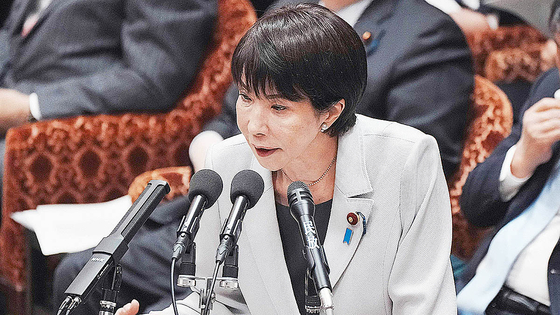
Japanese Prime Minister Sanae Takaichi attends the House of Representatives Budget Committee in 2025, AFP-Yonhap News
The scale of the threat helps explain why Japan is pursuing long-range strike capabilities. China's Rocket Force is estimated to possess about 1,900 medium-range and intermediate-range ballistic missiles capable of reaching the first island chain. The anti-ship ballistic DF-21D, the roughly 4,000 km-range DF-26 known as the "Guam killer," and the DF-17 carrying a hypersonic glide vehicle create overlapping strike envelopes. Some analyses say about 15 U.S. bases in Japan fall under this threat, and that if key bases in Okinawa were hit by missiles, fighter operations could be paralyzed for about 280 hours, or more than 10 days.
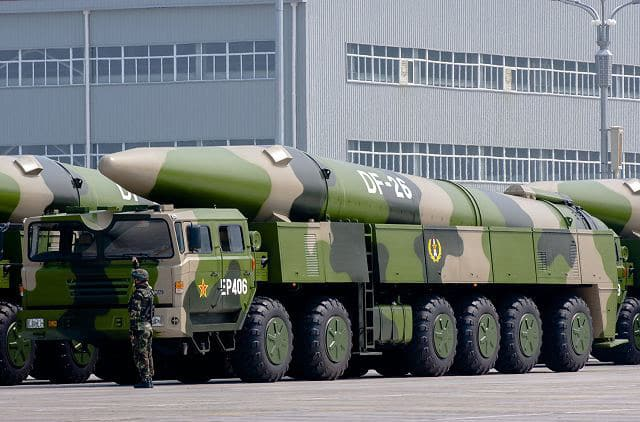
DF-26 missile, People's Liberation Army of China
The idea that fixed bases could be disabled in the early stages of a conflict is the starting point of Japan's counterstrike capability. In December 2022, Japan simultaneously revised three key security documents, including the National Security Strategy, formally adopting the concept. It was a shift that effectively moved Japan beyond its exclusively defense-oriented principle, defining a capability to strike missile bases and other targets in enemy territory if Japan came under armed attack. The pace then quickened. In April 2026, the Takaichi Cabinet formally lifted the postwar ban on exports of lethal weapons, and defense spending for fiscal 2026 topped 9 trillion yen for the first time, setting a record high for the 12th straight year. The increase was 3.8 percent from a year earlier.
The Japanese government says the counterstrike capability is strictly a form of defensive deterrence, an extension of "deterrence by denial" meant to convince an adversary it has nothing to gain from an invasion. Neighboring countries, however, read it as a shift toward offense. That divide, where the same weapons are seen as either defensive or offensive, is where the debate becomes sensitive.
■ What is it building? A layered arsenal
Japan's long-range strike force is not a single weapon, but a layered structure spanning land, sea and air.
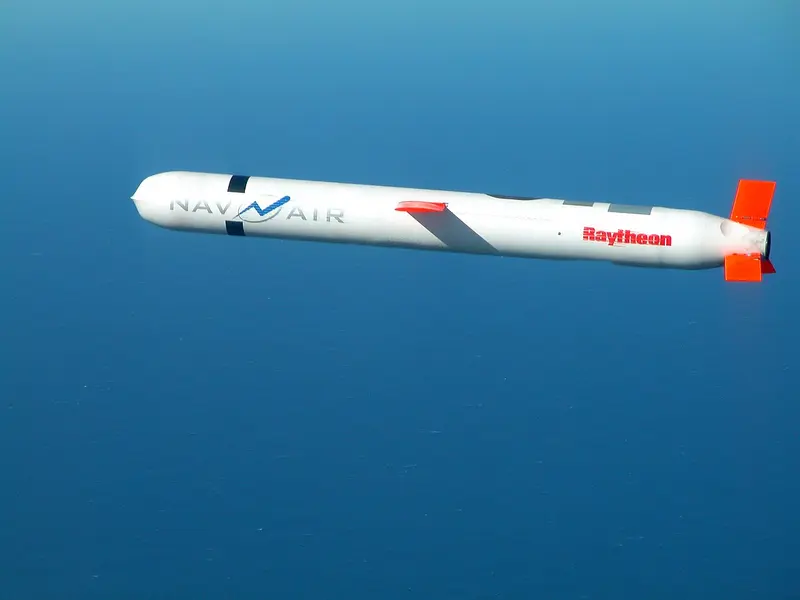
The first layer to be filled is the U.S.-made Tomahawk. Jokai's live firing was carried out with U.S. Navy support, making Japan the third country besides the United States to launch a Tomahawk from a surface ship. Australia and the Netherlands had done so earlier, while Britain has fired it only from submarines. The acquisition totals 400 missiles, 200 Block IVs and 200 Block Vs, and the sale approved by the U.S. State Department in 2023 was worth up to $2.35 billion. The Block IV can fly about 1,600 km, roughly 1,000 miles, to strike a target. Beginning with Kongo-class destroyers, modifications are planned in sequence for the Atago and Maya classes, and two large Aegis System Equipped Vessels, or ASEVs, will also gain the capability.
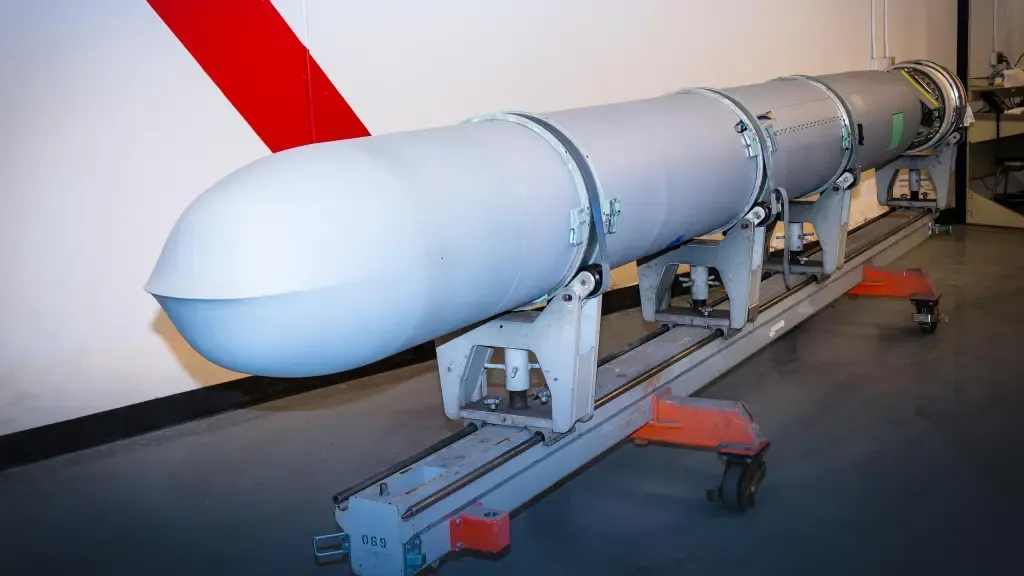
Block V Tomahawk missile, U.S. Navy
There is a reason the Tomahawk is described as a "bridge," a temporary stopgap. Even the U.S. Navy has recently seen Tomahawk stocks depleted so quickly in operations that supply has struggled to keep pace with demand. For Japan, the U.S. system fills the gap until domestic weapons take hold.
The core of that domestic lineup is the Type 12 family. Originally a coastal-defense anti-ship missile with a range of about 200 km, the Type 12 has been upgraded to roughly 1,000 km. In March 2026, the ground-launched version entered service as the Type 25 Surface-to-Ship Guided Missile, or 25SSM, and was deployed at Kengun garrison in Kumamoto. If dispersed across Kyushu and the Nansei Islands on mobile truck launchers, it would put the East China Sea and waters near Taiwan within range. The design aims to offset the vulnerability of fixed bases through mobility and dispersal, making it an answer to the previously noted concern over bases being incapacitated. From the outset, the family was designed as a multi-platform weapon with land, sea and air launch modes. The sea-launched and air-launched versions are scheduled for deployment in fiscal 2027.
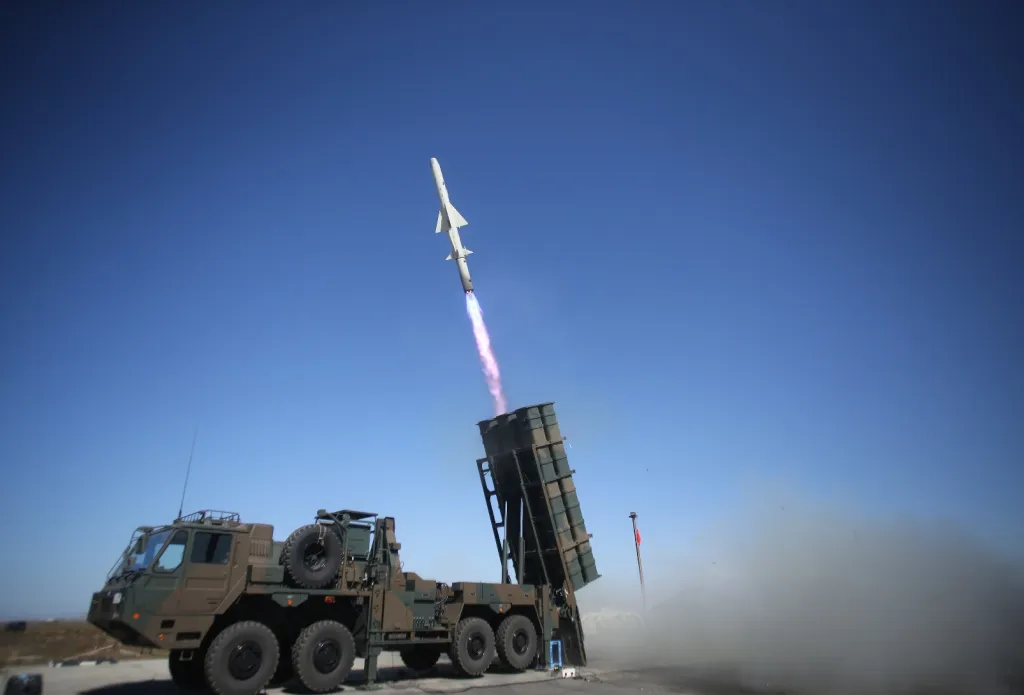
Type 12 missile launch, Japan Ministry of Defense
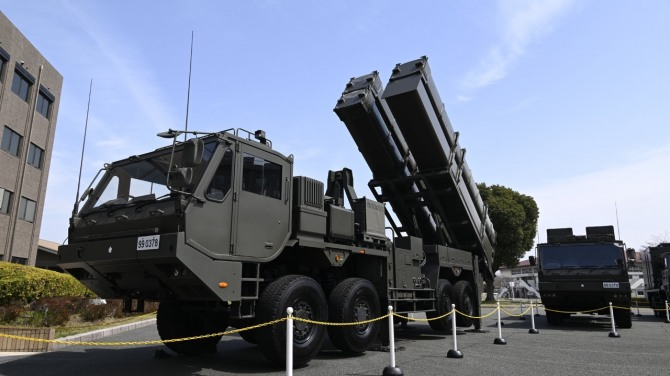
Type 25 surface-to-ship missile truck launcher, Japan Ministry of Defense
The missile carried by the F-2 on July 30 is believed to be that air-launched version. During development, it was known as the "upgraded Type 12 Surface-to-Ship Guided Missile, Air-Launched Variant (ALV)," and its official service name has not yet been finalized. Observers say the missile, unlike the land and sea variants, does not have a booster, and because it is air-launched its range may actually be longer. It is reported to combine GPS and inertial navigation with terrain-reference guidance and network-based targeting information, and to feature a low-observable design. Still, this flight was only an early-stage test to check flight characteristics with the missile attached. Separation trials and live firing have yet to come.
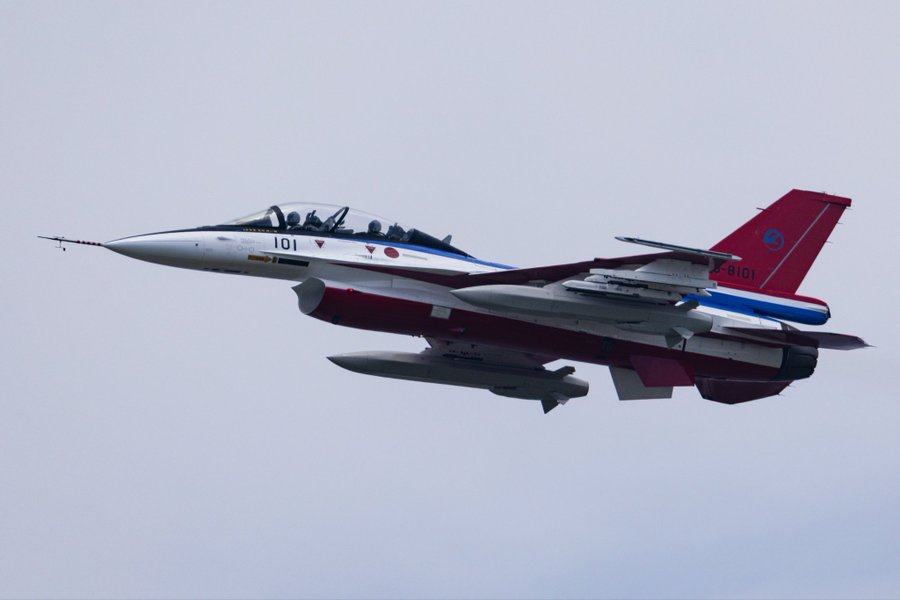
F-2B during training, X
Several more layers are added on top of that. They include an upgraded supersonic ASM-3 to replace existing anti-ship missiles, a new anti-ship guided missile with a turbofan engine and terminal evasive maneuvers, the stealth Joint Strike Missile, or JSM, carried by the F-35, the long-range JASSM approved for the F-15, and even a hypersonic glide weapon. It is not any one system by itself, but the overlapping net they create that defines the layered arsenal Japan is seeking.
■ So what about South Korea? Same goal, opposite path
Set Japan's arsenal alongside South Korea's, and an interesting contrast emerges.
South Korea, too, has long been building up long-range strike capabilities. The Hyunmoo-3 cruise missile family has ranges of 500 km for the 3A, 1,000 km for the 3B and 1,500 km for the 3C, forming the core of the Kill Chain and Korea Massive Punishment and Retaliation (KMPR). In addition, the Hyunmoo-5 bunker-buster ballistic missile, which carries a warhead of up to 8 to 9 tons, has been operationally deployed to frontline units since January 2026. The three-axis system, made up of the preemptive-strike Kill Chain, the retaliatory KMPR and the defensive Korean Air and Missile Defense (KAMD), is the doctrine that directly counters Japan's counterattack capability.
The difference lies not in the weapons themselves, but in the path to acquiring them. Japan has placed greater weight on importing finished systems from abroad. It is buying Tomahawks and JASSMs from the United States and JSMs from Norway, and the U.S. Navy supported the entire process for Joukai, from its modification and crew certification to its first live-fire test. In addition, in March 2026 the United States formally ended the dual-hatted arrangement under which the commander of U.S. Forces Japan also served as commander of the Fifth Air Force, a setup that had been maintained for more than 60 years since 1957. The move was intended to elevate U.S. Forces Japan from a liaison-centered organization into an integrated military command that would mesh with Japan's newly established Joint Operations Command, further deepening U.S.-Japan operational integration.
South Korea, by contrast, has never acquired Tomahawks. In 2013, after the United States did not approve the sale of JASSM, Seoul turned instead to the European-made Taurus. South Korea thus took the path of localization, and one overseas research institute even assessed that South Korea's missile force may be "the most underestimated" weapon in Asia. In other words, the two countries reached the same goal of standoff strike capability by taking completely opposite paths.
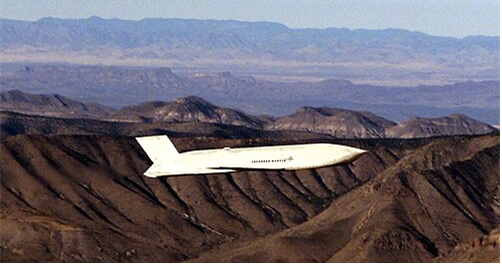
AGM-158 JASSM, U.S. Air Force
This contrast goes beyond a simple difference in procurement methods and extends to the question of security sovereignty. As Japan's counterattack capability expands, South Korea faces two tasks at once. One is to strengthen South Korea-U.S.-Japan intelligence-sharing and warning cooperation in response to the advancing North Korean missile threat. The other is to build a framework for mutual transparency and prior consultation so that Japan's long-range strike capability does not conflict with South Korea's security sovereignty. Discussions over UNC rear bases and a South Korea-Japan Acquisition and Cross-Servicing Agreement (ACSA) turn on this point. A South Korean maritime security research institute has projected that the Maritime Self-Defense Force, once equipped with counterattack capability, will operate more actively around the Korean Peninsula and in Asia-Pacific waters.
North Korea is exploiting this trend to its advantage. It uses Japan's military buildup as a pretext to claim legitimacy for its own missile development, and it heightens tensions by casting South Korea-U.S.-Japan security cooperation as the formation of a military alliance. It is a vicious cycle in which one side's defensive measures become the other side's justification for a military buildup. Underlying that tension is the geographic reality that 1,000-km-class missiles based in Kyushu and the Nansei Islands can reach parts of the Korean Peninsula, while South Korea's Hyunmoo-3B also has overlapping range. Of course, both countries officially present deterrence against North Korea and China as their rationale.
■ Conclusion
The two scenes disclosed side by side on July 30 were no coincidence. The Tomahawk as a bridge and the indigenous stealth missile as the core system appeared at the same time on the same roadmap. Japan's arsenal, moving beyond exclusive self-defense, is now being built up in layers across land, sea and air, and that shift is redrawing the Korean Peninsula's security landscape into a multilateral long-range strike equation.
There are three points to watch going forward. First, whether the sea- and air-launched 25SSM will formally enter service in fiscal 2027. Second, what official name will ultimately be given to the missile carried by the F-2. Third, how far additional Aegis ship modifications and South Korea-Japan security cooperation will go. The two pieces revealed in a single day are only part of a bigger picture that is still being assembled.