U.S. defense company Shield AI unveils first full-scale prototype of X-BAT VTOL stealth combat drone
Vertical takeoff and landing by jet-engine thrust; U.S. Navy and DIU back development with $200 million, first flight test planned this year
Aims to operate fighter-class drones without aircraft carriers; mass production planned for 2029
Published
Updated
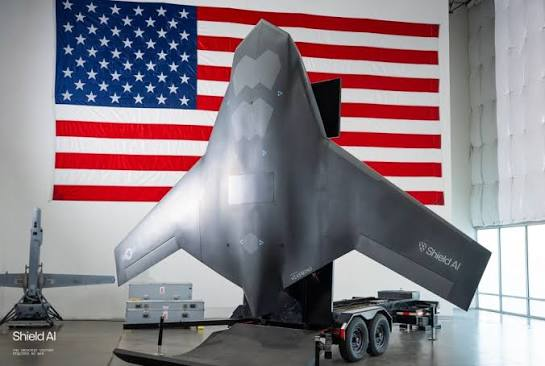
U.S. defense company Shield AI has unveiled the first full-scale prototype of X-BAT, a next-generation stealth unmanned combat aircraft that combines AI autonomous flight with vertical takeoff and landing capabilities. Roughly a year after outlining the development concept last October, the fighter-class jet-powered drone, designed to operate without a runway, is now nearing its first flight tests. With the U.S. Navy supporting technology development for dispersed air operations in the Indo-Pacific, the project has also drawn attention to the possibility of future operations from ships and forward island areas.
Shield AI released a roughly 30-second video on its official YouTube account on the 3rd, local time, showing the appearance of its first prototype, X-BAT 001. In a statement the following day, Armor Harris, senior vice president for aircraft engineering at Shield AI, said the prototype had been completed at the company's development facility in Frisco, Texas, and was being moved to a flight-test site in Newton, Kansas. The aircraft is the first of two full-scale prototypes planned in the development process, and Shield AI aims to conduct its first flight test later this year.
The full-scale prototype looks markedly different from the design first shown last year. The main wing, which on the initial model had a leading edge whose sweep changed partway along the wing, has been reshaped into an arrowhead-like form, while the thrust-vectoring exhaust nozzle at the rear now protrudes farther aft beyond the wing. Some of those changes were already reflected in a revised model shown at the Sea-Air-Space 2026 exhibition hosted by the Navy League of the United States this past April. The new video also shows added protrusions on both sides of the upper central fuselage and two circular openings fitted with mesh-like covers, but the specific functions of those structures were not disclosed.
The War Zone (TWZ), a U.S. military news outlet, assessed that the aircraft's shape appears to incorporate stealth features intended to reduce radar cross section, but said it remains uncertain whether the exhaust nozzle fitted to the current prototype will be retained on the final production version. In fighter development, it is common to modify parts of the airframe shape and propulsion system after evaluating a prototype's flight characteristics, and Shield AI also plans to continue refining the design based on test results. No test results have yet been released demonstrating its actual radar cross section or its ability to penetrate enemy air-defense networks.
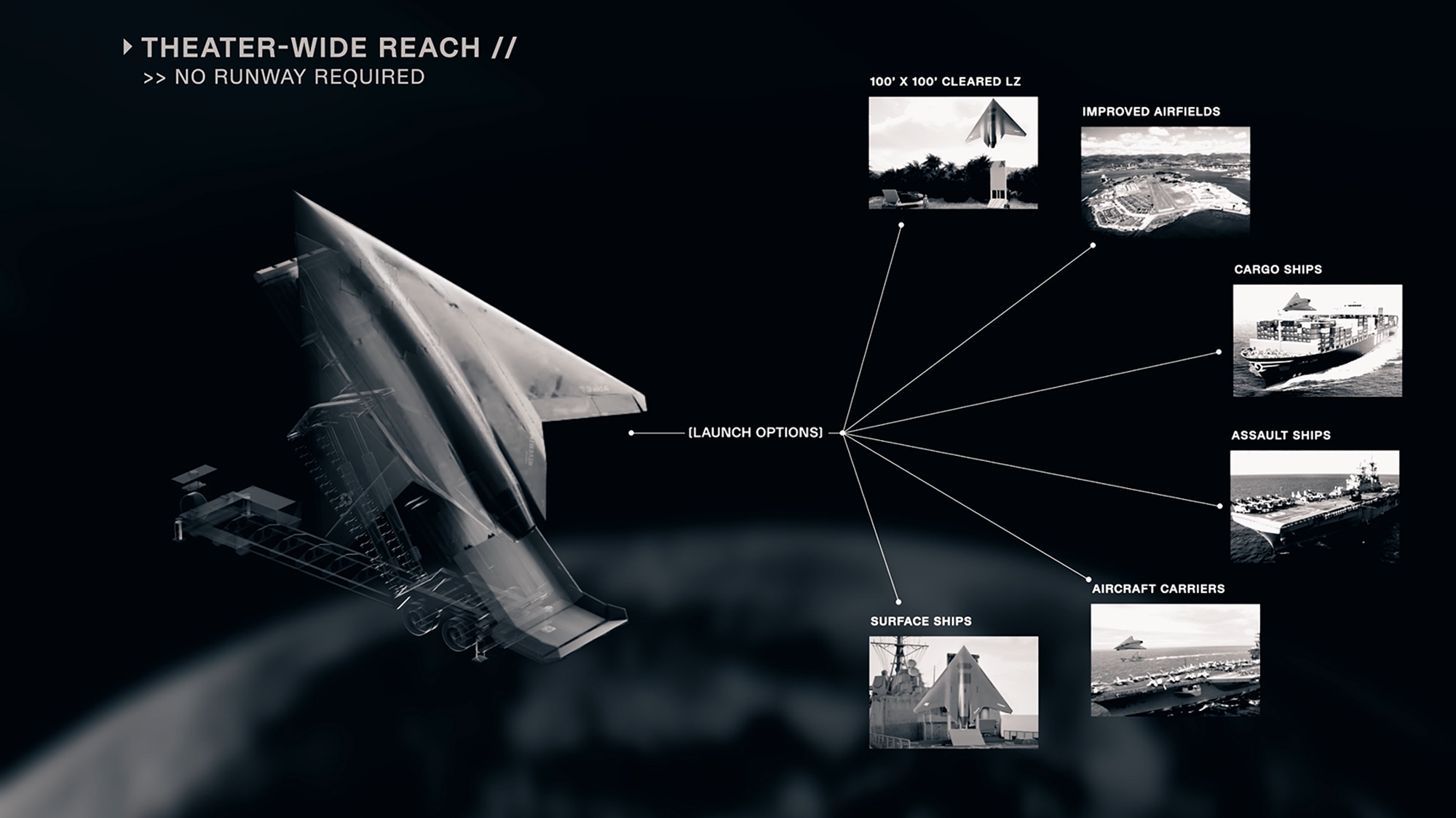
X-BAT's defining feature is its tail-sitter configuration, in which a jet engine lifts the aircraft vertically and lands it the same way. It rises on engine thrust with the nose pointed skyward, then transitions to level flight and flies on lift generated by its wings like a conventional fighter. For landing, the aircraft pitches back upright and descends vertically, eliminating the need for a conventional runway or other long takeoff and landing facilities. Shield AI is developing X-BAT so it can operate from mobile ground launch-and-recovery equipment and ship decks by exploiting those operating characteristics.
Vertical takeoff and landing requires not only a high-output jet engine but also technology to precisely control exhaust direction. Working with GE Aerospace, Shield AI is developing the F110-GE-129E propulsion system based on the F110 engine family used in aircraft such as the F-16 and F-15, and has integrated an axisymmetric vectoring exhaust nozzle (AVEN). The two companies completed engine-nozzle integration and ignition tests at a GE test facility in Peebles, Ohio, this past July. By controlling the direction of exhaust flow, the technology manages the aircraft's attitude and plays a critical role in maintaining stability when the aircraft is upright and transitioning to horizontal flight.
Shield AI says X-BAT is designed for a maximum range of at least 2,000 nautical miles (about 3,700 km), an operating altitude of at least 50,000 feet (about 15.2 km) and a wingspan of about 11.9 meters. It is designed to carry air-to-air and air-to-ground weapons in an internal weapons bay and on external hardpoints, and to perform intelligence, surveillance and reconnaissance (ISR) and electronic warfare missions. However, those figures are development goals presented by the manufacturer, not performance verified through actual flight tests. Future testing will also need to determine how fuel consumed during vertical takeoff and landing and weapon payload affect range and mission endurance.
X-BAT uses Shield AI's Hivemind software for autonomous flight. Shield AI is developing the system so aircraft can fly and carry out missions on their own even when satellite-navigation signals or external communications are cut off, and is also pursuing functions that allow multiple unmanned aircraft to share information and operate collaboratively. The company has already developed autonomous-flight technology through platforms including the V-BAT vertical takeoff and landing reconnaissance drone, and plans to expand it to a fighter-class jet-powered aircraft with X-BAT.
The U.S. Navy's support for X-BAT development reflects changes in the military operating environment in the Indo-Pacific. As China's long-range precision-strike capabilities have expanded, the possibility has grown that major U.S. air bases and runways in the Western Pacific could come under attack in a contingency, and the U.S. military is bolstering its ability to operate airpower in a dispersed manner to complement its existing deployment model, which concentrates air assets at a small number of large bases. In particular, if fighter-class airpower can be operated from forward island areas or small ships without relying on aircraft carriers, that would expand the options for sustaining air operations even when enemy attacks limit the use of existing bases.
Shield AI has proposed deploying X-BAT on amphibious assault ships and expeditionary sea bases. According to the company, up to three X-BATs can be placed in the deck space occupied by one conventional fighter or helicopter. The concept is to complement carrier-based airpower while providing reconnaissance and strike capabilities to Marines or Navy forces deployed forward, with the goal of dispersing long-range unmanned aircraft across multiple ships and island areas.
To support this, the U.S. Navy is pursuing the Runway Independent Maritime Expeditionary Strike (RIMES) program. In August, the Department of the Navy Rapid Capabilities Office (DON RCO) and the Navy's aviation acquisition organization, working with the Defense Innovation Unit (DIU), announced $50 million in support for X-BAT development. In October, they added another $150 million using Defense Department funds. With Shield AI also committing $200 million of its own money, total announced development investment now stands at $400 million.
RIMES is distinct from the U.S. Navy's separate carrier-based Collaborative Combat Aircraft (CCA) program. Rather than developing unmanned aircraft to support manned fighters from aircraft carriers, it focuses on acquiring long-range maritime strike capability that does not rely on runways. Alongside airframe development, Shield AI is also working on integrating weapons and sensor systems. Last month, it was reported that Raytheon's advanced technology unit under RTX plans to supply radar and electronic warfare equipment for X-BAT.
Flight tests following the unveiling of the full-scale prototype are set to focus on verifying X-BAT's core technologies: stability in vertical flight and its ability to transition between flight attitudes. The company plans to first check the engine and attitude-control functions on the ground, then test the propulsion system with the aircraft standing upright before suspending it from a large crane to assess attitude-control performance. It will then move on to takeoffs and landings without external support equipment and verify transitions between vertical and horizontal flight. For shipboard operations, it must also secure stable takeoffs and landings in confined deck space and the ability to control the aircraft in maritime conditions.
Senior Vice President Armor Harris said building this prototype was a major milestone in the development process and that the next step is to prove the vertical takeoff and landing technology in actual flight. Shield AI aims to conduct its first flight test this year, carry out test flights in 2028 with an aircraft equipped with mission equipment, and begin mass production in 2029. The U.S. Navy's actual procurement and operating schedule will be determined by future flight-test and performance-evaluation results, as well as the fleet's operational requirements.