Even the financial sector's security agency was breached: hack at Financial Security Institute leaks internal data
Leak confirmed on the 9th and reported to the Financial Services Commission; signs that the information security continuous assessment site was hacked
37 financial firms breached and 470,000 records leaked in a month; even the security agency was hit five days after a full security review was announced
Published
Updated
A hacking incident at the Financial Security Institute, which is responsible for cybersecurity inspections and incident response for Korean financial companies, has led to a data leak. The institute reportedly notified some financial companies that their internal materials had been leaked, and the hacked target is said to have been the support site for continuous assessments of the financial sector's information security levels. After a string of hacking incidents at banks, securities firms and virtual asset exchanges over the past month, the fallout is widening now that even the financial sector's joint security response body has been hit.
According to the financial sector and the security industry on the 10th, the Financial Security Institute confirmed on the previous day, the 9th, that some information had been leaked in a hacking attack and reported it to the Financial Services Commission and other relevant authorities. The target was reportedly the continuous information security assessment site that supports evaluations of financial companies' information security levels, raising the possibility that some of the security-status information submitted by those companies may also have been exposed externally. Dailysecu, a cybersecurity outlet, reported that the institute was notifying the affected companies of the data leak, citing tips from information security officials at financial firms. Yonhap News Agency also reported that afternoon that a data leak caused by a hacking incident had occurred at the Financial Security Institute.
In a chat room used by financial-sector information security officials obtained by Dailysecu, participants shared messages saying they had been contacted by the Financial Security Institute and told that materials from their companies had been leaked. Officials at other financial companies also said they directly contacted the institute's department in charge of continuous assessments and were told that an information security incident had occurred and that the institute was contacting organizations where data leaks had been confirmed. The institute was also reported to have said it planned to provide some financial company officials with guidance related to personal data leaks.
However, the number of financial companies confirmed to have been affected, the specific types of data involved, whether personal information was included and the methods used in the hack have not been disclosed so far. The Financial Security Institute is reported to have confirmed the leak on the 9th and notified the authorities, but it remains unclear when the attacker first penetrated the internal system, the scope of the servers, accounts and databases actually accessed, and the full scale of the leaked data.
The Financial Security Institute's continuous information security assessment support system has also come under scrutiny in connection with the incident. A notice posted on the system's homepage said server operations would be temporarily suspended from 6 p.m. on the 9th until further notice for a service revamp. However, it has not been confirmed whether the system maintenance was a response measure related to the hacking incident, and it has not been disclosed through what specific vulnerability or route the intrusion was carried out.
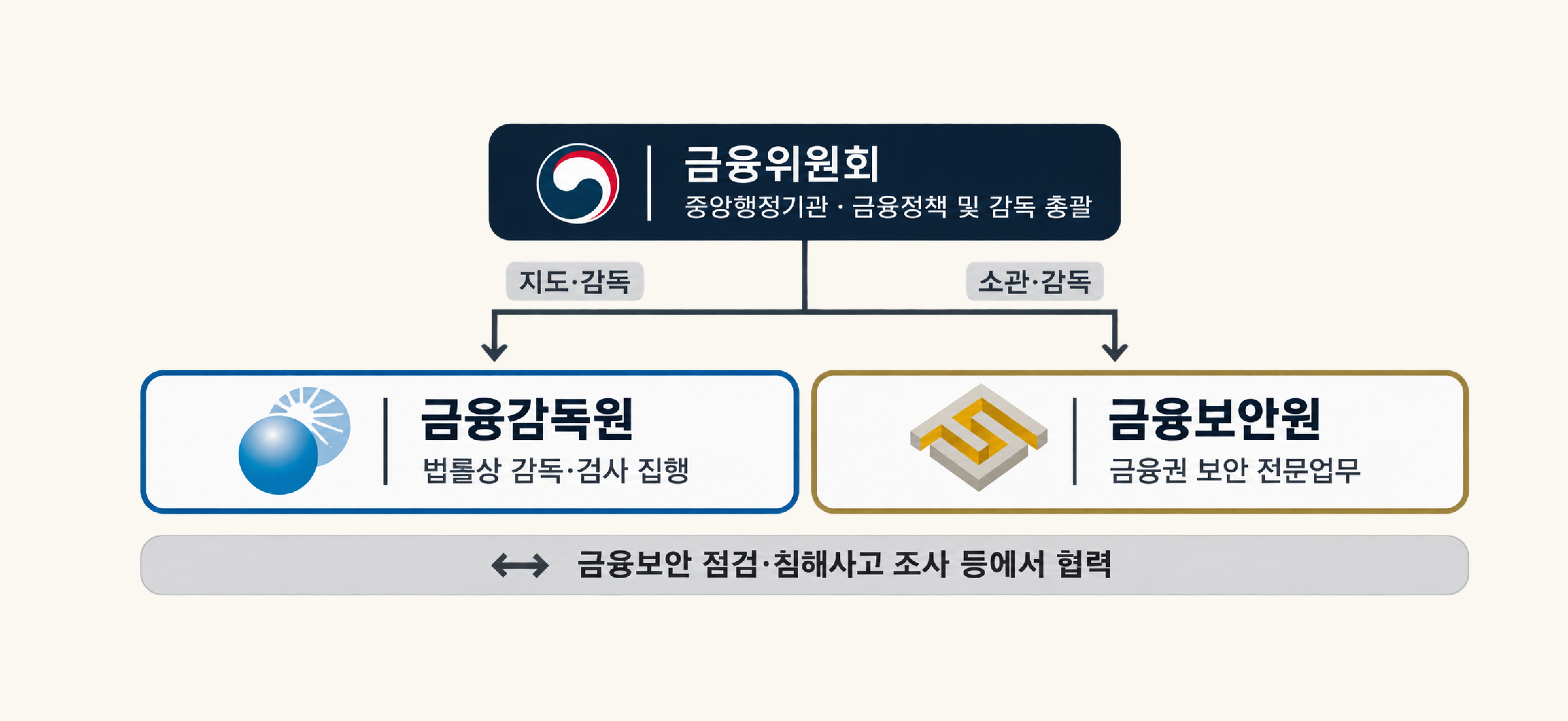
The Financial Security Institute is a specialized financial security agency that checks security vulnerabilities at financial institutions such as banks, securities firms and insurers and detects and analyzes cyberattacks. It handles integrated security monitoring across the financial sector, incident investigations, digital forensics, penetration testing and security assessments. When a security incident occurs at a financial company, it also analyzes the attack route and scope of the damage and shares threat information with other financial companies.
A key issue in this incident is the nature of the continuous information security assessment system operated directly by the Financial Security Institute. In April, the institute announced its 2026 continuous information security assessment plan and began checking how about 3,000 financial companies protect personal credit information. Under the system, which is based on the Credit Information Act, the institute reviews the results of personal information protection inspections carried out by financial companies themselves and passes them to the Financial Services Commission. The assessment results are also used in inspections by financial authorities.
Assessment items include the use, retention and deletion of personal credit information, management of access rights and access logs, encryption of personal information, monitoring of abnormal activity, security vulnerability checks, intrusion detection and blocking, and antivirus management. In particular, this year the institute decided to tighten the criteria for eight items to reflect recent security incidents in the financial sector and to conduct pilot on-site inspections of some financial companies. It is also pushing a plan to make penetration testing a formal assessment item starting next year.
The assessment process involves reviewing financial companies' internal information security systems and the status of their security controls. If an attacker obtained detailed security settings or vulnerability-related materials for each company, that information could potentially be used to identify security weak points at specific financial institutions. However, it has not been confirmed whether the data actually leaked so far included such information, nor does it mean that all roughly 3,000 financial companies subject to the continuous assessment suffered data leaks.
The financial sector has been hit by large-scale cyberattacks and data leaks since late September. According to data released by the Financial Services Commission on the 5th, a total of 40 cyber incidents were reported at 37 companies, including banks, securities firms, insurers, savings banks, electronic financial services firms and virtual asset businesses, between Sept. 30 and Nov. 3. In those incidents, about 473,000 records were leaked, and about 1 billion won in company funds was stolen from some virtual asset exchanges and electronic financial firms. Financial authorities said at the time that no cases had been confirmed in which individual users actually suffered losses of funds.
As these attacks spread, the Financial Security Institute's role in responding to cyber threats had become even more important. At a security seminar for financial companies this past September, the institute introduced a case in which artificial intelligence, or AI, agents were used to probe vulnerabilities in internet-exposed servers and web applications and then breach them. The attacker was analyzed at the time to have used AI to search for vulnerable servers and then exploited a remote-command execution vulnerability to install malicious programs. The institute had emphasized that regular diagnostics conducted only once or twice a year are not enough to respond adequately to such attacks and that internet-exposed assets must be checked on an ongoing basis.
However, it has not been confirmed whether this Financial Security Institute incident was carried out by the same attacker behind the recent AI-based hacking targeting the financial sector or whether the same vulnerability was used. No information has yet been made public that would allow a judgment on the nationality of the attacker or any links to a specific hacking group.
Five days before this incident became known, on the 5th, financial authorities held an 'all-financial-sector roundtable on innovating security systems in the AI era' at the Financial Security Institute's Yeouido branch and announced measures for a sweeping overhaul of the financial sector's security framework. The Financial Services Commission said it would conduct full inspections of the external-facing systems and internal control operations of about 580 financial companies and related service providers, and expand the cycle for vulnerability analysis and assessment at large financial companies to at least twice a year. It is also pursuing a plan to impose corrective orders and enforcement fines if critical security vulnerabilities are left unaddressed for long periods.
The framework for sharing attack information among financial companies will also be strengthened. Financial authorities said they would upgrade the joint security monitoring system so each financial company can quickly share the attack methods it has detected on its own, attacker IP addresses, exploited vulnerabilities and malware information, and make it available across the entire financial sector from the first quarter of next year. Small and mid-sized financial companies will be provided with the Financial Security Institute's AI-based vulnerability scanning and response support services.
The Financial Security Institute is also scheduled to host FISCON 2026, the financial sector's information security conference, in Yeouido, Seoul, on the 12th. The event will bring together chief executives and chief information security officers from major financial companies to discuss AI-based cyber threats and shifts in security systems. With this data leak now confirmed, it is likely to draw greater attention to the institute's own security management and response system as well.
The exact impact of this incident could vary depending on which parts of the systems managed by the Financial Security Institute were actually breached, what type of material the attacker obtained and how many financial companies were notified that their information had been leaked. In particular, because data leaked from an institution that checks each financial company's information security practices, it has become more important both to identify the cause of the incident and to verify how access rights to the relevant material were managed and whether there was external compromise. Additional response measures are expected to be determined based on the Financial Security Institute's official investigation and its announcement of the scale of the damage.