North Korea said "No soot means fake," but thermal protection principles point the other way
North Korea says 1,000 km, while South Korea and Japan put it at around 700 km. The inter-Korean hypersonic competition has shifted from speed to a dispute over numbers and "soot."
강병지
Published
Updated
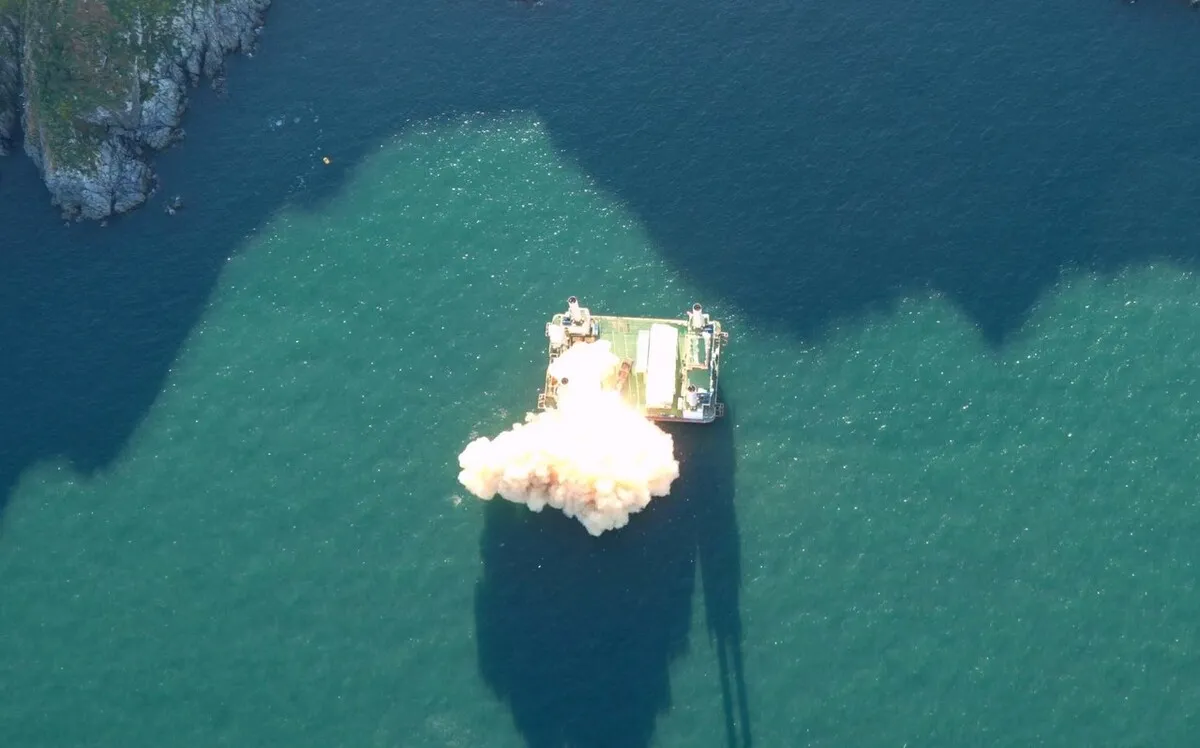
In the early hours of Oct. 3 off the coast of Wonsan, Kangwon Province, a missile rose into the East Sea from a mobile launcher as Kim Jong Un, chairman of the State Affairs Commission, looked on. On Oct. 8, at the Anheung test site of the Agency for Defense Development in Taean, South Chungcheong Province, the first hypersonic glide vehicle (HGV) developed by South Korea lifted off from a launcher mounted on a barge at sea under President Lee Jae-myung's observation. The leaders of the two Koreas watched tests of their respective "hypersonic" weapons five days apart.
The two tests had one more thing in common. Neither side fully disclosed key figures such as speed and range. The gap left by the missing numbers was filled with remarks belittling the other side's results. Within two weeks, both sides publicly cast doubt on each other's hypersonic weapons. The inter-Korean hypersonic competition is shifting from "who is faster" to "whose numbers can be trusted."
■ 1,000 km and 700 km
South Korea's Joint Chiefs of Staff said a ballistic missile launched from the Wonsan area at around 6:30 a.m. on Oct. 3 flew at least 700 km. Japan's Defense Ministry estimated a maximum altitude of about 90 km and a flight distance of about 680 km. The next day, North Korean state media claimed the "intermediate-range strategic missile" hit a target 1,000 km away and published the coordinates. Based on the released photos, analysts said it appeared to be a cone-shaped warhead mounted on a solid-fuel hypersonic missile in the Hwasong-16na family.
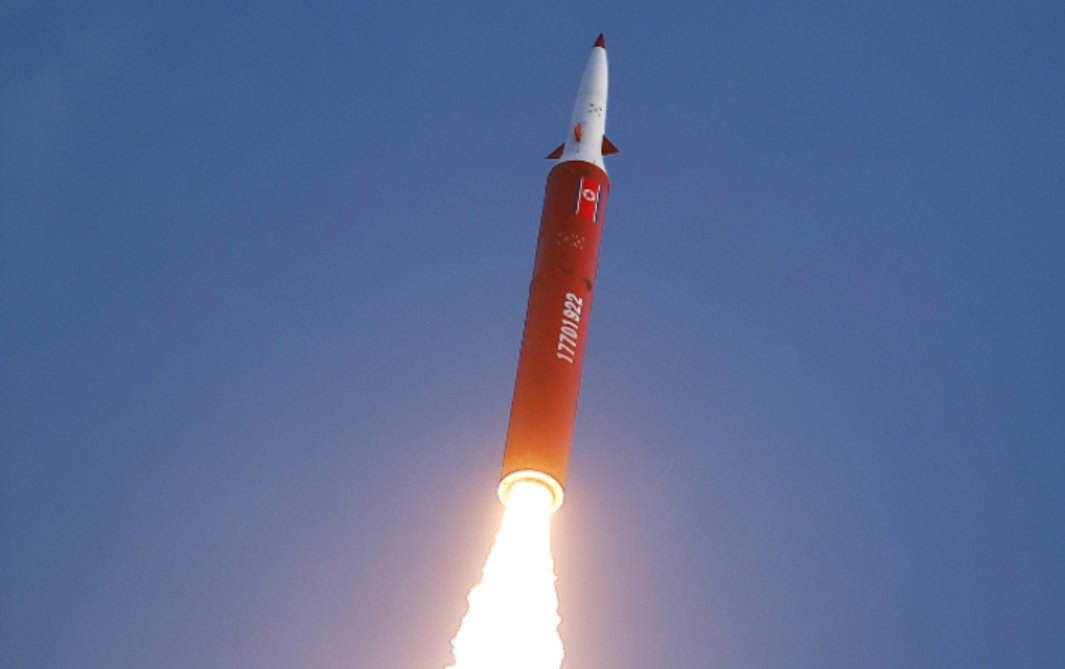
Against that roughly 300 km gap, Kim Yo Jong, director of the General Affairs Department of the Workers' Party of Korea, said in a statement on launch day that South Korea and Japan had lost track of the target after the first skip point because a "wave-like flight trajectory" had been used. In a statement on the 4th, South Korea's Defense Ministry said it had monitored North Korea's recent successive missile launches from the preparation stage and accurately identified the launch site, adding that the missile was at a level that could be sufficiently detected and intercepted by South Korean and U.S. defense assets. North Korea did not disclose the speed or apogee this time. That differed from the January 2025 launch, when it touted a speed of Mach 12.
■ South Korea's first glide vehicle: what was disclosed and what was not
The presidential office said on the 8th that the HGV climbed to its target altitude, separated from its booster and struck the designated target after an irregular glide involving vertical and horizontal course changes. It said the test was intended to verify the performance of ultra-high-temperature heat-resistant materials, guidance and control capability, and irregular low-altitude flight capability. Lee said the country must secure its own security through its own strength and pledged support for rapid development and operational deployment.
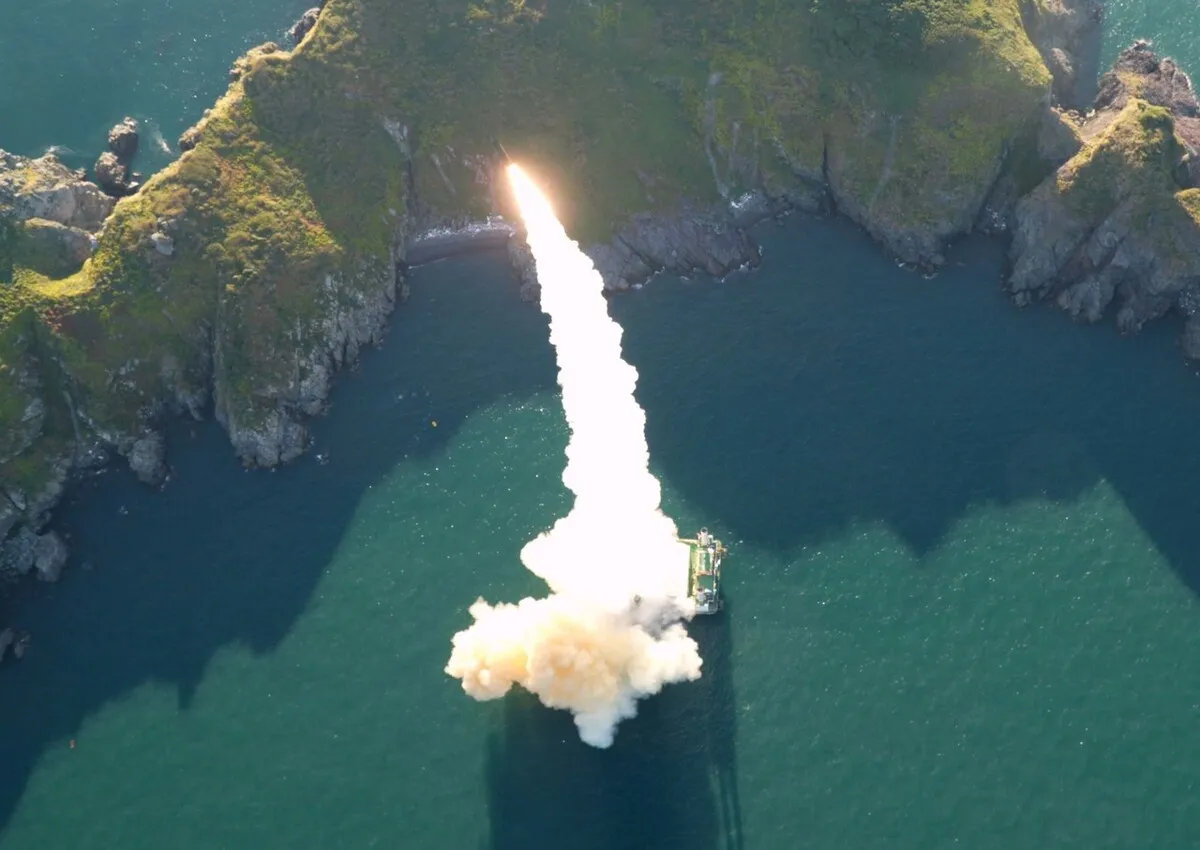
Much also went undisclosed. Its speed, range, maximum altitude and system designation were not announced. There were reports that its range was several hundred kilometers, but that is not an officially confirmed figure. Development had been carried out in secret by the Agency for Defense Development, and this test marked its first official acknowledgment. Lee also inspected the high-power ballistic missile Hyunmoo-5 that day.
The presidential office statement did not mention North Korea. Although it came five days after the North's launch, the government did not link the two tests. In South Korea, many analysts viewed it as a deterrent message to North Korea after a Sept. 21 mine blast in the western section of the Demilitarized Zone (DMZ) injured three service members. But given the multi-year development schedule, the possibility that the test date had been set in advance cannot be ruled out.
■ North Korea's counterattack: the "soot" dispute
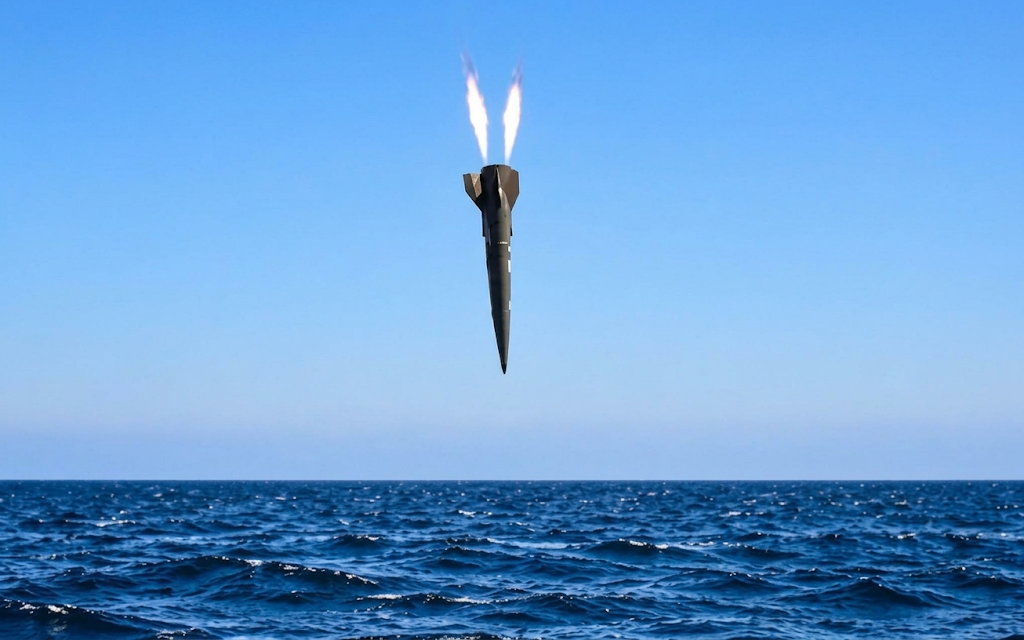
A week later, North Korea hit back. In a KCNA question-and-answer published on the 15th, Jang Chang Ha, director of North Korea's Missile General Bureau, argued that the glide vehicle in photos released by the presidential office had no soot on its exterior and its paint looked clean, suggesting it may not have achieved hypersonic flight. The Defense Ministry rebutted on the 16th that the vehicle had been designed around domestically developed heat-resistant materials and achieved soot-free thermal protection even in a hypersonic environment. Kim Jong Sik, first vice department director of the Workers' Party of Korea's Munitions Industry Department, then issued a statement that night, dismissing the ministry's explanation as "an excuse lacking scientific explanation" and saying no country's technology can prevent paint from burning as surface temperatures rise.
Until now, it had mainly been South Korea that questioned the performance of the other side's missiles. This time, North Korea challenged the performance of a South Korean weapon. Hong Min, a senior research fellow at the Korea Institute for National Unification, said North Korea appeared to be trying to justify its own weapons development by presenting it as a two-sided situation in which South Korea also develops threatening weapons.
■ Is "no soot" evidence of failure?
North Korea's claim warrants technical scrutiny. A vehicle flying through the atmosphere at hypersonic speed is exposed to ultra-high surface temperatures because of air compression and friction. At Mach 5, surface temperatures can exceed 1,500 degrees Celsius. There are broadly two ways to block that heat.
One is an ablative system. When materials such as carbon fiber coated with phenolic resin decompose under heat, the gases they release push the hot air layer away from the surface, while the material is gradually worn away, leaving behind a carbon-rich char layer. Researchers at the U.S. National Aeronautics and Space Administration (NASA) explain that as this char layer continues to be heated, it oxidizes or flakes off, causing the surface to recede. Blackened burn marks on the exterior mainly appear with this approach.
The other is a non-ablative system that does not burn away. Ceramic composites or glassy coatings withstand the heat. A representative example is the U.S. space shuttle. To make it reusable, it used a non-consumable thermal protection system. The black tiles rated to 1,260 degrees and the white tiles used in areas at 649 degrees or below were silica fibers with a glassy coating. On the hottest nose and wing leading edges, it used carbon-carbon composites coated with silicon carbide, rated at about 1,510 degrees. Such materials may oxidize and change color at high temperatures, but that is different in nature from soot produced when resin burns.
For HGVs, non-ablative systems are especially advantageous. Unlike a ballistic missile warhead, which is heated during a relatively short reentry phase, an HGV must glide through the atmosphere for an extended period, continuously exposed to high temperatures while changing course. If the front portion erodes or oxidizes and its shape changes, aerodynamic characteristics also change, undermining maneuverability and accuracy. If, as the Defense Ministry says, it used heat-resistant materials that do not burn, the absence of soot is less a sign of failure than a result consistent with the design intent.
Seen that way, North Korea's logic that the absence of soot means there was no hypersonic flight is hard to sustain. Kim Jong Sik's claim that no country's technology can prevent paint from burning as surface temperatures rise may hold for ordinary organic coatings, but it does not fit thermal protection materials whose outer surface is itself ceramic or glass-coated. There is also the case of the European Space Agency's IXV reentry test vehicle. Researchers at the thermal protection supplier reported that non-burning ceramic-composite thermal protection material showed "excellent behavior" in the 2015 flight.
There is also substantial groundwork supporting the possibility that South Korea has secured such materials. The Defense Ministry said only that they were "domestically developed heat-resistant materials," but according to a 2024 paper by researchers at the Institute for Defense Technology Planning and Advancement, defense projects are underway including "Development of highly heat-resistant and electromagnetic-control composite materials for hypersonic vehicles" (2022-2027) and "Manufacturing technology for highly heat-resistant coatings and composites for application to key components of high-speed vehicles" (2023-2028). Civilian research has also accumulated. According to a 2022 review by researchers at the Korea Institute of Materials Science, zirconium- and hafnium-based ultra-high-temperature ceramics withstand oxidation even above 1,800 degrees. The institute has researched reentry thermal protection systems with the Korea Aerospace Research Institute and ultra-high-temperature ceramic coatings with Jeonbuk National University.
There is flight experience as well. Hycore, a hypersonic core-technology project carried out by the Agency for Defense Development from October 2018 to June 2024, recorded a top speed of Mach 6 and an altitude of 23 km in flight tests. That means South Korea already has experience launching a hypersonic vehicle and taking measurements from it. Because ballistic missile warheads must also withstand intense heat during reentry, capabilities built up while developing the Hyunmoo series are also likely to have served as a foundation. Experts also lean toward the view that the technology has been secured. Park Jong-seung, former head of the Agency for Defense Development and a chair professor at Korea Aerospace University, said in a media interview on the 13th, "The technology should be regarded as secured," calling it the result of long-term research on glide-vehicle shapes and the development of key technologies. Choi Ki-il, a professor in the Department of Military Studies at Sangji University and head of the Korea Defense Industry Research Institute, also said there appear to be no technical hurdles at present.
Overseas cases show how difficult this technology is. The U.S. Defense Advanced Research Projects Agency's hypersonic glide test vehicle HTV-2 crashed after about three minutes of controlled flight at Mach 20 during its second flight in 2011. DARPA cited "unexpected skin degradation," in which a larger-than-expected area of the outer skin peeled away from the airframe structure. A U.S. military outlet reported, alongside the released photos, that the South Korean glide vehicle was reported to have remained intact until the moment of impact. That suggests there was no in-flight skin damage of the sort seen in HTV-2.
Of course, the absence of soot alone does not prove hypersonic flight. Shin Jong-woo, secretary general of the Korea Defense and Security Forum, said it is common for soot to form on a glide vehicle during hypersonic flight. But he said the photos released by the presidential office were too low in resolution to make out soot or paint color, and viewed North Korea's claim as a stretch. The speed at the moment the photos were taken was also not disclosed.
■ What the shape and the way it was disclosed suggest
Soot is not the only clue visible in the photos. First is the shape of the glide vehicle. Hypersonic glide vehicles broadly fall into two types: wedge-shaped and conical. A conical design is axisymmetric, making design and thermal analysis relatively simple, but it sacrifices glide range and maneuverability. The U.S. Army and Navy also chose a conical shape for their common glide vehicle and deferred wedge-shaped development in order to speed deployment. The HTV-2 mentioned earlier was also wedge-shaped. A wedge shape, with a flat underside, generates more lift, allowing it to glide farther and making it better suited to irregular maneuvers such as pulling up or veering sideways. But because its upper and lower surfaces are asymmetric, it is harder to calculate airflow and heat distribution and to control attitude.
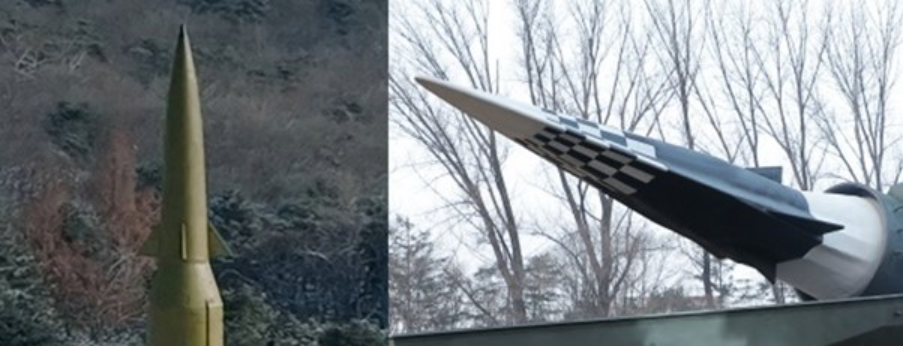
North Korea's trajectory illustrates that difficulty. What it first mounted on the Hwasong-8 in September 2021 was wedge-shaped. The speed detected at the time by South Korean and U.S. intelligence authorities was reported to be around Mach 3, and the Joint Chiefs of Staff assessed it as being in an early stage of development. In two tests in January the following year, a little more than three months later, North Korea mounted a conical body on a scaled-down Hwasong-12 booster. After the first test, the Defense Ministry said the warhead shape was not suitable for gliding and assessed it as a maneuverable reentry vehicle (MaRV). The same pattern was repeated with a solid-fuel intermediate-range missile. After first testing a conical type in January 2024, North Korea mounted a wedge-shaped body on the Hwasong-16na in April that year and on a missile of the same family in January 2025. But U.S. analysts of North Korean missiles said they could not confirm the success of a wedge-shaped glide vehicle in either case. And the launch on the 3rd was analyzed as having again used a conical warhead. North Korea has not abandoned the wedge shape altogether, given that it used one on the short-range Hwasongpo-11ma-1 tested on Sept. 20. But the return to a conical design for an intermediate-range system suggests the wedge-shaped version may not yet have reached the level needed for operational deployment.
The shape of South Korea's glide vehicle is not certain, because the released photos are low-resolution. The U.S. outlet cited earlier said it looked at first glance like a conical type with stabilizing fins, but could also be a wedge-shaped design with distinct upper and lower surfaces. In South Korea, some analysts said it could be a biconic design, with different cone angles front and rear. If it is wedge-shaped, South Korea chose the more difficult design from its first test. If it is conical, it followed a lower-risk path like the United States.
Some assessments say the way the test was disclosed suggests development is nearing its final stage. Professor Choi Gi-il described the launch as being at "almost the final stage" of development and, citing the president's personal attendance, said operational deployment appears imminent. The logic is that the president would not have been invited if the chance of failure had been high. Some also said it was unusual that 50 photos covering the launch through impact were released the next day. The impact sequence included a large photo capturing the moment the vehicle plunged into the water, as well as an image that the same U.S. outlet said appeared to have been taken by an aircraft-mounted camera. Some viewed the fact that a camera aimed at the impact area captured the vehicle as evidence that the impact point had been predicted precisely.
Still, that reading has limits. The domestically developed submarine-launched ballistic missile (SLBM) test attended by former President Moon Jae-in in September 2021 was a "final" test launch, but this one was the "first." The president's attendance and the release of photos also overlapped with the goal of sending a message to North Korea. The photos were released after success had been confirmed, and filming the impact area is also part of a test range's normal instrumentation procedures. What the Presidential Office called "preparations complete" also meant that preparations to secure a deterrent capability had been completed. President Lee himself also said it "must be further advanced." Both the shape and the way it was disclosed are only circumstantial clues, not evidence proving performance.
■ The recurring battle over the numbers
This is not the first dispute over the numbers. In April 2024, North Korea claimed the Hwasong-16na flew 1,000 km, but the Joint Chiefs of Staff assessed it at a little over 600 km. In January 2025, North Korea put the figure at 1,500 km, but the JCS said about 1,100 km and raised the possibility of deception. In the Sept. 20 test of the new Hwasongpo-11ma-1, North Korea displayed 908.2 km on footage it released, but the South Korean military assessed the two missiles' flight ranges at 450 km and 600 km, respectively. On Oct. 12, four days after South Korea's HGV test, North Korea also fired several ballistic missiles into the East Sea from the Pyongyang area, and the JCS said they flew at least 900 km.
Until now, the exchanges had largely run in one direction: South Korea questioning North Korea's claims. This time, it also ran the other way.
■ An asymmetrical exchange
The two sides' claims cannot be weighed equally. South Korea's doubts are based on South Korean, U.S. and Japanese radar detections and an independent estimate by Japan's Defense Ministry. North Korea's doubts rest on reading appearances from low-resolution photos, and even that logic does not fit the principles of thermal protection technology. Taking together the publicly available indications and South Korea's domestic technology base, the weight tilts toward South Korea's account. That does not mean there are no verification gaps on South Korea's side. South Korea also did not disclose the HGV's speed or range, making it hard for outsiders to verify performance. The Defense Ministry's explanation of "soot-free thermal protection" is also an assertion that does not identify the material.
The talk of a "five-year gap" also warrants caution. A U.S. military publication said South Korea was five years behind, citing North Korea's first hypersonic glide vehicle test in September 2021 with the Hwasong-8. But that only compares the timing of each side's first test, and the operational level of North Korea's hypersonic weapons has never been externally verified either.
■ Challenges that remain
The two weapons differ in purpose from the outset. North Korea's hypersonic missile is premised on carrying a nuclear warhead, meaning it can tolerate some degree of impact error. Analysts say South Korea, which would use a conventional warhead, needs much higher precision.
There is still a long way to go before fielding. The military says it will move toward fielding after additional tests and evaluations. Some reports said the military authorities aim to deploy it in the early 2030s, but that has not been confirmed in an official announcement. Former Agency for Defense Development chief Park Jong-seung said he expects it would "not take more than four years" to field if development is pursued intensively. That assumes repeated flight tests to verify and optimize performance.
There are challenges on the defense side as well. The military is developing a high-altitude interceptor for the L-SAM-II long-range surface-to-air missile system, with the goal of completing a prototype in 2028. An interceptor capable of hitting North Korean hypersonic weapons during the glide phase is technically difficult, so its propulsion method has been reviewed separately from the high-altitude interceptor. Two things will bear watching: how much data South Korea discloses in additional tests, and whether the Joint Chiefs of Staff releases the results of its detailed analysis of North Korea's Oct. 3 launch.
The two tests, held five days apart, showed that North and South Korea have entered the same weapons race. But in a competition where speed is concealed, what ultimately persuades the other side and the international community is disclosed and verified numbers. The outcome of the soot dispute, too, will be decided not by photos but by data.