Six weeks from empty field to launch site: how fast Russia is preparing for a winter war of attrition
Russia is getting faster at building launch sites than Ukraine is at destroying them. A jet-drone base built in just six weeks is one example.
강병지
Published
Updated
On Aug. 31, only a few vehicles stood in a field in southwestern Russia's Rostov region. Satellite imagery the next morning showed signs that construction had begun. Six weeks later, in mid-October, a facility covering about 126 soccer fields (roughly 0.9 square kilometers) had almost taken shape on the same spot. Eight launch pads and 32 staging areas were in place, and two of the pads on the western edge already had rails installed. Rail work was well underway on two others.
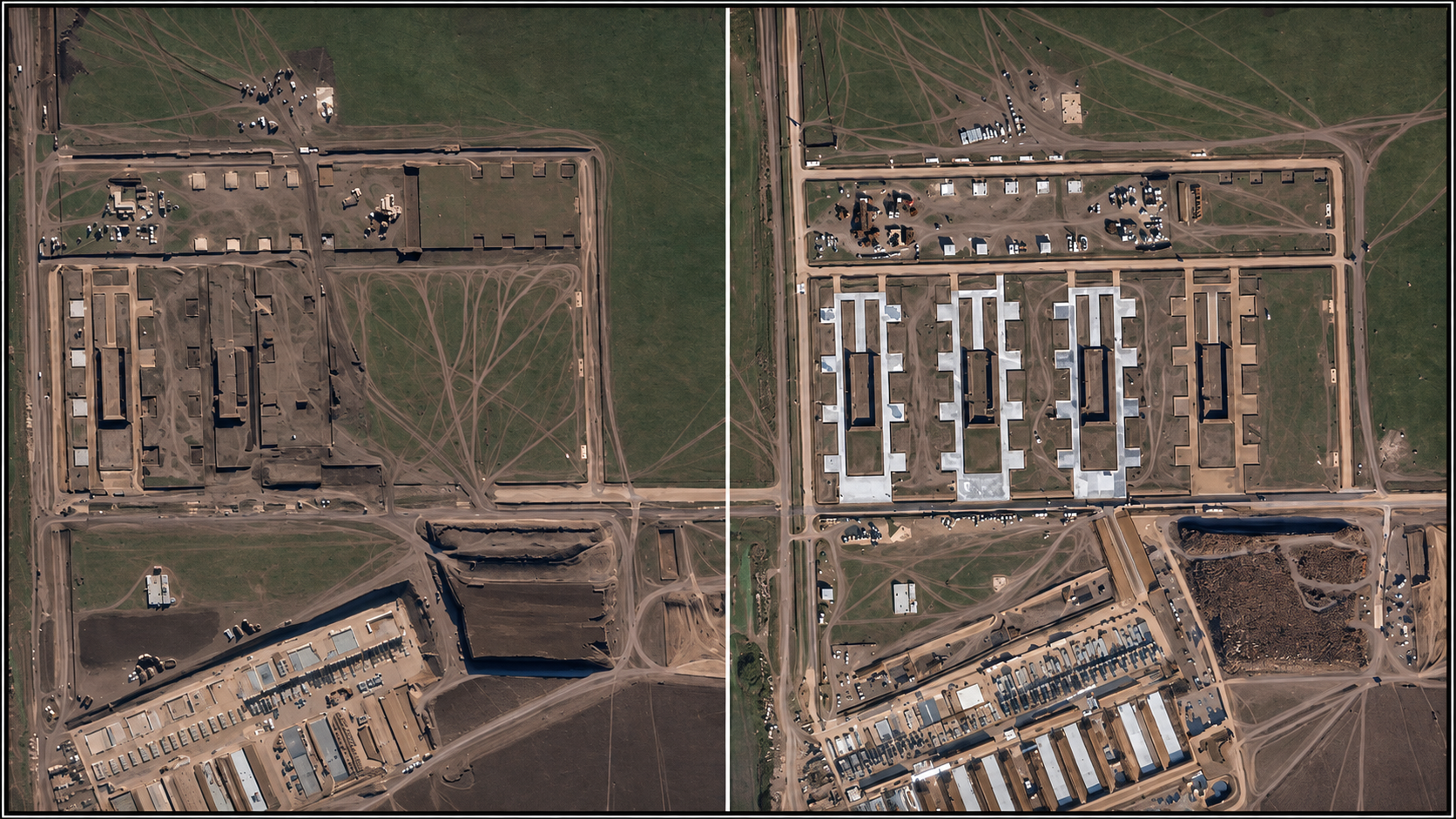
The facility is about 3.5 kilometers from Millerovo Air Base, where the 31st Guards Fighter Aviation Regiment is stationed. Mike Monnik, chief executive of private intelligence firm DroneSec, assessed it as a base capable of launching Russia's latest jet-powered attack drones, the Geran-4 and Geran-5. He said it was only "weeks, perhaps less" from full operation. Russia's Defense Ministry did not immediately respond to a request for comment on the facility.
■ This is not just one base
On Oct. 16, the day after analyses in the foreign press brought the base's construction to wide attention, Valery Gerasimov, chief of the Russian General Staff, reported to President Vladimir Putin that Russia had "begun large-scale airstrikes" on Ukrainian energy facilities. Russia's Defense Ministry had already signaled on Aug. 30 that it was preparing major energy strikes in response to Ukrainian attacks on Russian energy facilities. Construction at Millerovo began the next day.
It has not been confirmed whether the two timelines came from a single plan. Timing alone does not prove causation. But tracing how Russia's drone launch hubs have changed over the past two years suggests Millerovo looks less like a one-off facility built by chance than the latest version of a recurring pattern.
■ When a site is hit, Russia relocates and expands
In June and July 2024, Ukraine struck Shahed-type drone hubs in Yeysk in southern Russia and Cape Fiolent in Crimea in quick succession. They were two of the five sites then regarded as the main launch areas. No launches were reported from either site immediately after the strikes. On Aug. 2, 2025, Primorsko-Akhtarsk airfield in Krasnodar region, protected by an S-400 air defense battery, was attacked, damaging three drone storage buildings. It was a hub with eight fixed launch pads.
Russia still did not stop launching. When it lost one hub, it built another elsewhere and expanded the ones that remained. By early 2026, satellite imagery had confirmed launch-site expansions at at least six locations, including Shatalovo, Primorsko-Akhtarsk, Nablya, Chimbulova, Millerovo and occupied Donetsk. As of January, Millerovo airfield already had four fixed launch pads and garages capable of holding 96 drones. The newly built site is a jet-drone launch facility constructed about 3.5 kilometers from that existing hub.
■ From propellers to jets
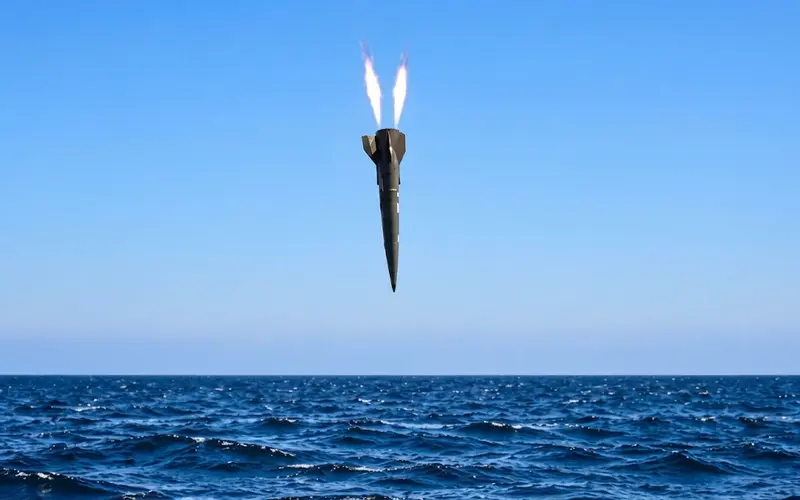
At the same time, the drones themselves changed. Russia imported Iran-made Shahed-136 drones and localized them under the name Geran-2, then began using the jet-powered Geran-3 in 2025. In January 2026, the Geran-5, shaped like a small cruise missile, was first used in combat. The first reported shootdown of a Geran-4 also came that month, and Ukraine's Defense Intelligence Directorate (HUR) officially confirmed combat use of the Geran-4 in May.
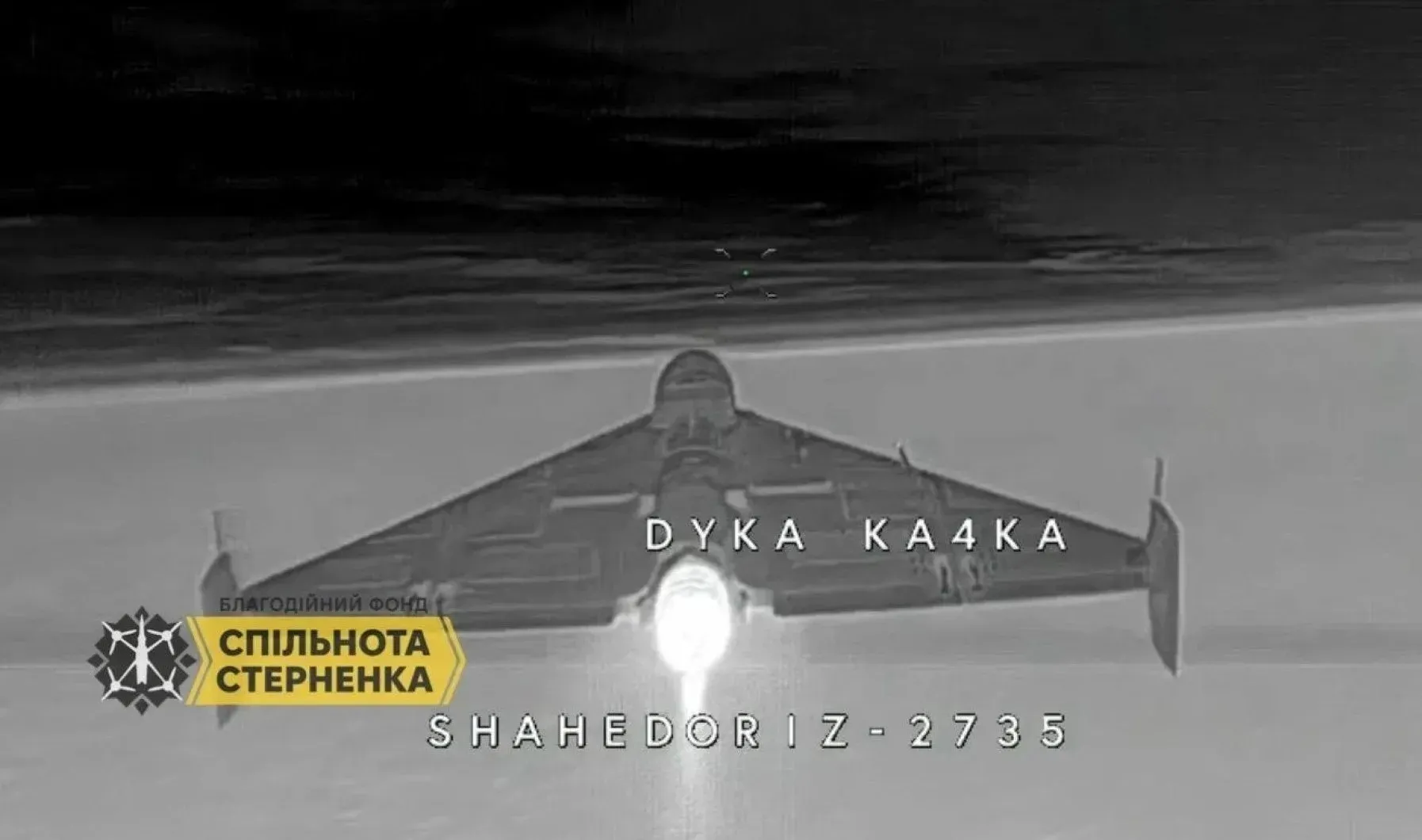
According to HUR, the Geran-5 has a cruising speed of 450 to 600 kilometers per hour and an estimated range of up to 950 kilometers. Its warhead is reported to be in the 90-kilogram class. It is a different weapon from the Geran-2, whose top speed is around 180 kilometers per hour. HUR said it had identified Chinese-made turbojet engines in the Geran-4 and Geran-5, and more recently said the Geran-4's engine had been replaced by a Russian-made one produced at the Alabuga plant. It assessed that production of the Geran-3 had been halted. As the drones became heavier and faster, their launch rails also grew longer. Analysts say launch rails for jet drones are about 80 meters long, three times the length of those used for earlier drones. That is why new launch facilities are needed to fire jet drones.
Launch numbers have surged. According to the Ukrainian Air Force, jet-drone launches totaled about 350 in June, 1,500 in July and 2,850 in August, and reached 3,177 by Sept. 29. HUR estimates Russia is already producing about 3,000 jet drones a month.
■ The cheap shield can no longer keep up
Until last year, Ukraine shot down a large share of Shahed-type drones with interceptor drones costing less than $2,000 apiece. But those interceptor drones cannot match the speed of jet drones. President Volodymyr Zelenskyy acknowledged in late September that the interception rate against jet drones was 55 to 57 percent, far below the more than 90 percent rate against conventional Shaheds. Prototype interceptor drones also emerged that lost control once they exceeded 400 kilometers per hour. For now, much of the burden is being shouldered by fighter aircraft fast enough to chase jet drones. From Oct. 14, military Starlink terminals (Starshield) used by the Ukrainian military were subject to a speed limit of about 161 kilometers per hour. Zelenskyy said on the 17th that because of that limit, interceptor drones equipped with those terminals could not be used against jet drones. The U.S. government described it as a technical defect, while Elon Musk claimed the restriction had been imposed by the U.S. government.
Zelenskyy said 67 companies were developing ways to intercept jet drones and called it "Plan B." Citing internal Russian documents obtained by Ukrainian intelligence, he also claimed that Russia plans to spend $12 billion on jet drones and loitering munitions production alone in 2027. That figure has not been independently verified.
■ Chimbulova expands even under attack
The template for Millerovo is Chimbulova in Oryol region. Construction at the base, 150 to 175 kilometers from the Ukrainian border, began in August 2024, and it expanded sharply in 2026 as long launch pads for jet drones were added. An August analysis of satellite imagery found that 20 of its 23 launch pads were for jet drones, the Geran-3, Geran-4 and Geran-5. According to an investigative analysis by Ukrainian media, it also had 387 garages and 26 underground storage facilities, and covered an estimated 5 square kilometers.
Ukraine attacked the site in late August, damaging one launch pad and storage facilities. On Sept. 21, it announced that it had struck a jet-drone launch area and five launch pads. Another airstrike followed on Oct. 3, with fires observed across the base. But construction continued throughout September. Russia appears to have converted some above-ground storage areas into underground bunkers and erected steel towers likely intended for anti-drone netting or communications relays.
Millerovo appears to have been modeled on Chimbulova. Several Ukrainian analysts believe the layout of the new base is almost identical to Chimbulova's. The difference is its location. DroneSec assessed that the new launch site sits inside the air-defense "bubble" of the air base, making it harder for Ukraine to strike. It is not known whether Russia chose the site with the strikes on Chimbulova in mind. But as a result, the new base was built in a position where it can benefit from that protection.
■ Airstrikes continued regardless of the ceasefire announcement
The growing number of jet drones is being used heavily in attacks on the energy grid. On Sept. 30, Russia carried out its biggest energy strike in months, using 188 drones along with missiles. Of the drones, 86 were jet-powered. Ukrenergo, Ukraine's power-grid operator, imposed the first emergency power cuts since spring in Kyiv and three surrounding regions.
On Oct. 11, U.S. President Donald Trump unilaterally announced an "energy ceasefire," saying the two countries had agreed to immediately halt attacks on energy facilities. President Volodymyr Zelenskyy said it was "the first I've heard of it," and Russia did not immediately state its position. Hours after the announcement, Kharkiv's No. 5 combined heat and power plant was attacked. According to Zelenskyy, attacks targeting Ukraine's power generation and transmission facilities topped 200 in the week of Oct. 5-11 alone.
From the night of the 13th into the early hours of the 14th, Russia launched 39 ballistic missiles and 128 drones. Seventy-seven of the drones were jet-powered, and 59 of those were shot down or otherwise neutralized. Only four missiles were intercepted. According to the Ukrainian government, at least 600,000 people lost power in Kyiv, Kyiv region and Kharkiv. Two days later, Gerasimov reported that "large-scale air strikes" had begun.
■ Russia builds faster than Ukraine can destroy
Taken together, the scattered incidents point to one trend: Russia is building new launch sites faster than Ukraine can destroy them. In the summer of 2024, the number of major Shahed launch sites was put at about five. Now, according to DroneSec, there are at least 11 fixed launch sites, with a nearly completed jet-drone launch base built in just six weeks poised to join them.
Monik said the new base has the potential to launch more than 100 jet drones in 24 hours. Rob Jordan, program director at the Royal United Services Institute (RUSI), said it was impressive that this much construction had been completed in such a short period. He said it may show Russia is relying on deep-strike capability, possibly even at the expense of its ground forces. In a Sept. 27 assessment, the Institute for the Study of War (ISW) said President Vladimir Putin's revised strategy for victory depends heavily on the ability to launch cheap jet drones in large numbers. It said Russia is also seeking to exploit Ukraine's shortage of Patriot interceptors this winter to force Ukraine into submission before spring 2027.
■ Caveats and limitations
This trend should not be overstated. Launch capacity is not the same as actual launch volume. Monik himself cautioned that Russia typically fires in small batches over the course of a day, and that actual numbers depend on supplies and targets. If the bottleneck lies not in launchers but in drone and engine production, adding one more base will not increase the volume of attacks in direct proportion.
Ukraine's response is also underway. Cases have begun to emerge in which domestically made interceptor drones actually shoot down jet drones. Many analysts and industry officials interviewed locally cautiously said that by late November, enough interception capabilities could be fielded to counter the current threat. The damage at Tsimbulova was real as well. Most importantly, the relationship between the Aug. 30 announcement and the Sept. 1 start of construction is only a coincidence in timing, and there is no direct evidence proving it.
■ What South Korea should watch
Monik described the combination of industrial-scale production of jet drones and gaps in counter-drone defenses across many NATO countries as a strategic vulnerability for the West. South Korea cannot view it as someone else's problem, either. In June 2025, Kyrylo Budanov, then head of HUR, said Russia and North Korea had agreed to begin establishing production capacity inside North Korea for Geran and Garpiya drones. He added, however, that they had only reached the stage of beginning production preparations, and actual production in North Korea has not been confirmed.
The lesson from Ukraine's experience is clear. A shield that cheaply stops slow drones quickly becomes obsolete against faster ones. The indicators to watch are when the first launch from Millerovo is confirmed, whether Ukraine can strike this base, whether projections that interception capabilities will be fielded by late November prove correct, and what share jet-powered drones account for in air raids.
■ The next field
Six weeks ago, no one was paying attention to the field at Millerovo. Now launch rails stand there. If Russia builds its next base at the same pace, that site probably still looks like an ordinary field today. Whether Ukraine's power grid can hold out this winter may depend in large part on how quickly it can find that field.