FBI searches about 40 North Korean laptop farms, seizes 187 devices
As crackdowns seize laptops, North Korea recruits more people to keep them running. Shifts in its fraudulent employment tactics and cryptocurrency theft are best read together.
강병지
Published
Updated
■ Laptops in the living room
In the living room of an ordinary home in Texas, several company-issued laptops sit side by side, powered on. Small remote-control devices (KVMs) are plugged in next to them. The homeowner does not work on these laptops. The people using them are thousands of kilometers away. The company's security system shows the employee connecting from Texas.
The U.S. Federal Bureau of Investigation, or FBI, searched about 40 residences in Texas from Sept. 21 to 25 that were identified or suspected as such "laptop farms." The operation was called Lone Star Roundup. Across the operation, the FBI seized about 187 laptops and KVM devices. According to prosecutors, about 100 of them came from North Texas. R. Joseph Rothrock, head of the FBI's Dallas field office, said one seized laptop could represent one company that hired a North Korean IT worker. Security firm CrowdStrike, which assisted the investigation, has tracked this group of North Korean IT workers and facilitators as "Famous Chollima."
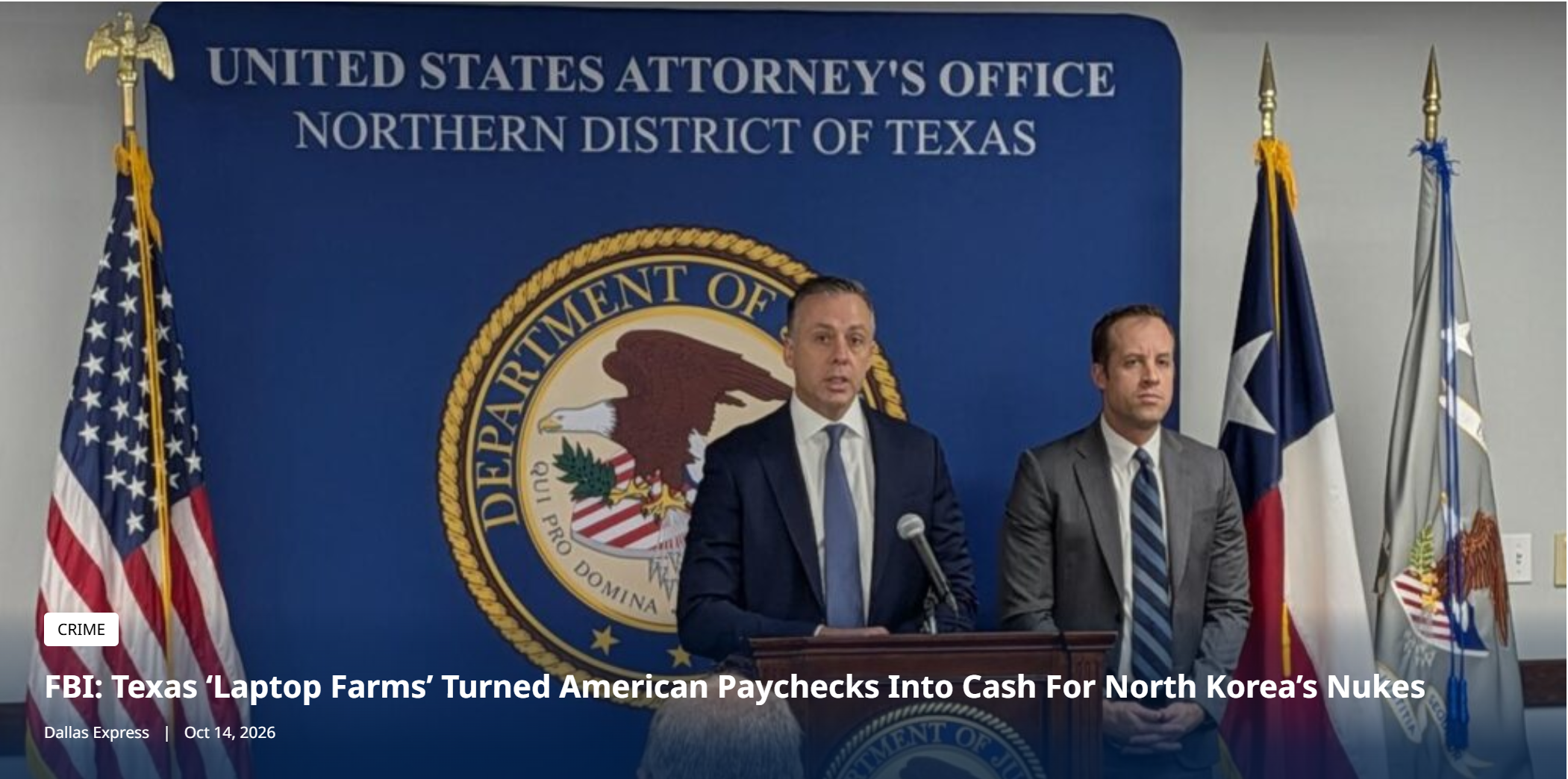
On Oct. 13 local time, the U.S. Department of Justice announced the results of the operation, along with charges in a separate case. In that case, handled by the U.S. Attorney's Office for the Northern District of Ohio, 14 people were charged and two Americans were arrested. According to the indictment, North Korean IT workers posed as U.S.-based workers from 2019 through around July 2025, using stolen or forged identification, virtual private networks (VPNs) and proxies. More than 70 companies in healthcare, telecommunications, cyber support, retail and manufacturing were deceived, and the victim companies spanned 17 states, including Ohio, and Washington, D.C. Investigators believe the scheme generated about $3 million, which was remitted to sanctioned North Korean-controlled entities. Of the 14 people charged, two are Americans, 10 live in China and two were not publicly identified. The charges are wire fraud, money laundering and identity theft.
■ Is $3 million the whole story?
About 187 devices seized in the Texas operation, more than 70 victim companies in the Ohio case, and about $3 million in proceeds. Those are the numbers in this announcement.
But another development unfolded at the same time. On Sept. 24 local time, a day before the Texas searches ended, funds in the $300 million range were drained from an online wallet at cryptocurrency exchange Bitget. Blockchain analytics firm Chainalysis assessed the incident as the work of actors linked to North Korea. It said this single case pushed North Korea's cryptocurrency theft this year above $1 billion.
■ A tightening crackdown
This was not the first crackdown on North Korean IT workers landing jobs under false identities. The U.S. Justice Department said it searched 29 sites in 16 states in June 2025 that were known or suspected to be laptop farms.
This year, the crackdown has broadened to include investigations, sanctions, sentencing and legislation.
March 12: The U.S. Treasury Department's Office of Foreign Assets Control, or OFAC, sanctioned six individuals and two entities involved in North Korea's IT-worker operation. Those designated included a North Korean national who led North Korean freelance IT workers out of Boten, Laos.
April: Two Americans who helped North Korean workers obtain jobs under false pretenses were sentenced to nine years and seven years and eight months in prison, respectively.
July 27: Rep. Young Kim, the Republican chair of the House Foreign Affairs Committee's Subcommittee on East Asia and the Pacific, introduced a bill to prevent North Korean IT workers from obtaining jobs under false pretenses. Rep. Ami Bera, the subcommittee's Democratic ranking member, joined as a co-sponsor.
July 31: Eleven countries, including South Korea, the United States, Japan, the United Kingdom and Australia, issued a joint advisory on North Korean IT workers. Separately the same day, the FBI said eight facilitators had received prison sentences this year.
The Texas operation is part of that broader trend. The Justice Department said the action was part of a joint effort by the department's National Security Division and the FBI, targeting North Korea's illicit revenue generation and its facilitators in the United States.
■ From machines to people
In the Oct. 13 announcement, the newest element was not the number of people charged but the public service announcement (PSA) the FBI issued the same day. In that document, the FBI warned that North Korea is infiltrating Western companies with thousands of state-controlled remote IT workers. It also said their tactics are changing.
First, they are recruiting more facilitators. The FBI said North Korean IT workers are increasingly relying on help from Americans who are either aware or unaware of the scheme, especially people under financial strain. The facilitators' role has also expanded. Beyond keeping laptops switched on, they take part in interviews, handle identity verification and receive packages. The Justice Department said the shift was a response to stronger private-sector detection tools and law enforcement investigations.
Second, they are breaking their hubs into smaller units. According to the FBI, North Korean IT workers have increased the number of laptop farms while reducing the number of laptops at each one. The aim is to avoid the risk that the entire operation collapses if one site is detected. That could make crackdowns less effective if they rely on raiding a single living room packed with dozens of laptops.
Third, they are subcontracting the work. The FBI said it has also identified cases in which North Korean IT workers subcontract jobs to freelancers in Pakistan, India and Nigeria, passing along only part of the pay they received from Western employers. If the people doing the actual work are not North Korean nationals, identity screening may become even less likely to catch them.
Fourth, the threats have grown more aggressive. The FBI said it identified cases in which North Korean IT workers extorted victims, demanding money while threatening physical violence. In some cases, after being fired, they threatened to kill former supervisors and their families.
Technology is helping drive the shift as well. In an April report, a security firm said a North Korea-linked group used synthetic identities and job applications written with generative AI to bypass companies' security controls. The FBI estimates that 85% to 90% of the proceeds from this business flow to the North Korean government. The U.S. Treasury estimates that North Korean IT workers earned nearly $800 million in 2024 alone.
The FBI's prescription reflects this shift as well. It says no single indicator can flag North Korean IT workers, making "in-depth identity verification" necessary, with multiple layers of checks throughout the employment cycle from hiring to departure. Taken together, the FBI's analysis suggests that as enforcement targets the hardware, North Korea is recruiting more people to keep it powered on.
■ Another Engine
If fraudulent employment is an engine that steadily brings in smaller sums, virtual asset theft is an engine aimed at landing a large payout in a single strike.
Blockchain analysis firm TRM Labs estimated that North Korea-linked groups stole $643 million in the first half of this year. That was about two-thirds of the $972 million in global hacking losses over the same period. Another security firm, Blockaid, put North Korea's share at about 55% in the same period. The methodologies differ, but both point to the same conclusion: more than half.
According to TRM Labs, about 90% of North Korea's first-half haul, or $577 million, came from two incidents in April. On April 1, about $285 million was drained from Solana-based decentralized exchange Drift, although Drift itself estimated the loss at $270 million to $280 million. On April 18, about $290 million was stolen from decentralized finance platform KelpDAO. Drift said it believed the attack was part of a North Korean operation that lasted about six months. It also said the person the attackers presented for in-person contact was not a North Korean national. This use of a third party resembles the facilitator structure seen in fraudulent employment schemes.
The Sept. 24 Bitget incident is regarded as the largest virtual asset theft of the year. Bitget initially estimated the losses at about $351.6 million, then revised that to about $387.5 million. Chainalysis also put the figure at $387 million. According to Chainalysis, the funds were moved 23 times in the first three hours after the theft, followed by hundreds more transfers.
There are intermediaries at the stage of turning stolen funds into spendable money as well. On Oct. 5, a blockchain investigator disclosed that he had infiltrated a Chinese criminal organization last year while posing as a client. He claimed the group laundered more than $1 billion stolen by the North Korean hacking group Lazarus. Separately, he said that after the Bitget incident, he found accounts in public chat rooms seeking help with laundering the stolen funds. He did not, however, present evidence linking those accounts to the organization he had infiltrated.
■ Has the crackdown failed?
It is too early to read this trend as a failure of the crackdown. There are also facts pointing the other way.
First, the amount stolen has fallen. By TRM Labs' count, North Korea's haul in the first half of this year was less than half of the roughly $1.7 billion stolen in the first half of 2025. But most of last year's figure came from roughly $1.5 billion stolen from the Bybit exchange in a single incident in February. Excluding that one case, a simple calculation suggests last year's first-half total was smaller than this year's. That is why it is hard to read the decline as evidence of the crackdown's effect. North Korea's share of global hacking losses also slipped only slightly, from about 70% in the first half of last year to 66.2% in the first half of this year, still roughly two-thirds.
Penalties for facilitators are getting harsher. In April, a facilitator who helped operate a laptop farm was sentenced to nine years in prison. The explanation that the shift in tactics is a response to the crackdown is also only the judgment of the FBI and the Justice Department, not an independently verified causal link.
The level of confirmation for these links also needs to be distinguished. Attributing the Bitget incident to North Korea is based on assessments by private analysis firms such as Chainalysis and suspicions raised by Bitget's chief executive. There has been no official announcement yet from investigative authorities. The claim that a Chinese laundering network handled more than $1 billion is also only one investigator's assessment, not a figure confirmed by authorities. Framing fraudulent employment and virtual asset theft as "two engines" is this article's analysis. The U.S. government believes both activities are used to fund weapons development, but no direct evidence has been made public showing that the two operations run under a single command structure. In terms of amount, virtual asset theft through September this year, more than $1 billion, has already exceeded the Treasury Department's estimate of nearly $800 million in IT-worker revenue for 2024. The years differ, which limits any simple comparison.
Even so, the FBI's analysis and the Drift case suggest one thing: North Korea's hard-currency earnings depend as much on people as on technology, and those people are increasingly being recruited outside North Korea.
■ Is South Korea an exception?
South Korea is not immune to this trend. South Korea's Ministry of Foreign Affairs and National Police Agency joined the 11-country joint advisory on July 31. The government warned that if companies sign service contracts with North Korean IT workers and pay them, they could face sanctions or financial repercussions for violating not only domestic law but also U.N. Security Council Resolution 2397.
The threat on the virtual-asset side is not someone else's problem either. On Nov. 27, 2025, 44.5 billion won worth of assets was stolen from Upbit, South Korea's largest virtual-asset exchange. Relevant authorities were reported to see a high likelihood that Lazarus was behind it, citing the fact that the date matched the 2019 hack and that the method of targeting the online wallet and the laundering techniques were similar. The Financial Security Institute, however, said there were no grounds to view it as North Korea's work. It is understood that no official attribution has yet been announced.
With remote hiring now routine, fraudulent employment is not just a problem for U.S. companies. There are four things to watch going forward.
Whether the U.S. House bill to block fraudulent employment moves forward
North Korea's annual virtual-asset theft tally, to be released at year-end
Whether investigative authorities make an official attribution in the Bitget case
The trial outcomes for the facilitators arrested this time
■ Back to the living-room laptops
The FBI removed about 187 laptops and KVM devices from living rooms in Texas. Machines can be seized. But the people who kept those machines running can be recruited again. The next farm could be another house with only a few laptops, or a freelancer's desk across the border. As the crackdown pursues the hardware, North Korea is seeking more people and intermediaries.