Lee administration's first defense white paper likely to retain 'enemy' label for North Korean regime and military
Defense ministry plans to keep wording used under Yoon Suk Yeol; unification ministry seeks a review
North Korea maintains hostile two-state doctrine and military threats; publication planned for late December
Published
Updated
The 2026 Defense White Paper, the first to be published since the Lee Jae-myung administration took office, is expected to retain language defining the North Korean regime and military as enemies, according to reports. The defense ministry is preparing the white paper with a view to keeping the phrase "the North Korean regime and the North Korean military are our enemies," as stated in the Yoon Suk Yeol administration's 2022 Defense White Paper.
The Seoul Shinmun, citing military sources, reported that the defense ministry had decided to retain the existing wording. The ministry is reportedly scheduled to complete the collection of materials, including those on the defense budget and policy, by the end of this month and publish the white paper in late December after consulting other ministries and outside experts.
The defense ministry has maintained its existing position defining North Korea as an enemy since June. At a regular briefing on June 18, deputy ministry spokesperson Lee Kyung-ho denied a report that the ministry was considering changing the white paper's language on North Korea. "There is no change in our position that the North Korean regime and the North Korean military are our enemies," he said.
In written answers submitted to the National Assembly for his confirmation hearing on Sept. 11, Defense Minister Kang Shin-chul said forces that threaten South Korea's security and the lives and property of its people can be regarded as enemies. He said the North Korean regime and military fall within that definition because they define South Korea as an enemy and continue to pose military threats, including nuclear threats.
Kang also defined North Korea as an enemy at his confirmation hearing before the National Assembly's National Defense Committee on Sept. 16. Asked by People Power Party lawmaker Kang Sun-young why he had not used the term "main enemy," he said using it could create logical problems in relation to other enemies and noted that successive administrations had not used the term since 2004.
The unification ministry has called for a review, saying wording that defines North Korea as an enemy is inconsistent with the government's policy of peaceful coexistence on the Korean Peninsula. In June, a ministry official said it was difficult to pursue peaceful coexistence while defining North Korea as the main enemy, and that the wording should be discussed with reference to expressions used in the Roh Moo-hyun and Moon Jae-in administrations' defense white papers.
However, the defense ministry reportedly held no separate exchanges with the unification ministry as it settled on retaining the existing wording. There remains a possibility that the unification ministry's position could be reflected as the defense ministry seeks views from other ministries. For now, however, the defense ministry's reported policy is to keep the existing language.
Since late 2023, North Korea has redefined inter-Korean relations as "relations between two hostile states" and shifted its policy toward the South, including by dismantling organizations responsible for unification. This year, it institutionalized the two-state approach by removing unification-related provisions from its constitution and explicitly specifying its border with South Korea.
Military tensions also persist along the border. On Sept. 21, a landmine exploded during an operation to open a patrol route in the western sector of the Demilitarized Zone (DMZ), injuring three South Korean service members. On Oct. 5, the Joint Chiefs of Staff concluded that the incident had been caused by a plastic-cased antipersonnel mine planted by North Korean troops south of the Military Demarcation Line (MDL), based on a joint on-site investigation with the United Nations Command and forensic findings from the National Forensic Service. The military said the mine had been planted about 10 meters south of the MDL, in violation of the armistice agreement.
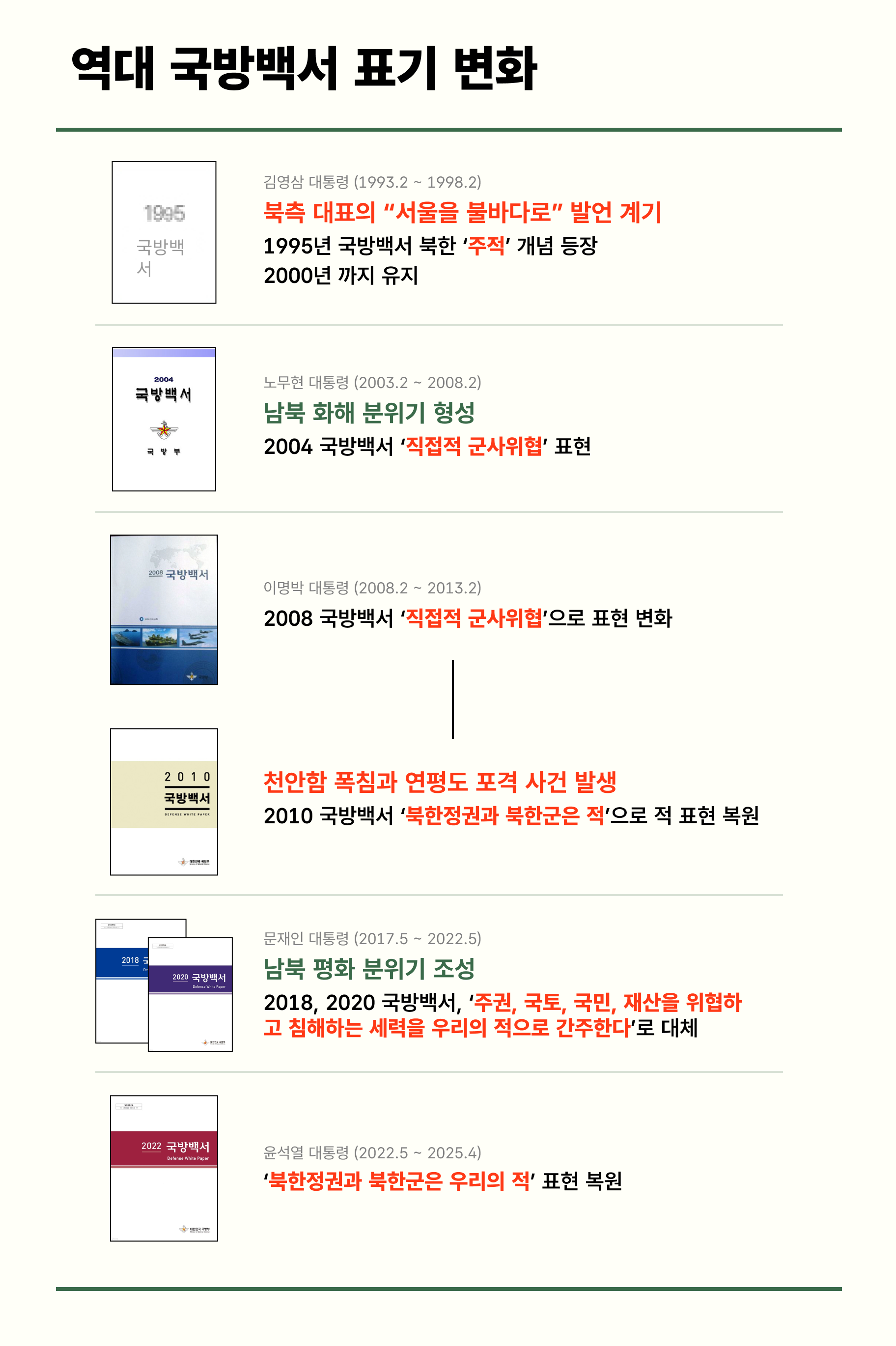
The white paper's language on North Korea has changed several times with successive administrations' policies toward the North and the security situation. The concept of the "main enemy" first appeared in the 1995 Defense White Paper following North Korea's "sea of fire" remark about Seoul at inter-Korean working-level talks in 1994, and remained through 2000. The Roh Moo-hyun administration removed the term from the 2004 Defense White Paper and used expressions such as "direct military threat."
Following the attack on the Cheonan and the shelling of Yeonpyeong Island in 2010, the phrase "the North Korean regime and the North Korean military are our enemies" reappeared and remained through the Park Geun-hye administration. The Moon Jae-in administration's 2018 and 2020 Defense White Papers instead adopted a broader definition, regarding forces that threaten or infringe on South Korea's sovereignty, territory, people and property as enemies, without directly naming North Korea.
The Yoon Suk Yeol administration restored language defining the North Korean regime and military as enemies in the 2022 Defense White Paper, published in February 2023, after a six-year absence. At the time, the defense ministry cited North Korea's strategy toward the South, advances in its nuclear forces and continuing military provocations as reasons for restoring the wording.
Defense white papers are normally published every two years, but no edition was issued in 2024 in the aftermath of the Dec. 3 emergency martial law crisis. If the new white paper is published next month as scheduled, it will be the first since 2023, roughly four years ago, and the first under the Lee Jae-myung administration.