Pusan National University’s Saetbeol-2 completes flight test, demonstrating South Korea’s first publicly documented RDRE ignition in flight
Stage separation and second-stage engine operation achieved after incomplete first test last month; metal 3D printing used and both stages recovered
Published
Updated
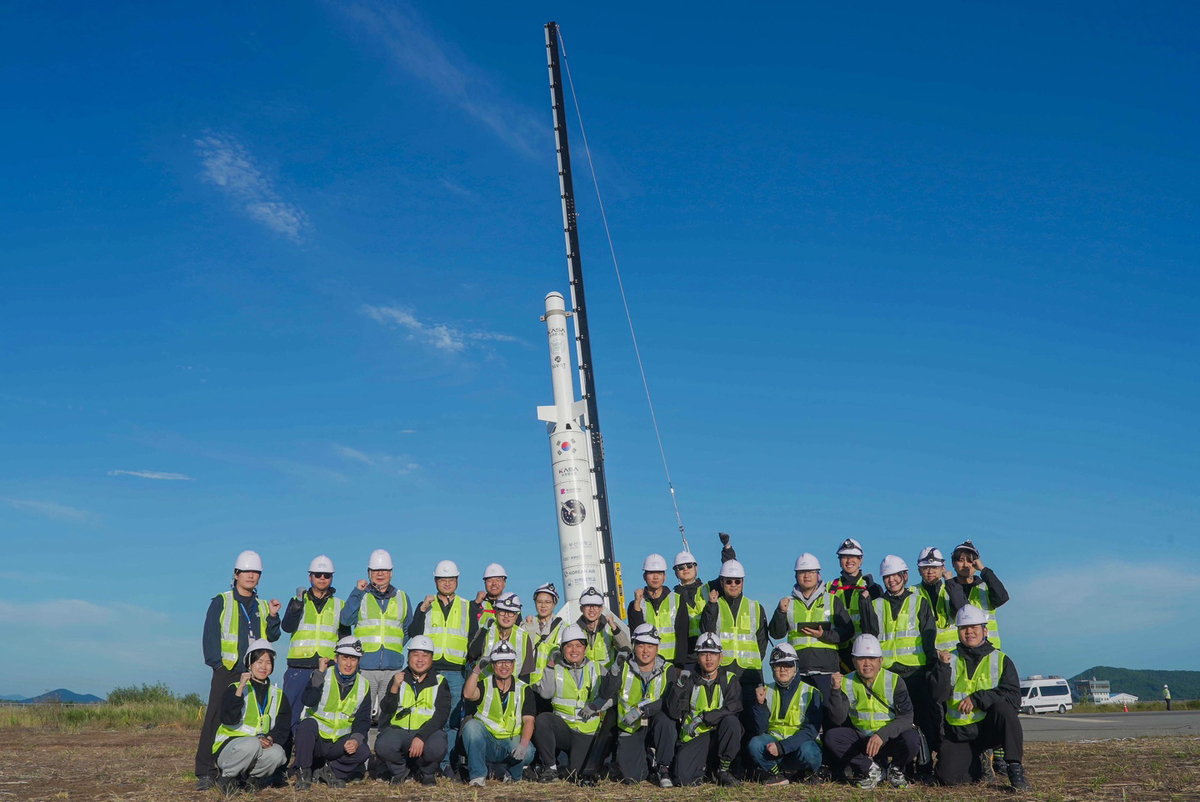
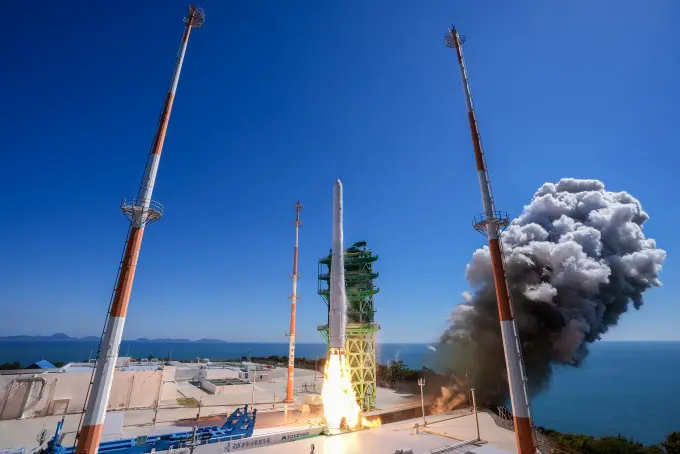
Saetbeol-2, a two-stage research rocket developed by Pusan National University researchers, has successfully separated its stages and ignited its second-stage engine in flight. The next-generation rotating detonation rocket engine (RDRE) on the second stage began operating in an actual flight environment, providing flight data for a propulsion technology that had previously been developed primarily through ground testing.
The university’s Space Launch Vehicle and Space Transportation Education and Research Center said on the 9th that Saetbeol-2 had successfully completed its main test procedures during a flight test in Goheung, South Jeolla Province, on the morning of the 7th. The two-stage research rocket is 4.1 meters long and has a liftoff mass of 138 kilograms. Its first stage uses a hybrid rocket propulsion system, while its second stage uses the RDRE the university has been researching.
The test included first-stage ignition and combustion, stage separation, ignition and initial operation of the second-stage propulsion system, and parachute ejection from both stages. Strong winds partially constrained parachute deployment, but the researchers recovered both stages and are analyzing data from the propulsion and flight systems.
The success followed an earlier flight test and several launch postponements. The team had originally prepared for launches on September 19 and October 3, but delayed them after identifying problems in communications and ignition systems. The first flight test of Saetbeol-1 on October 17 confirmed operation of the first-stage propulsion, flight safety and recovery systems, but did not proceed to stage separation or second-stage engine operation. The team analyzed the flight data, improved the systems and carried out additional ground tests before conducting the latest flight.
Saetbeol-2’s key technology is the rotating detonation rocket engine used in its second stage. An RDRE burns propellants through detonation waves that travel at supersonic speed and rotate continuously inside the combustion chamber. The technology has drawn attention because it can use the pressure rise generated by detonation to produce thrust, potentially allowing a smaller combustion chamber and higher propulsion efficiency than conventional rocket engines.
NASA also considers RDREs an important area of research for future space transportation propulsion. Its development work has included a ground firing lasting more than 340 seconds in December 2025 using a rotating detonation engine combustion chamber fueled by liquid methane and liquid oxygen. The Pusan National University team’s achievement lies in integrating an RDRE with the vehicle’s propellant supply, ignition, structures and avionics and verifying ignition and initial operation in an actual flight environment.
Additive manufacturing, including metal three-dimensional (3D) printing, was used to build Saetbeol-2. Nickel-based superalloys were used for major engine components that must withstand high temperatures and pressures, while the propellant tanks were made from titanium alloy. Vitzro Nextech handled additive manufacturing of the engines and propellant tanks, MWMW developed the recovery system, and Genohco developed the power supply and wiring components. AT Tech and SM Precision participated in manufacturing the airframe.
Development was undertaken as part of the Korea AeroSpace Administration’s Future Space Education Center program, with support from Busan Metropolitan City. Pusan National University led the project, with INNOSPACE, Korean Air and Inha University participating as joint research partners. The Korea Aerospace Research Institute’s Goheung Aviation Center provided the launch site and assembly and inspection facilities and supported launch operations.
The university’s Space Launch Vehicle and Space Transportation Education and Research Center was established in 2022 after selection for the Ministry of Science and ICT’s Future Space Education Center program. The five-year project has a total budget of 6.4 billion won, including 5 billion won in central government funding and matching contributions from local government and industry. Its main objective is to train launch-vehicle specialists through joint university-industry research. Since its establishment, the center has identified development of high-performance upper-stage engines using detonation-engine technologies, and the construction and demonstration of test vehicles, as major research tasks. Saetbeol-2’s flight test also represents validation in an actual flight environment of about four years of research and development. University graduate students took part in every stage of the latest effort, from system design, manufacturing and final assembly to ground testing, launch operations, flight testing and data analysis.
Choi Jeong-yeol, a professor in Pusan National University’s Department of Aerospace Engineering, explained that identifying the causes of problems encountered during testing, improving the systems and returning to flight testing are themselves important parts of real launch-vehicle development. He also said that obtaining data on in-flight ignition and initial operation of a rotating detonation rocket engine would provide a foundation for further propulsion research.
The researchers plan to analyze propulsion, flight and avionics data from the Saetbeol-1 and Saetbeol-2 tests together and use the findings to improve vehicle performance and reliability. They also intend to continue researching next-generation space propulsion technologies, including rotating detonation rocket engines.