Palantir rushes to address ‘JAVA4Shell’, rolling out updates across Java services
OpenJDK flaw can allow unauthenticated remote code execution; AVX-512 disabled in customer compute environments
Published
Updated
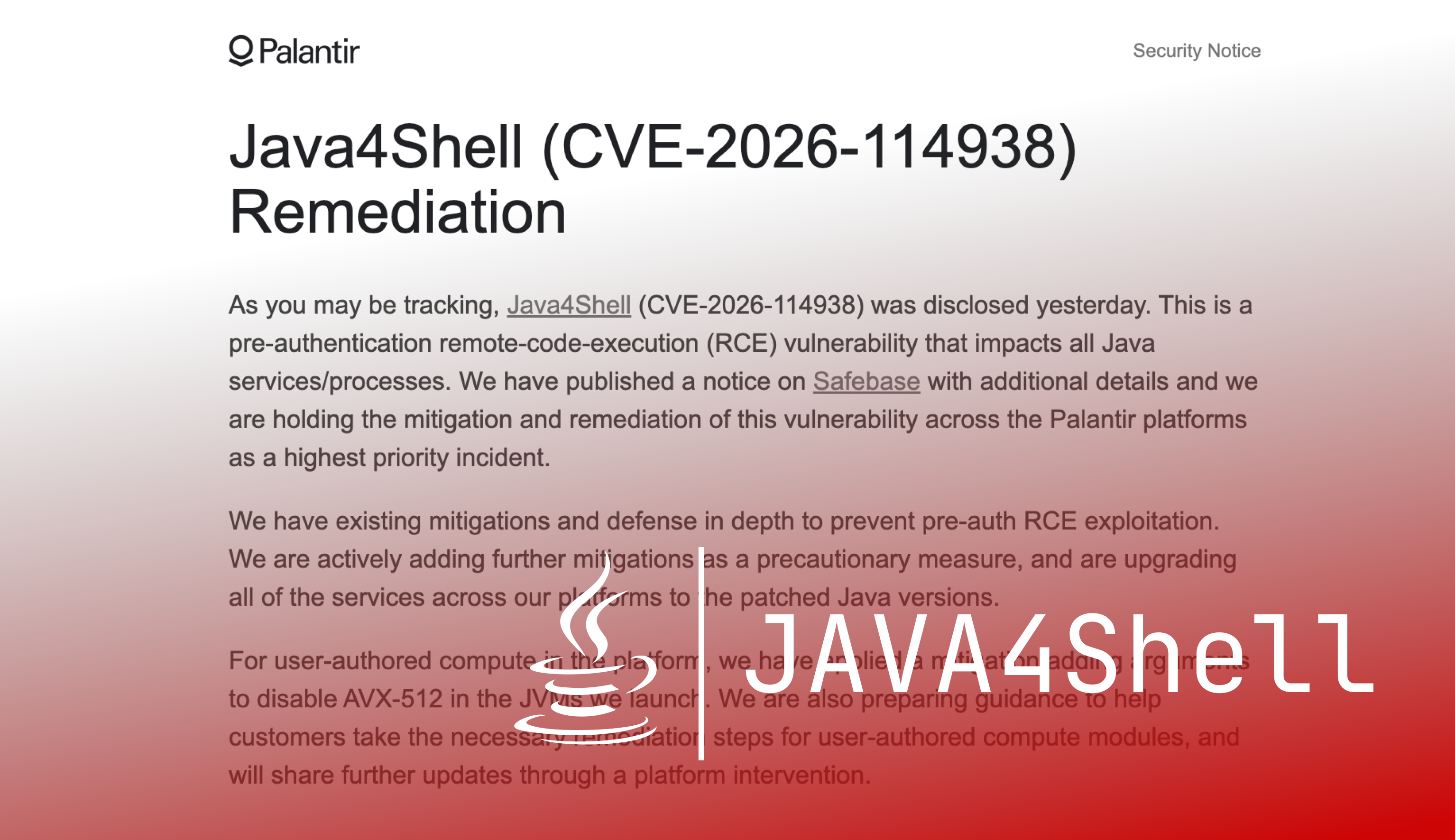
Palantir, the U.S. defense and information technology company, has begun rolling out security updates across its platforms to address Java4Shell, a high-risk vulnerability discovered in the Java runtime environment. It has also introduced temporary safeguards in environments that execute customer-written programs to prevent exploitation.
According to a customer security notice dated the 19th obtained by AnchorPost, Palantir has designated mitigation and remediation of the vulnerability, identified as CVE-2026-114938, as its highest-priority security response. The company said it already operates multiple layers of defense against pre-authentication remote code execution, but is introducing additional precautionary safeguards while replacing the Java runtimes of all services on its platforms with patched versions.
For environments that run customer-written compute programs, Palantir has added a Java Virtual Machine (JVM) runtime option that disables AVX-512 instructions. AVX-512 is a set of high-speed computing instructions supported by some Intel and AMD processors, and the vulnerability arises during Java data processing that uses these instructions. Palantir is preparing separate guidance so that customers can take the necessary steps in their own compute modules, with follow-up information to be provided through its platforms.
Disclosed on the 17th, local time, Java4Shell is a memory-corruption vulnerability in the Base64 decoder of OpenJDK, a Java runtime environment. Base64 is an encoding method that represents binary data as text and is widely used for user authentication in web services, file transfers and data exchange between systems.
The flaw occurs when OpenJDK decodes Base64 data using AVX-512 VBMI instructions on certain x86-64 processors. Malformed input can cause an error in calculating the length of the decoded output, allowing data to be written beyond the memory allocated to the program. An attacker exploiting the vulnerability could crash the program or steal information stored in memory without logging in to the server and, under certain conditions, execute arbitrary code remotely.
U.S. security research firm Calif said it had achieved pre-authentication remote code execution in default configurations of enterprise software including Keycloak, Atlassian Jira and Confluence, Jenkins, JFrog Artifactory and PingFederate. These products are used in enterprise authentication and software development and deployment environments. Some of the functions used in the demonstrations process external input without requiring separate authentication.
Calif also confirmed that remote code execution was possible in Apache Kafka, Solr and Elasticsearch through functions accessible only after authentication. The researchers’ proof-of-concept results demonstrate that exploitation is possible; they do not mean that actual breaches have occurred in those products.
Affected systems combine a vulnerable Java version with a processor that supports the relevant instructions. The main targets are OpenJDK versions from 17.0.6 onward and unpatched versions in the Java 21, 25 and 27 families, running on CPUs that support AVX-512 VBMI. Examples include Intel Xeon Ice Lake and later product families, and AMD Zen 4 and later architectures. ARM64 systems and x86-64 processors without the relevant instruction support are not affected. Standard Java 8 and 11 environments are also excluded because they lack the vulnerable code, although some high-performance distributions of Oracle Java 8 are exceptions.
Oracle assigned the vulnerability a score of 8.1 under the Common Vulnerability Scoring System (CVSS) 3.1, while Calif assigned it 9.2 under CVSS 4.0. The scores use different assessment frameworks. Both organizations identified the ability to attack without authenticating to the server as a major risk factor.
Oracle and the OpenJDK project released fixes on the day the vulnerability was disclosed. For Oracle Java SE, the fixed versions are 17.0.21.1, 21.0.13.1, 25.0.5.1 and 27.0.1.1. Users of other OpenJDK-based distributions must apply the security updates provided by their respective vendors.
For systems that cannot be updated immediately, Red Hat advised using the JVM startup option ‘-XX:-UseBASE64Intrinsics’ to disable the vulnerable Base64 hardware acceleration. The AVX-512 disablement that Palantir said it had applied to customer compute environments similarly blocks the instruction path in which the vulnerability occurs.
In South Korea, the National Security Office held an emergency cybersecurity meeting involving the private sector, government and military on the 17th, ahead of the disclosure. Director-general-level officials from the Ministry of Science and ICT, Ministry of National Defense, National Intelligence Service, Ministry of the Interior and Safety, Financial Services Commission, Financial Supervisory Service and Financial Security Institute reviewed Java usage across the public, private and defense sectors and arrangements for a coordinated emergency patch response.
The Korea Internet & Security Agency (KISA) also issued a security advisory on the 18th listing fixed versions of affected products, including Oracle Java and GraalVM. It subsequently added distribution-specific update information for OpenJDK and frequently asked questions, recommending that organizations identify the Java runtimes actually used by their services and containers and restart services after applying patches.
Palantir supplies data analytics software to defense and intelligence agencies and private companies through Gotham, Foundry and its Artificial Intelligence Platform, AIP. The measures described in its security notice distinguish between Java services managed within its platforms and compute programs written by customers. Palantir is updating the platform services itself and plans to provide further guidance for compute modules managed by customers.