U.S. Marines hold reconnaissance course in South Korea for first time, joined by 707th unit and Coast Guard teams
South Korea–U.S. multi-domain reconnaissance training runs through November 6, focusing on linking intelligence to joint fires
Efforts to strengthen reconnaissance and detection draw attention as the U.S. pursues deployment of Multi-Domain Task Force capabilities to the peninsula
Published
Updated
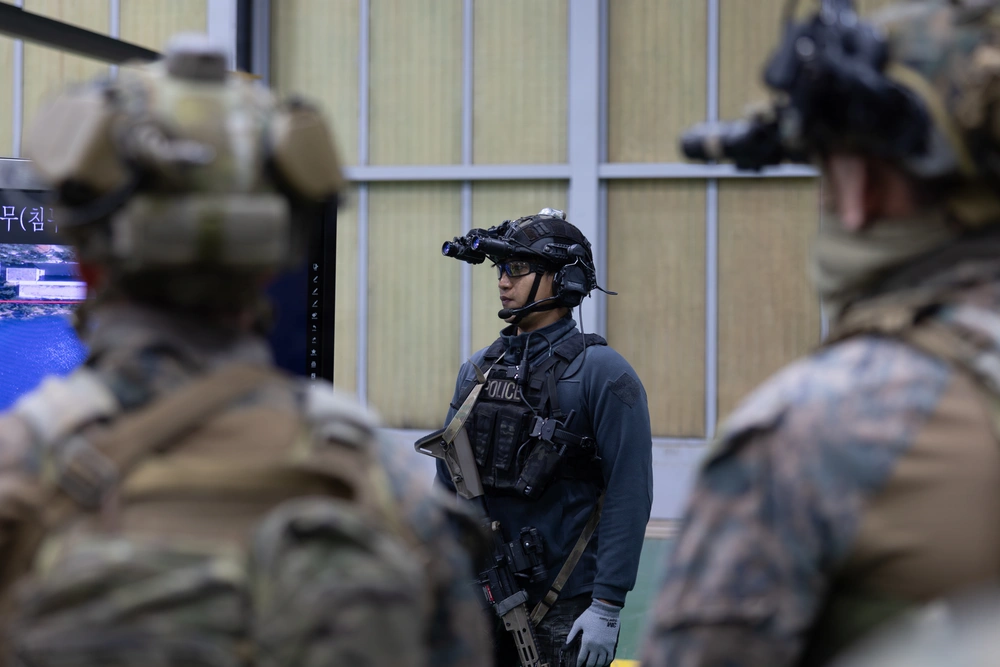
The U.S. Marine Corps is holding its annual reconnaissance capability assessment course in South Korea for the first time this year, moving it from its usual location in Hawaii. South Korean military and police special-operations units, including the Army’s 707th Special Mission Group, are participating. With the U.S. also pursuing deployment of Multi-Domain Task Force (MDTF) capabilities to the peninsula, the training has drawn attention to allied efforts to strengthen reconnaissance and detection.
The III Marine Expeditionary Force’s Expeditionary Operations Training Group is conducting Multi-Domain Reconnaissance Course (MDRC) 26.1 at locations across South Korea from October 21 to November 6. According to the Marines, the course assesses the 31st Marine Expeditionary Unit’s Force Reconnaissance Platoon in carrying out reconnaissance using support from multiple operational domains in an environment simulating a peer adversary. It is the first time the Marines have conducted the course in South Korea with South Korean forces.
The course is notable for assessing how reconnaissance intelligence collected by Marines is linked to allied operations and fire support. The Marine Corps listed joint kill-chain integration, live-fire employment of supporting forces, crisis response and full-mission-profile reconnaissance among the tasks. A kill chain is the sequence of detecting, locating, tracking and selecting a target, engaging it and assessing the effects. Information sharing between reconnaissance units, commanders and strike forces is central to those operations.
This focus aligns with the Marine Corps’ ongoing force restructuring. Commandant Gen. Eric Smith has emphasized links between detection, tracking, intelligence analysis and long-range precision fires in his guidance for the service, and the need for forward-deployed Marines to share targeting information with other services’ strike assets. The Marines’ ‘Stand-in Forces’ concept also emphasizes small units operating within an adversary’s threat envelope to collect surveillance and reconnaissance information and provide it to the joint force.
The training in South Korea has included maritime special operations. On the 23rd, the Force Reconnaissance Company of the 3rd Reconnaissance Battalion, 3rd Marine Division, trained with Korea Coast Guard tactical personnel in visit, board, search and seizure (VBSS) at a Coast Guard mock-vessel facility. Photographs released by the Marines showed reconnaissance personnel installing boarding equipment and searching the vessel’s interior. Built over about eight months, the facility is designed for repeated practice of boarding, searching and securing vessels, key elements of maritime raids.
South Korean military and police special-operations forces have also participated beyond the Coast Guard training. According to an SBS report on the 31st, a Marine reconnaissance company conducted four days of basic marksmanship, small-unit combat skills and tactical training with the Army’s 707th Special Mission Group and police tactical units from October 20. Combined training with South Korean Marine Corps special reconnaissance personnel is also planned for early November. The details of activities involving the 707th, police tactical units and Marine special reconnaissance forces were reportedly withheld by agreement between the two countries.
The U.S. Marines said the course also aims to strengthen noncombatant evacuation operations (NEO) and regional crisis response. This is understood to reflect situations in which military operations and civilian evacuation could occur simultaneously, with maritime and land special-operations forces preparing for varied missions. Before deploying to South Korea, participants completed several weeks of classroom instruction and practical training in multi-domain reconnaissance and surveillance in Okinawa, Japan, with the comprehensive exercise in South Korea concluding the course.
The course comes amid continuing efforts to expand U.S. multi-domain operational capabilities on the peninsula. Washington is pursuing the deployment of MDTF capabilities integrating land, sea, air, space, cyber and electronic warfare. Yonhap News Agency reported in September that the U.S. was working on a plan to move MDTF capabilities stationed in Europe to South Korea. U.S. Forces Korea commander Gen. Xavier Brunson has also repeatedly cited the need for MDTF capabilities in South Korea, emphasizing more accurate detection and understanding of the battlefield environment.
The MDTF is an Army formation, organizationally separate from the Marines conducting MDRC. No direct connection between the training and deployment plans has been established. Both nevertheless relate to the U.S. military’s direction of development: integrating information and capabilities across operational domains to improve detection and reconnaissance. In particular, developing South Korean–U.S. reconnaissance sharing and joint fire support on the peninsula could affect future combined operational arrangements.
Col. Clinton Cummings, commander of the III Expeditionary Operations Training Group, described the course as an assessment of the 31st MEU Force Reconnaissance Platoon’s ability to conduct varied reconnaissance missions using multi-domain support. He said completing in South Korea the preparatory training begun in Okinawa gave the two countries’ forces opportunities to rehearse missions including crisis response and joint kill-chain integration together.
The Marines have not disclosed the specific composition of reconnaissance and surveillance assets, information-sharing systems or fire-support forces used in the course. Nor have they detailed why the training normally held in Hawaii was moved to South Korea this year. Confirmation of results after the course ends on November 6, and of any future iterations in South Korea, could provide a clearer picture of how the Marine Corps intends to employ its reconnaissance forces.