Nuriho 5th launch, domestic cluster satellites successfully placed into orbit... all communication established
Initial communication confirmed for all separated satellites including NeonSat 2 to 6... Persat 02 experienced launch failure. An additional 5 NeonSats planned for the 6th launch in the second half of 2027... aiming to establish a 10-satellite cluster observation network
강병지
Published
Updated
At 1:08 PM on October 7, a signal was captured by the antenna at the Antarctic Sejong Station ground station. The signal came from the ultra-small cluster satellite No. 6, which was launched by Nuriho about 40 minutes earlier from the Naro Space Center in Goheung, Jeollanam-do, at an altitude of approximately 576 km. The satellite sent unique identification information and remote sensing data, and responded to commands from the ground. Following this first signal, communication continued for nearly five hours until that evening.
■ Questions more important than success rate
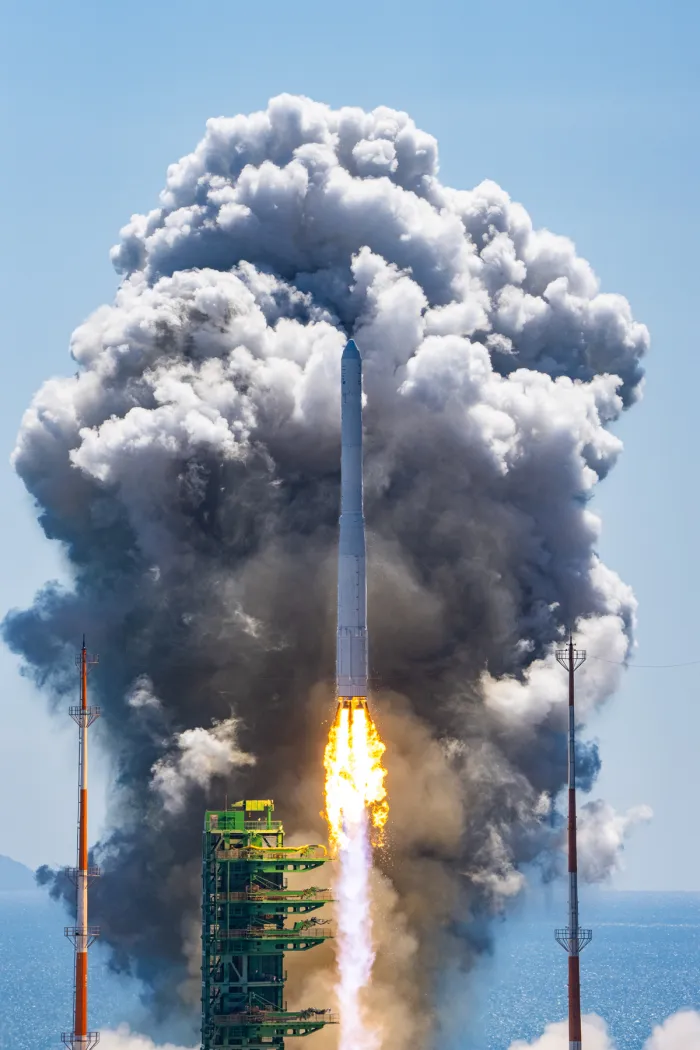
The 5th launch of Nuriho has been deemed a success. Following the first failure in January 2021, the 2nd to 5th launches were successful, raising the launch success rate from 75% to 80%. Carrying 15 satellites is the highest number ever for Nuriho, and the total weight of the satellite payload exceeded 1 ton, increasing from 960 kg in the 4th launch last year to 1,071 kg.
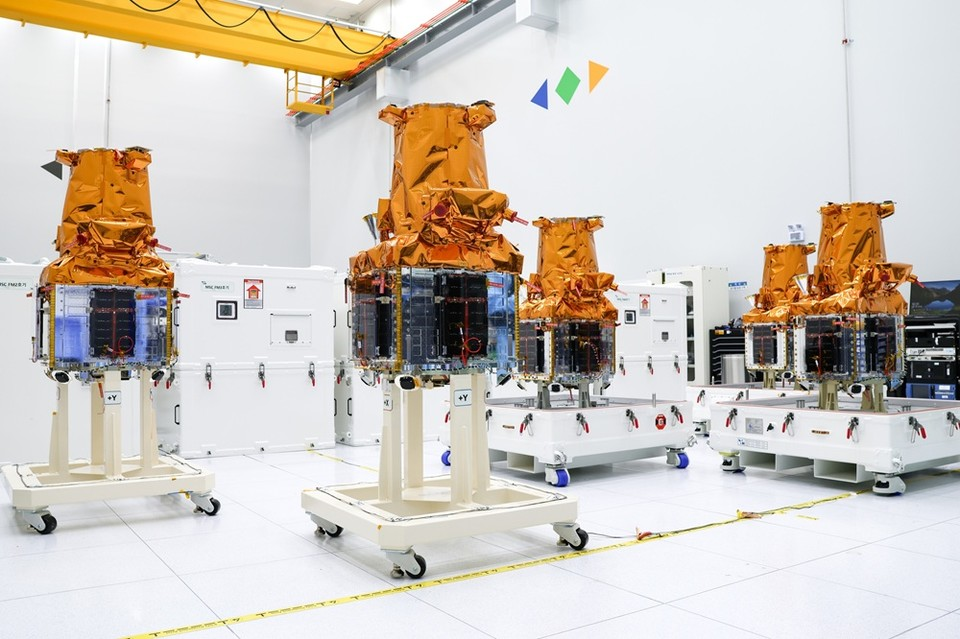
However, what is more important in this launch is not the success rate but what was launched. The main payload satellites are five domestic production observation satellites designed to closely monitor the Korean Peninsula and surrounding waters, and ultra-small cluster satellites (Neonsat) No. 2 to 6. The Korea Aerospace Research Institute stated that successfully launching and communicating with five production satellites performing the same mission simultaneously is a first among national satellites.
■ From foreign rockets to our own rockets
The NeonSat weighs less than 100 kg per unit. Nevertheless, it carries black-and-white 1m class and color 4m class electro-optical cameras. Instead of relying on a single large satellite for all observations, the concept of cluster satellites involves deploying multiple small satellites at regular intervals to frequently capture images of the same area. While the performance of one unit may not match that of a large satellite, the interval for revisiting the same location is shortened when multiple units pass by in succession.
The development is overseen by the KAIST Satellite Research Institute, while Satrec Initiative is responsible for the system, satellite body, and payload. The Korea Aerospace Research Institute explained that the NeonSat was developed as an 'ITAR-free' satellite not subject to the U.S. International Traffic in Arms Regulations (ITAR), allowing it to be launched with domestic launch vehicles. Satellites containing ITAR-controlled items require U.S. government approval to be transferred to other countries or launched on foreign vehicles. During the first launch in 2024, the government announced it would invest approximately 231.4 billion won in the project by 2027.
Before this group of five, there was a preliminary group. The prototype satellite No. 1 was launched in April 2024, and the verification satellite was launched on January 30 of this year aboard Rocket Lab's Electron rocket from New Zealand. The verification satellite successfully communicated immediately after launch and was scheduled to begin Earth observation in July after six months of performance testing. The first satellite produced over 20,000 images from more than 1,700 captures by the end of January this year. The improvements identified while operating the two satellites were reflected in the production models. The production method has also changed, adopting a method to assemble and test multiple units simultaneously, reducing the production time by more than half. While the first two satellites were launched on foreign rockets, the first group of production satellites was launched on a domestic launch vehicle.
■ Four months of delay
However, it was not without challenges. According to the Korea Aerospace Research Institute, the initial target for the 5th launch of Nuriho was June of this year, but the schedule was delayed three times. It was revealed that the launch originally scheduled for the end of July was postponed to October, and the reasons were disclosed in early August. The issue was not with the launch vehicle, but with the satellites. After operating the prototype and verification satellites, it was found that the performance of the thrusters did not meet expectations, leading to the decision to switch the thrusters of satellites 2 to 6 to products from a company with more space operation experience.
The thruster is a component that maintains or changes the orbit of the satellite. There were no commercial products in the country that met the required performance, so reliance on foreign products was necessary. The lack of 'space heritage'-a history of verification in space-for these components has hindered the schedule. Since cluster satellites must adjust their orbits slightly to maintain spacing, the thruster is key to constellation formation.
The government prioritized the stability of the satellites over the schedule. The five replaced satellites underwent a review meeting before transport on August 13, entered the Naro Space Center on August 24, and the launch date was confirmed as October 7 by the launch management committee on August 27.
■ October 7, five launches and five communications
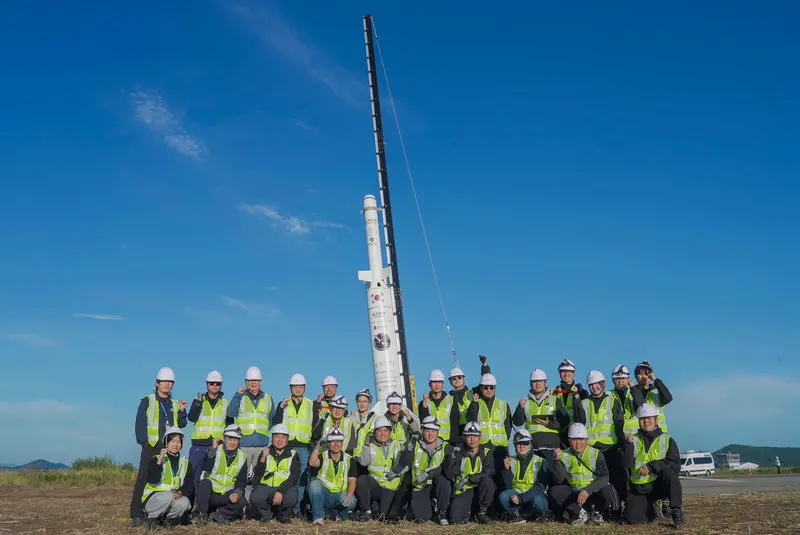
Nuriho took off at 12:25 PM on the 7th. Unlike the 4th launch last year, which was conducted in the early morning, this launch was scheduled during the day considering the observation mission of the payload satellites. According to the initial analysis by the Korea Aerospace Research Institute, the first stage separated at an altitude of approximately 66.5 km, 121 seconds after launch. The fairing separated about 231 seconds later, and the second stage separated about 262 seconds later. The third stage reached an altitude of about 575 km approximately 746 seconds later.
The technical key to this launch was the next step. In the 2nd to 4th launches, the main payload satellites were launched one at a time. This time, five satellites had to be placed in the same orbit without colliding with each other. Nuriho launched the second satellite first, then adjusted the launch vehicle's attitude at intervals of 35 to 40 seconds to push the five satellites in different directions. A new low-impact satellite separation device was also applied to reduce separation shock. Following this, two CubeSats were released at an altitude of approximately 579 km, and the third stage performed collision avoidance maneuvers to prevent re-approaching the satellites.
The entity responsible for launch operations has also changed. Hanwha Aerospace was selected as the system integration company and observed the entire process before the 3rd launch in 2023, taking charge of production from the 4th launch onward. This time, they directly managed 20 out of 22 consoles in the launch control center, and the number of personnel involved increased to 42, ten more than the 4th launch. The role of the private sector is growing not only in production but also in operations.
The satellites in orbit have awakened one by one. Following satellite 6, satellite 4 communicated with the Sejong base at 2:42 PM, satellite 3 with the Svalbard ground station at 3:27 PM, and satellite 2 with the Sejong base at 4:18 PM. The last signal from satellite 5 was received at 5:52 PM. All five satellites had deployed their solar panels to generate power, and their temperature and orientation were also reported to be good.
Handling five satellites at once was a test in itself. Lee Sang-hyun, head of the ultra-small cluster satellite project at KAIST's Satellite Research Institute, explained that five antennas were prepared to differentiate the frequencies of the five satellites before launch. The operations team had to identify each satellite and send commands within a short communication window. This is why this communication is being evaluated as the first real-world confirmation of simultaneous operation capabilities, not just for the satellites themselves.
■ Half of the monitoring network
Oh Tae-seok, the head of the Korea Aerospace Research Institute, stated that this launch confirmed the capabilities for satellite production and cluster operations, and that the satellites would be used for national security and disaster response after initial operations and performance verification.
According to the plan, the appearance of the cluster will be as follows. In the sixth launch scheduled for the second half of next year, five additional units, numbered 7 to 11, will be launched, bringing the total number of production satellites to 10. By distributing these 10 satellites across two orbital planes, it will be possible to capture images of the Korean Peninsula more than three times a day and revisit the same point within 24 hours. The mission lifespan of one satellite is three years, including the initial operational period. This revisit cycle targets security demands that require frequent monitoring of time-sensitive disasters like wildfires or floods, as well as movements around the Korean Peninsula.
However, only half of the production satellites are currently in orbit. The five satellites launched this time will operate alongside the previously launched prototype and verification satellites, but they will not begin observations immediately. Over the next 2 to 3 months, the orbits of each satellite will be adjusted to form a constellation, the optical payloads will be checked, and the quality of test images will be verified. As of the 9th, images from the five satellites launched this time have not been released.
■ Remaining tasks
The performance of the auxiliary satellites is not complete. Among the 10 CubeSats created by domestic universities, companies, and local governments, one failed to reach orbit. This was the Quaternian's Persat02, which was supposed to monitor marine debris and currents around Jeju. Although the deployment signal was sent, the deployment cover did not open, preventing it from separating from the launch vehicle. The cause is under investigation, and the Korea Aerospace Research Institute has not yet determined whether the issue lies with the launch vehicle or the satellite. Earlier, immediately after the flight ended, it was announced that all 10 CubeSats had been deployed, but after analyzing remote reception data, it was corrected to 9 during the afternoon briefing.
The nine separated units eventually all sent signals. The eighth unit communicated on the day of the launch, and the last to communicate was the DaejeonSat 1, developed by Step Lab and overseen by the city of Daejeon. Unlike the NeonSat, which uses ground stations around the world, the DaejeonSat can only communicate from one ground station in Jeju during the brief period of about 10 minutes when the satellite passes over the Korean Peninsula. After five unsuccessful attempts, communication was established during the sixth attempt at 11:20 PM on the 8th. The city of Daejeon announced on the 9th that the battery, attitude control, camera, and GPS reception were all normal. The Korea Aerospace Research Institute will announce a comprehensive status of the auxiliary satellites on the 13th.
The performance of the CubeSats varied with each launch. During the third launch in 2023, the ToyoSat 3 was not deployed, and another unit failed to communicate. In last year's fourth launch, all 12 units communicated, but signals from the last three were only received 7 to 9 days after launch.
The challenge of component self-sufficiency remains. The thrusters that caused the delay this time were foreign products. While it has become possible to produce the launch vehicle independently, the process of filling the core components of the satellites with domestically verified products is still ongoing.
It is important not to confuse this with other projects. Neonsat is a project led by the Korea Aerospace Research Institute and developed by KAIST's Satellite Research Institute, separate from the multi-agency project for the synthetic aperture radar (SAR) based 'ultra-small satellite system' being promoted by the Defense Acquisition Program Administration and the Defense Science Research Institute.
■ Awakened, but not yet opened eyes
The indicators to watch moving forward are clear. The comprehensive announcement of the auxiliary satellites on the 13th, the cause of the non-launch of Persat 02, the first test images from Neonsat, the expected formation of the constellation between the end of this year and early next year, and the 6th launch in the second half of next year.
The five satellites that launched four months late all sent signals by that evening. The eyes observing the Korean Peninsula have now awakened. The actual awakening of these eyes will occur on the day the first images are delivered to the ground.