South Korea evaluates 29 candidate sites for 2032 lunar landers, assessing surface safety and resources
Korea AeroSpace Administration reviews nine sites for a soft-landing demonstrator and 20 for a resource-exploration lander, aiming to select regions this year
Slope, sunlight and communications assessed; hydrogen concentration in Plato crater draws attention as lunar missions take shape
Published
Updated
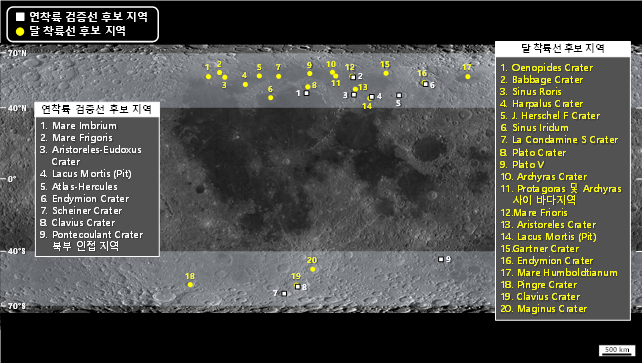
Analysis has been released of 29 candidate areas where two South Korean lunar spacecraft, targeting landings in 2032, could touch down. The Korea AeroSpace Administration (KASA) examined surface slopes and obstacles, periods of communication with Earth and access to sunlight, alongside scientific assessments of resources including hydrogen and metals. Following work on launch vehicles and landers, South Korea’s lunar program is taking more concrete shape through analysis of actual landing environments.
At the Korean Space Science Society’s autumn conference on the 30th, KASA held a consultation on selecting South Korea’s lunar landing sites and presented analyses for the soft-landing demonstrator and lunar lander scheduled for launch in 2032. Nine candidate areas were reviewed for the demonstrator and 20 for the resource-exploration lander. The Korean Space Science Society, Geological Society of Korea and Korea Aerospace Research Institute (KARI), among others, participated. KASA plans to consolidate expert views and select landing regions before the end of the year.
The government plans to launch the soft-landing demonstrator in the first half of 2032 and the resource-exploration lander in the second half. The demonstrator will test safe landing techniques that minimize impact and observe the effects of the solar wind and Earth’s magnetosphere on the lunar surface, as well as the properties of lunar dust. The subsequent lander will make a precision landing in its target area and investigate the distribution of minerals, volatile substances and metal resources.
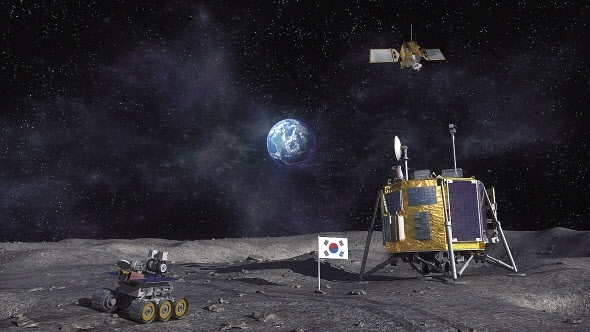
The spacecraft’s different missions call for different site-selection criteria. The demonstrator’s assessment focuses on areas suitable for observing interactions between the space environment and the lunar surface. The resource-exploration lander prioritizes surface chemistry, mineral diversity and the potential presence of resources including hydrogen and oxygen. Both assessments also consider whether the terrain permits an actual landing and whether communications with Earth and power supplies can be secured.
KARI’s engineering assessment identified key conditions including surface slopes of less than 6 degrees and the ability to maintain an uninterrupted view of Earth and the Sun for 10–12 days. It also examined whether safe terrain makes up at least 95% of a 5-kilometer-by-5-kilometer area. Rocks, steep slopes and impact craters can limit accessible landing points and increase the risk of heavy loads on the landing gear or the spacecraft overturning during descent.
The Moon lacks a thick atmosphere like Earth’s, so parachutes cannot sufficiently reduce landing speed. A lander must use propulsion to slow its descent and control its attitude while approaching the surface. Guidance, navigation and control technologies are essential for accurately determining position and velocity and finding a safe touchdown point. Local slopes and terrain are major factors in defining the performance requirements of this equipment.
The time for which the Sun and Earth are visible also affects mission success. Day and night each last about 14 days on the lunar surface, so sunlight conditions determine how long a solar-powered lander can operate. The duration of direct communications with Earth also depends on the lander’s position and surrounding terrain. At high lunar latitudes in particular, the Sun remains low and terrain can cast long shadows, requiring detailed analysis for power generation and scientific observations.
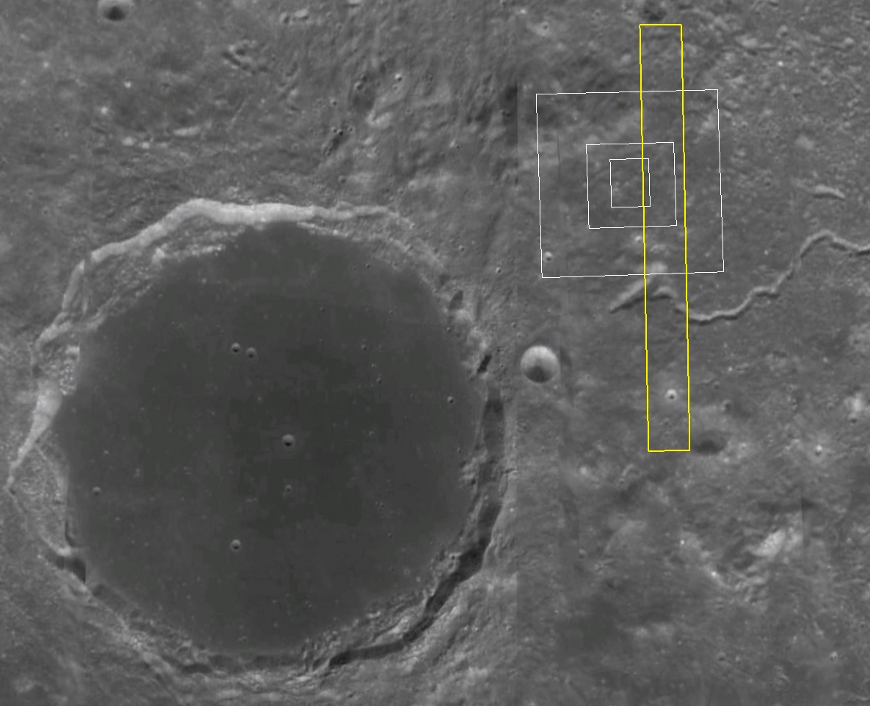
Plato crater in the Moon’s northern hemisphere drew attention in the analysis. Among the candidates examined by the Geological Society of Korea, Plato’s hydrogen concentration was estimated at approximately 68 parts per million (ppm). Hydrogen is an important target in studying the distribution of water and volatile substances on the lunar surface. This figure is an estimate derived from orbital observations, not a measurement of how much water or ice could actually be extracted. The chemical form of the hydrogen and its depth below the surface would need to be established through on-site observations.
Technologies for obtaining water on the Moon are important to long-term crewed exploration and in-situ resource utilization (ISRU). A sufficient supply could eventually support life-support systems or provide oxygen and hydrogen through electrolysis. Practical resource use, however, requires more than establishing hydrogen or water concentrations: recoverable quantities, depth, processing energy and the environment in which equipment would operate must also be assessed.
Candidate-site analysis also feeds into spacecraft design. Once the terrain and sunlight conditions of the final region are established, engineers can refine landing-guidance accuracy, propellant requirements, power systems and communications equipment. The distance between a landing point and the scientific targets also affects instrument selection and operations.
South Korea has been collecting lunar imagery and scientific observations through Danuri, its first lunar orbiter, launched in 2022. While Danuri observes terrain and the environment from orbit, the 2032 landing project would send a domestically developed spacecraft to the surface to obtain on-site data. KASA plans to lay the foundations for long-term lunar exploration through resource surveys and the development of ISRU technologies.
The 29 areas disclosed are candidates, not final landing locations. The government plans to assess scientific value and landing safety through the end of this year, with more detailed landing zones to be examined subsequently. Deciding both what to observe on the lunar surface and where to safely set down the spacecraft will be an important step in defining South Korea’s first lunar soft-landing missions.