Counterintelligence Agency Enters History After 49 Years: Launch of the Defense Counterintelligence Headquarters and Remaining Challenges
The Counterintelligence Agency, involved in the December 3 Martial Law, has been disbanded after 49 years and divided into three agencies. While the concentration of authority has been alleviated, cooperation remains a challenge.
강병지
Published
On August 3, the Ministry of National Defense held the founding ceremony for the Defense Counterintelligence Headquarters at the Gyeonggi Gwacheon Government Complex, officially launching a new organization dedicated to military counterintelligence and security functions. The event, presided over by Minister An Gyu-baek, marked the end of the Army Counterintelligence Command (Counterintelligence Agency), which had been deeply involved in the December 3 Martial Law, after 49 years, with the successor organization beginning its activities.
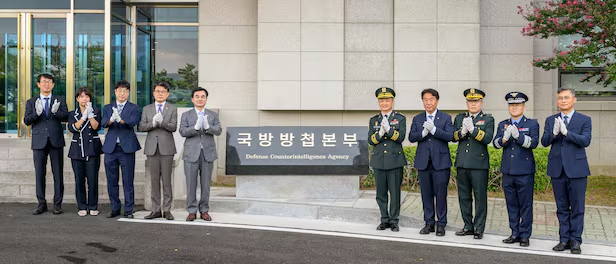
Minister of National Defense An Gyu-baek, who conducted the plaque unveiling ceremony at the launch event of the Defense Counterintelligence Headquarters, Ministry of National Defense
The unit was established on July 31 in accordance with the Ministry of National Defense General Order No. 182, and the official launch procedure was completed on that day. The first acting head of the headquarters is Major General Pyeon Mu-sam, the former Counterintelligence Commander, who is expected to be formally appointed after an official appointment process.
From Involvement in Martial Law to Disbandment
The Counterintelligence Agency was established in 1977, originating from the Army Security Command, and has changed its name through the Defense Security Command and the Security Support Command, but its functions and authority have rarely diminished. However, it came under scrutiny for sending troops to the National Assembly and the National Election Commission during the emergency martial law on December 3, 2024, and for operating a so-called 'politician arrest squad.' Former Counterintelligence Commander Yeo In-hyung has been indicted on charges related to insurrection and is undergoing trial.
The new government has pursued the rectification of the Counterintelligence Agency's past mistakes and the reform of counterintelligence organizations as a national agenda since its inception. On June 25, the Ministry of National Defense announced the 'Defense Counterintelligence Headquarters Act,' and on July 21, five presidential decrees, including the 'Abolition of the Army Counterintelligence Command Act,' 'Defense Counterintelligence Headquarters Act,' 'Defense Security Support Unit Act,' 'Comprehensive Amendment of the Ministry of National Defense Investigation Headquarters Act,' and 'Partial Amendment of the Martial Law Command Structure Act,' were collectively approved at the State Council meeting. These presidential decrees were promulgated on July 28.
Authority Distribution - 'Three-Way Split' Structure
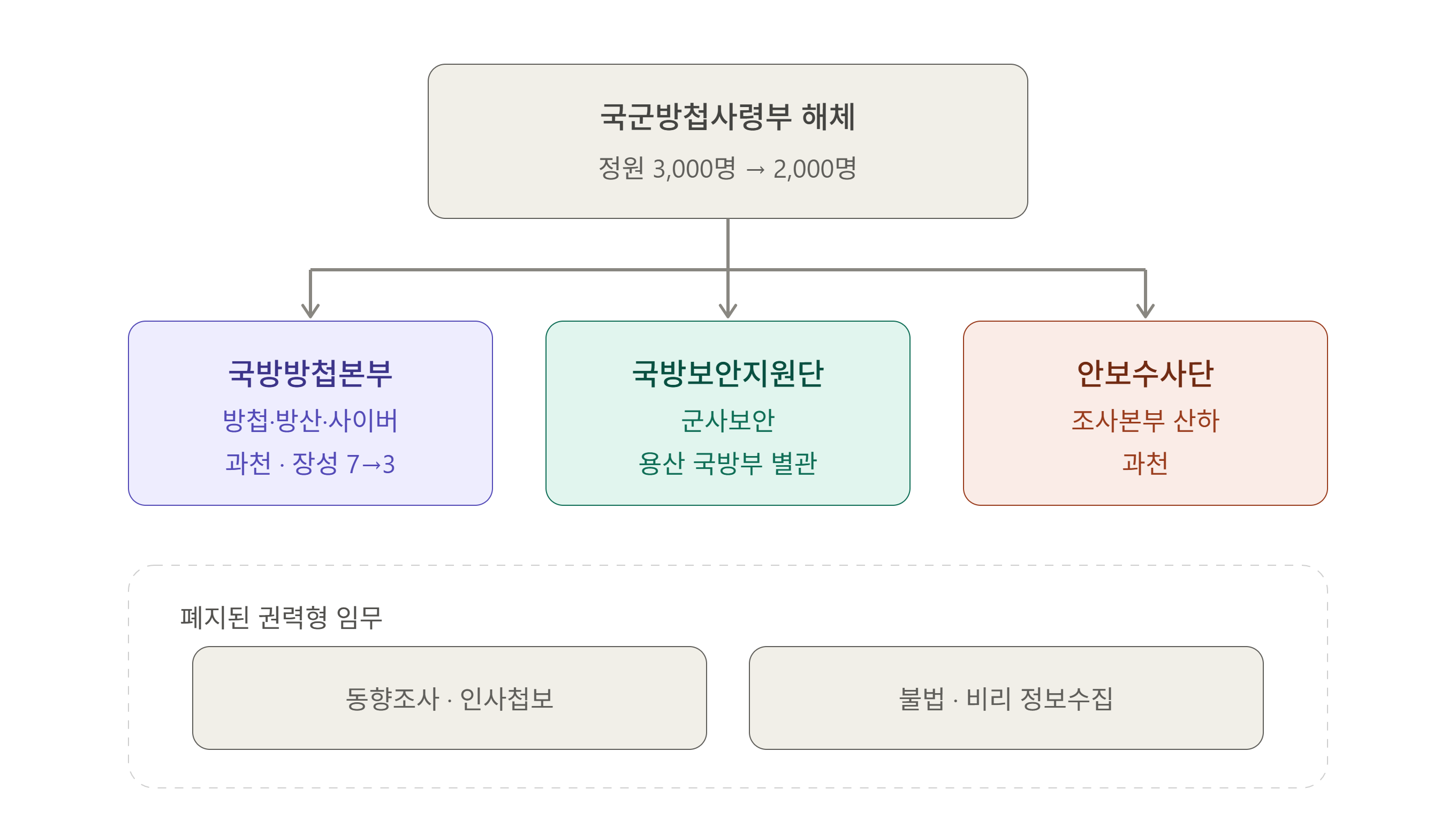
The core of this reorganization is the division of authority that was concentrated in the Counterintelligence Agency into three branches. The functions of counterintelligence, defense industry, and cybersecurity information will be handled by the Defense Counterintelligence Headquarters, military security functions will be managed by the newly established Defense Security Support Unit, and security investigation functions will be taken over by the Security Investigation Unit under the Ministry of National Defense. The personnel count will also decrease from about 3,000 to around 2,000, with the reduced personnel returning to their original military units. The number of senior command positions will be reduced from seven to three. The power-related tasks of the Counterintelligence Agency, which had repeatedly sparked controversy over trend investigations, personnel intelligence, and the collection of illegal and corrupt information, have been institutionally abolished.
Minister An Gyu-baek stated in his address that he is breaking away from the dark past of the counterintelligence agency, which had become a tool of power, and said, 'We have fundamentally abolished the function of power and redesigned it as a professional organization that concentrates its capabilities on its original mission.'
Shift in Focus to Future Threats
The new organization plans to shift its focus to 'proactive response to future threats.' In the counterintelligence field, advanced eavesdropping and surveillance equipment will be gradually introduced to respond to the increasingly covert and sophisticated military intelligence activities of North Korea and foreign entities, as well as terrorist threats. In the defense industry sector, the focus will be on preventing military secrets from leaking, while also discovering new areas of work such as providing counterintelligence support for the maintenance, repair, and overhaul (MRO) of U.S. Navy vessels and the operation of major strategic assets. In the cyber domain, it will support the establishment of the Korean Risk Management Framework (K-RMF) for managing the cybersecurity of weapon systems from the development stage and expand the security scope to include weapon and information systems that utilize artificial intelligence (AI) and satellites.
Remaining Challenge: Cooperation Without Gaps
The key issue is how organically the divided functions will interconnect in real situations. Concerns have been raised that as multiple agencies take on roles, the processes of information sharing and decision-making may become complicated. When air defense and counterintelligence situations arise, the division of roles and information transfer between agencies will be put to the test.
The opposition has criticized the hasty disbandment, citing gaps in counterintelligence investigations and budget allocation for the newly established unit. In contrast, the ruling party argues that what is disappearing is only the political surveillance function directed at the public and military personnel. The Ministry of National Defense announced that it will operate a 'Security Investigation Council' involving the three agencies to share information and coordinate joint responses with related organizations. Additionally, it plans to establish a 'Military Counterintelligence Personnel Duty Performance Act' (tentative name) within the year, which specifies the scope of counterintelligence activities and penalties for illegal activities.
The long-standing issue of concentrated authority has been institutionally resolved. However, the new organization must prove that the distributed structure, which enhances transparency, does not lead to a gap in security capabilities.