North "1000km hit" vs Military "over 700km"…'hypersonic' missile 300km dispute
North Korea claimed on the 3rd that a missile launched from Wonsan hit a target over 1000km away, but South Korea and Japan detected it at around 700km.
강병지
Published
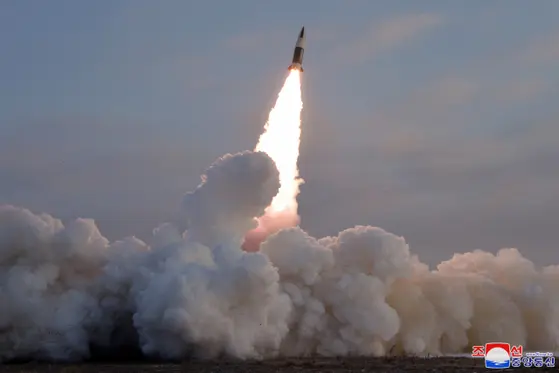
On the early morning of the 3rd, North Korea launched one ballistic missile into the East Sea from the Wonsan area in Gangwon Province. North Korea stated that it conducted a launch training for a 'medium-range strategic missile' under the observation of Chairman Kim Jong-un, claiming it was for the training of missile troops operating hypersonic strategic weapon systems.
■ Divergent flight distances
According to the Joint Chiefs of Staff, the missile was launched around 6:30 AM and flew over 700km. The Japanese Ministry of Defense estimated the maximum altitude at about 90km and the flight distance at about 680km. The Joint Chiefs of Staff stated that detailed specifications are being analyzed precisely by South Korea and the United States.
North Korea's explanation differs. North Korean state media claimed on the 4th that the missile flew northeast and hit a target point set 1000km away in the East Sea, even disclosing the coordinates of the target point. This shows a difference of around 300km from the announcements of South Korea and Japan. Hypersonic missiles are weapons that fly at speeds exceeding five times the speed of sound (Mach 5) while changing trajectories, making detection and interception difficult.
Kim Yo-jong, the head of the Workers' Party Organization and Guidance Department, issued a statement on the afternoon of the launch day questioning the detection figures from South Korea and Japan. She claimed that by applying a 'wave-like flight trajectory,' the opponent lost track of the target after the first leap point, asserting that this figure demonstrates the limitations of detection capabilities. She also reported that the missile command has introduced low-altitude flight trajectory modification capabilities and artificial intelligence (AI), and can set at least four different flight trajectories depending on the purpose. Kim linked this launch to the enhancement of nuclear war deterrence.
The Ministry of National Defense stated in a press release on the 4th that it had monitored North Korea's recent series of missile launches from the preparation stage and accurately identified the launch point immediately after detection and tracking. It further assessed that the missiles recently launched by North Korea could be sufficiently detected and intercepted by the defense assets held by South Korea and the United States. The Blue House held an emergency security situation assessment meeting chaired by the National Security Office on the day of the launch and urged the cessation of launches.
■ Not the first divergence
This launch is the 15th ballistic missile launch of the year and the first in 13 days since September 20. It occurred shortly after Vice Minister Kim Yo-jong issued a statement denying the results of the South Korean military's investigation into a landmine explosion incident in the Demilitarized Zone (DMZ), and the Blue House urged an end to the criticism.
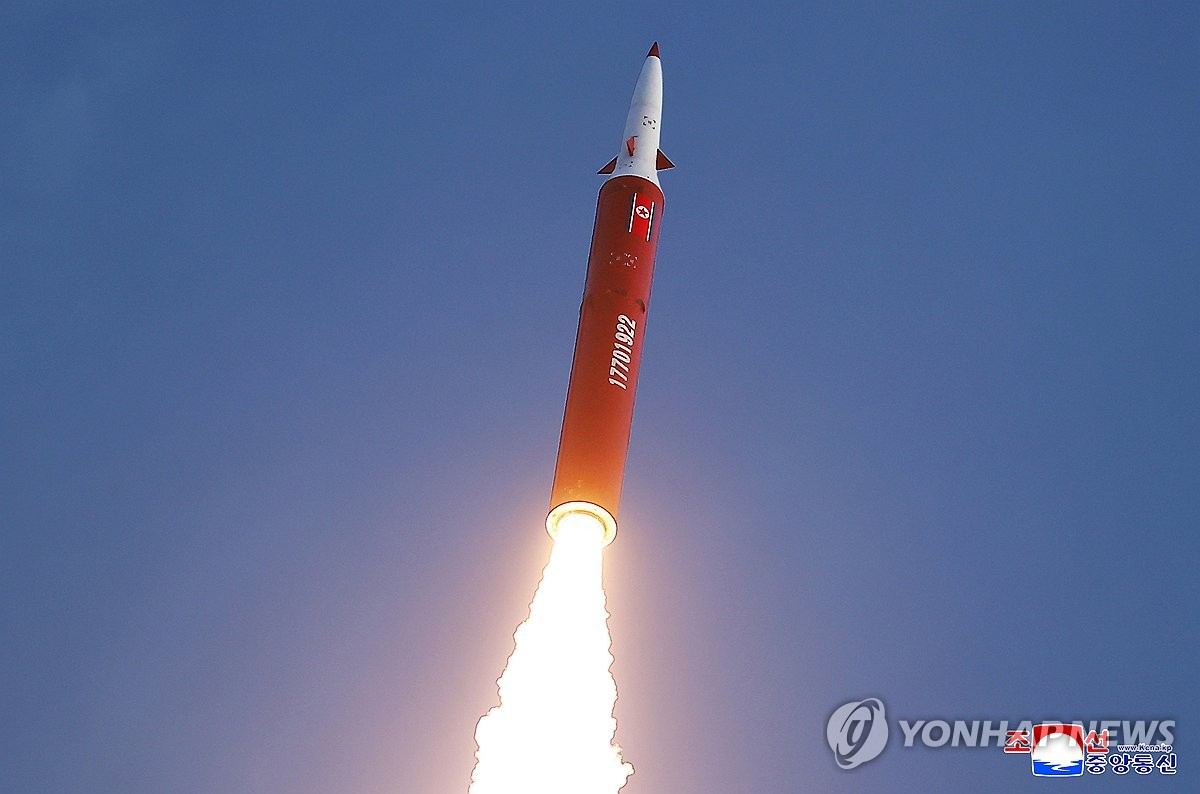
North Korea did not disclose the type, but based on the released photos, there are analyses suggesting it is a solid-fuel hypersonic missile from the 'Hwasong-16na' series. If so, this is the third launch following those in April 2024 and January 2025. The difference is that this time it is equipped with a conical warhead instead of the flat gliding warheads used in the previous two launches. There are also views that this missile appears to be the conical hypersonic system first tested in 2022.
The method of disclosing figures has also changed. North Korea revealed the peak altitude during a launch in April 2024, and in January 2025, it disclosed a speed of Mach 12 and peak altitude. This time, it did not disclose speed or altitude, aside from flight distance and target coordinates.
It is not the first time that North Korea's claims and the South Korean military's evaluations have diverged. In April 2024, North Korea claimed a flight of 1000km, but the Joint Chiefs of Staff assessed it at around 600km. In January 2025, North Korea asserted 1500km, but the Joint Chiefs of Staff reported it as about 1100km, raising questions about the second peak altitude claim.
The remaining issue is the reality of the 300km difference. Some analyses suggest that the warhead may have flown at a low altitude in the radar shadow area created by the curvature of the Earth, causing tracking to be lost. On the other hand, North Korea's claim of 1000km has not been verified externally. It is also too early to determine whether the replacement with a conical warhead is an extension of the test or a step before actual deployment.