The border drawn by landmines: What the DMZ explosion revealed
On the way to investigate the landmines, one exploded. While North Korea draws the border with landmines, our soldiers were injured south of the MDL. Now, we need a standard to maintain that line.
강병지
Published
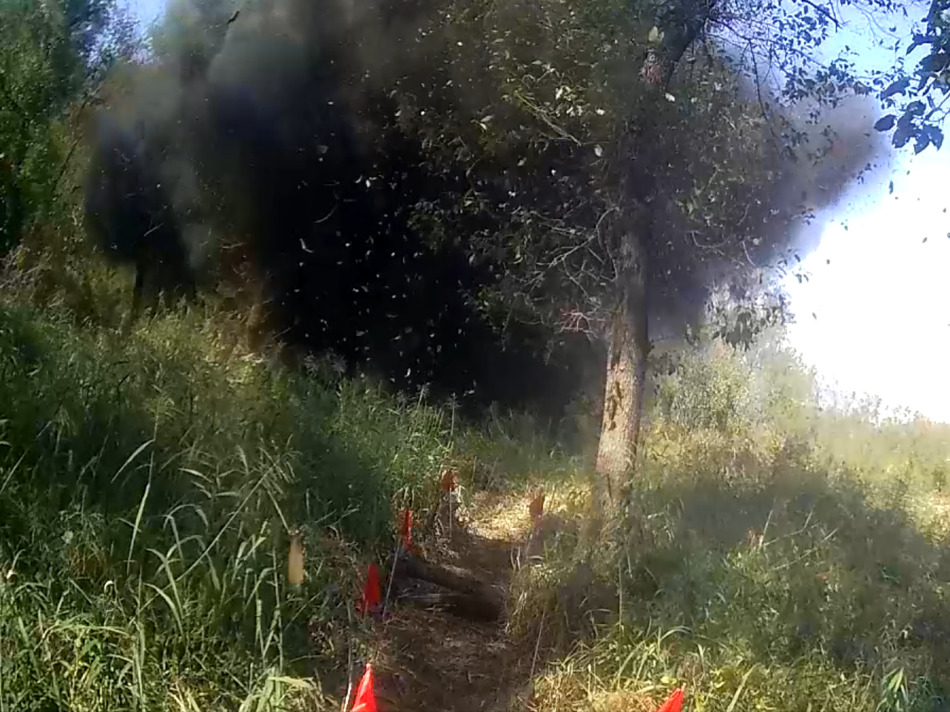
Immediately after the first explosion, the search battalion commander ran to the fallen engineer, shouting, "Are you okay?" At that moment, a second explosion occurred. This happened on September 21 in the western front DMZ. They were clearing a path to investigate landmines suspected to have been buried by North Korean troops south of the Military Demarcation Line (MDL). The target of the investigation exploded on the way to investigate. Eight days later, on September 30, the United Nations Command (UNC) ruled that a violation of the armistice agreement had occurred in relation to this incident, and on October 5, the Joint Chiefs of Staff concluded that the landmines buried by North Korea south of the MDL were the cause. It is now clear who buried the landmines. The remaining questions are why there were landmines there, why they were not stopped, and what needs to be done moving forward.
■ Two explosions just before withdrawal
The incident occurred around 10:50 AM on the 21st, in the DMZ under the jurisdiction of the Army's 25th Division, about 10 meters south of the MDL. Eighteen individuals, including the search battalion commander, were divided into detection, command, and operational support teams, clearing a new search route toward the MDL. This was after they had advanced about 200 meters off the existing search route. The purpose of this operation was to secure a safe path in advance for the UNC to investigate the site.
The battalion commander, judging that they were close to the MDL, decided to end the operation. The moment a combat engineer sergeant preparing to withdraw stepped forward with his left foot, the first explosion occurred, followed by a second explosion right in front of the battalion commander who was running to him. The remaining soldiers knelt down and secured an exit route of about 20 meters by stabbing the ground with their hand tools. The seriously injured were evacuated by helicopter from about 200 meters away.
As a result of this accident, one lieutenant colonel and two sergeants, all three being officers, were injured, with one suffering a severe injury resulting in an ankle amputation. Of the 18 personnel involved in the operation, 15 were discharged by the 28th. This is the first time in 11 years since the 2015 Mokham landmine incident that a landmine exploded in the DMZ and injured our soldiers.
■ From three landmines to four, from assumption to conclusion
The on-site investigation was not easy. The accident site was an unverified landmine area without an existing search route. The military and the UN Command secured a maneuver route on the 26th and began the first joint investigation on the 27th, but could not reach the accident site. There were criticisms that the investigation was delayed, while the military insisted that the safety of the soldiers was the priority.
On the 28th, the Joint Chiefs of Staff released the interim investigation results. Explosive components (TNT) and brown-colored foreign substances were detected from the equipment of the injured, and on-site soldiers reported seeing plastic objects similar to North Korean landmines. The Joint Chiefs of Staff assessed that they were not our landmines and concluded that there were a total of three landmines at the site, including one unexploded landmine revealed by testimony regarding the two that exploded. The explosion site was located about 10 meters away from an area where North Korean troops are believed to have recently buried landmines.
During the investigation on the 29th, an additional North Korean plastic anti-personnel mine was discovered. The JCS assessed that it was a different type of mine than what the soldiers had reported. The number of mines buried in a narrow area increased to at least four. The next day, the UNC stated that it had confirmed operational North Korean anti-personnel mines in the area south of the MDL, concluding that a violation of the armistice agreement had occurred.
The on-site investigation, which took place three times, concluded on the 29th. The Joint Chiefs of Staff announced the final conclusion on October 5 after going through the National Institute of Scientific Investigation. It stated that our soldiers were seriously injured by plastic anti-personnel landmines installed by North Korea south of the MDL. The TNT and resin components found in the fragments of the injured were similar to North Korean landmines recovered from the Imjin River in the past, and the accident site measured about 10 meters south of the MDL using GPS. The landmines were buried at depths of 3 to 10 cm, spaced 1 to 2 meters apart. The Joint Chiefs of Staff assessed this as not being landmines that had washed away but rather as having been intentionally placed, determining that the burial occurred 12 months prior to the accident.
■ Demands for Apology, Mine Removal, and 'Self-Made Play'
On September 30, the Joint Chiefs of Staff (JCS) issued a statement demanding that North Korea immediately cease its so-called 'border fortification' and apologize while taking responsible actions. Minister of National Defense Kang Shin-cheol stated the day before in the National Assembly that the violation of the armistice agreement was clear and that corresponding measures would be implemented gradually. On October 5, when a final conclusion was reached, the JCS again urged North Korea to sincerely apologize and to immediately remove the landmines.
On the same day, around 12:51 PM, the military removed the North Korean landmine area near the accident site. Due to the high risk of manually clearing it, they used a method of detonation on site, and it was explained that measures were taken in close cooperation with the UN Command to prevent accidental clashes. This is considered the first case where our military directly removed North Korean landmines south of the MDL. The military stated that if North Korea does not remove them on its own, it will continue to remove the illegally buried landmines south of the MDL.
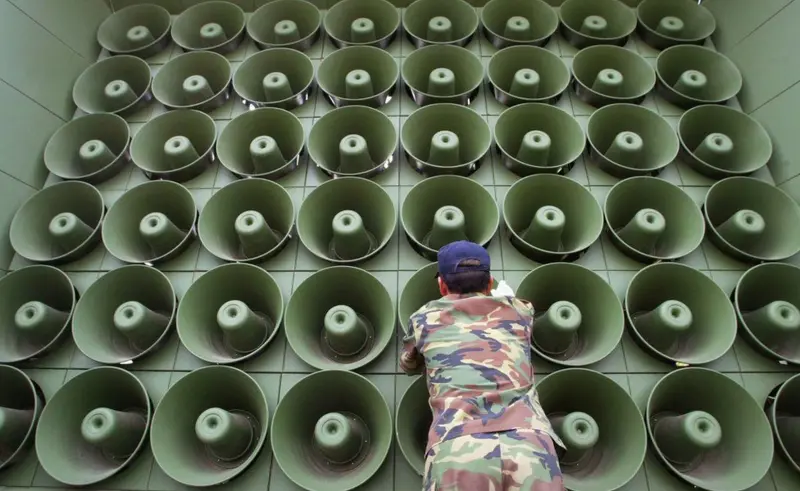
No additional corresponding measures have been announced yet. The plan to reinstall the loudspeakers aimed at North Korea, which were dismantled last year, faces significant opposition from local governments in border areas and concerns about harm to residents. The government is reportedly considering a warning statement from the Minister of National Defense, strengthening ROK-US joint training such as the deployment of US strategic bombers, and independent sanctions against North Korea's illegal cyber activities.
President Lee Jae-myung instructed to transparently clarify the facts in cooperation with the UN Command, stating that security should not be jeopardized by unfounded conspiracy theories. The UN Command stated that it would handle violations in accordance with the established armistice agreement system and would focus on preventing heightened tensions.
North Korea first referred to this incident as 'Seoul's self-made farce' in a statement by Kim Yo-jong, warning that all responsibility would fall on those who planned the provocation. They specifically threatened that if our military fired live rounds at North Korean troops conducting border construction or if bullets fell on the North Korean side, they would retaliate immediately. The next day, on October 6, the Ministry of Foreign Affairs issued a statement claiming that the JCS announcement was a 'self-made play' that was unilaterally manipulated and concluded. Regarding our military's mine removal, they warned that if it infringed on our territory by even 1 mm, they would take strong countermeasures.
■ Landmines buried for over a year
There are two key questions that define the nature of this incident. One is whether North Korea intentionally buried landmines south of the MDL, and the other is whether they targeted our soldiers.
The answer to the first question has been provided. The JCS believed that the depth, spacing, and arrangement of the mines were consistent with the typical methods used by the North Korean military to create minefields. The fact that four mines were clustered in a narrow area is also difficult to explain as a loss. Minister Kang also stated that they appeared to have been buried during the border fortification process.
The second question is of a different nature. Minister Kang defined 'intent' as the intention to harm knowing that our military was entering, but did not conclude whether such intent existed. Since the final investigation revealed that the landmines were buried 12 months prior to the accident, it was not an ambush aimed at this operation. However, it was a burial intended to draw a line. Simply burying landmines south of the MDL is a violation of the armistice agreement, and as a result, people were injured.
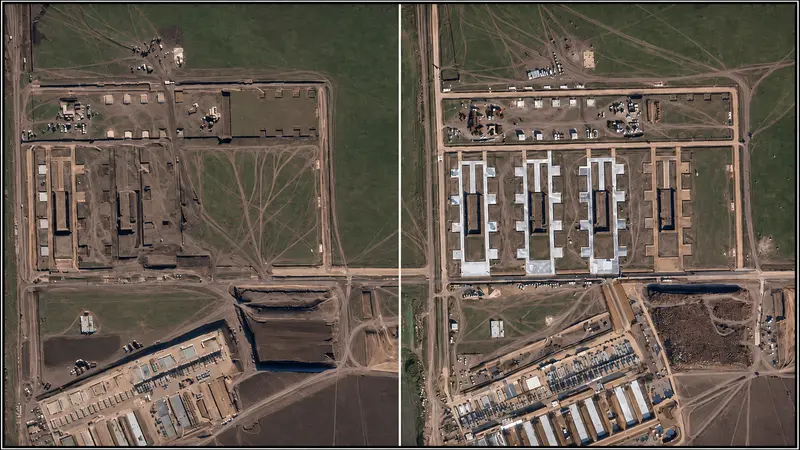
This landmine placement did not happen suddenly. In December 2023, North Korea defined the inter-Korean relationship as that of 'two belligerent countries.' Starting in April of the following year, they began burying landmines and erecting barbed wire and anti-tank barriers north of the MDL, and in October, they blew up roads and railways connecting the two Koreas. In March of this year, they amended their constitution to remove expressions related to unification and defined their territory as 'the area bordering the Republic of Korea to the south.' The North Korean military's incursions across the MDL have also increased. According to JCS statistics, incursions, which numbered 9 times in 2024 and 17 times last year, have surged to around 50 times this year. After the first incursion in August, there were over 20 incursions within a month, with some even coming down to about 20 meters south of the MDL. Just over ten days before the incident, an opposition lawmaker claimed that there were six North Korean minefields that crossed the MDL by 10 to 15 meters in the area of a division along the western front.
The timing of the landmine placement, which was 12 months prior to the incident, also overlaps with this trend. According to military authorities, North Korea expanded its fortification construction, which began in April 2024, to all sections in March of last year. The landmines in question were buried during the peak of this fortification and had remained south of the Military Demarcation Line (MDL) for over a year.
■ Consistent standards, unreachable site
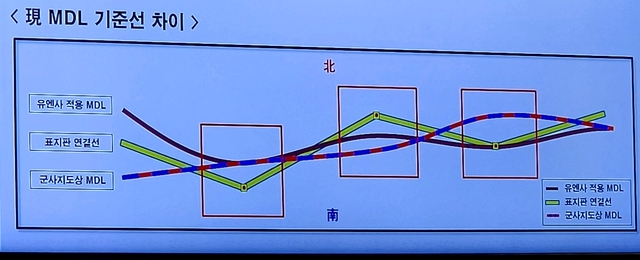
What has the UN Command, which manages the armistice agreement, been doing while North Korea has been fortifying right in front of the MDL for over two years? The UN Command's position is summarized in a briefing document released in June. It states that the installation of barbed wire and road repairs conducted without heavy weapons north of the MDL do not violate the armistice agreement, that barbed wire is a facility for defense and separation, and that burying landmines for defensive purposes in the northern area is also permitted. Most fortifications are being carried out within 100 meters north of the MDL, and claims that they have crossed the MDL are still under investigation, but there is no evidence yet. South Korea is also conducting the removal of more than 36 roads, barbed wire, and vegetation on the southern side of the DMZ, and it added that the same standards apply to both sides.
The Ministry of National Defense rebutted this. They argued that the reason the armistice agreement designated the DMZ as a buffer zone was to prevent incidents that could lead to the recurrence of hostile acts, and that fortification close to the MDL contradicts that purpose.
The UNC's criteria are consistent. Defensive facilities on the North Korean side are permitted, while crossing the MDL is considered a violation. In fact, when North Korean landmines emerged south of the MDL, the UNC judged it as a violation according to its own established criteria. The issue lies in how that criterion operates on the ground.
First, there is the threshold of proof. To determine a violation, physical evidence from the site is needed, and the only way to confirm that evidence is to enter the minefield directly. According to some reports, our military has previously captured suspected landmines south of the MDL via satellite. It has not been confirmed when and in what form this information was communicated to the UNC. What is clear is that the determination was made only after soldiers were injured and the landmines were physically encountered.
Second, it is a blurry line. The criterion that 'defensive landmines north of the MDL are acceptable' is based on the premise that the MDL is clear on the ground. However, of the 1,292 MDL markers established in 1953, only about 200 can be identified today. The baseline is not even one. Our military uses coordinates set by the US in 2004, the UN Command uses newly created coordinates at 10-meter intervals from 2016, and North Korea seems to use another line as a reference. This difference is cited as a background for frequent violations of the line. Military authorities have warned that tens of thousands of landmines newly buried by North Korea in 2024 could be washed south due to heavy rain or dam releases. Defensive landmines 'a few meters' in front of the MDL in areas where the line is blurry and landmines could flow in pose a threat to southern troops.
There is also a more fundamental limitation. The criteria for judging violations that the UNC uses, such as the introduction of heavy weapons and crossing the line, are typical violations addressed by the 1953 armistice agreement. However, there are no provisions that directly deal with the work of solidifying the demarcation line as a border. Of course, there are counterarguments. Since the Cold War, both Koreas have been dismantling the principle of 'demilitarization' by introducing military facilities and heavy weapons into the DMZ. There are practical reasons for using the minimum standards of heavy weapons and crossing the line as a benchmark. It is more accurate to say that the UNC did not err, but rather that the incident occurred at a point where that criterion had stagnated.
■ The Party Making the Judgment and the Party Taking the Risks
Let's revisit the starting point of the operation where the accident occurred. The Joint Chiefs of Staff officially confirmed the day after the accident that this operation was to create conditions for a UN Command field investigation. The judgment is made by the UN Command, and the road necessary for that judgment was made by the Korean military at the risk of their lives. Within the military, there are claims that if the UN Command had taken action earlier, the accident could have been avoided.
Conflicts surrounding access to the DMZ have also been accumulating. The armistice agreement prohibits both military and civilian personnel from entering the DMZ without permission from the Military Armistice Commission or the commander. The UN Command denied the visit of a Vatican minister to the DMZ last year due to procedural deficiencies, and also blocked the entry of the National Security Office's first deputy for safety reasons, only to grant permission a month later. The government views the purely military nature of the agreement as a violation of sovereignty if it controls non-military access as well. When a bill was proposed for the South Korean government to have the authority for non-military access, the UN Command opposed it, claiming it was a violation of the armistice agreement. The logic was that if an incident in the DMZ escalated into hostile acts, the responsibility would not lie with the South Korean president but with the UN commander. In August, reports emerged that the UN Command was planning to create a security brigade that would encompass its subordinate organizations. At that time, the Minister of National Defense stated that an agreement was reached not to establish it, but the UN Command explained that it was a reorganization of existing resources, leading to conflicting statements from both sides.
However, it has not been confirmed that the United Nations Command (UNC) limited personnel or equipment during this search operation. The deployment of emergency helicopters immediately after the incident was carried out with the cooperation of the UNC. After the incident, the UNC actually demanded a swift on-site investigation, but claims from the opposition stated that the South Korean military delayed this, while the military explained that securing safety was the priority. Ultimately, the UNC should not be viewed as an enemy. The problem lies in the structure where the party with the authority to make judgments and the party taking risks are divided.
■ How to Maintain the Line
In the 2015 landmine incident, the government resumed loudspeaker broadcasts toward North Korea, and after North Korea's shelling and our military's retaliatory fire, they managed to obtain an expression of regret from North Korea during high-level talks that lasted four days without overnight stays. However, the background this time is different. The border fortification that did not exist then is currently underway. This is not a matter that can be resolved with one act of retaliation and one negotiation.
There are two divergent voices regarding the level of response. One argues that we should retaliate with irregular and surprise DMZ operations, while the other argues that we should diplomatically pressure North Korea to engage in discussions about the MDL issue. The government is reviewing the plan to push for military talks between the North and South regarding the discussion of MDL baseline standards, which was proposed last November. However, North Korea dismissed dialogue in a statement from its Ministry of Foreign Affairs on the 6th, stating that it would protect its territory through "thorough exercise of power" rather than through negotiation. Regardless of which path is chosen, restructuring is unavoidable.
First, we need to clarify the line. We must restore the MDL standard coordinates shared by the Korean military and the UN Command and restore the lost field markers to avoid disputes over 'where the violation begins.' Just as the military removed the landmine area around the accident site this time, we must continue to remove the confirmed landmine areas south of the MDL. Next is the judgment procedure. If we agree in advance with the UN Command on the criteria for recognizing satellite and remote reconnaissance information as evidence, we can reduce the instances where soldiers must enter landmine areas for violations to be acknowledged. Third, we need to re-examine the detection equipment and procedures used for clearing search routes near the MDL. Finally, we must discuss the distinction between military operations and non-military access to prevent conflicts with the UN Command from spilling over into security vacuums.
North Korea is drawing the border with landmines. Before that line solidifies, there is one question we must answer. By whose standards will we maintain that line, and how?